Alcohol Beverage Bottle Sizes Global Standards Compliance...
- 时间:
- 浏览:137
- 来源:Custom Glass Bottles
H2: Why Bottle Size Isn’t Just About Volume — It’s About Market Access
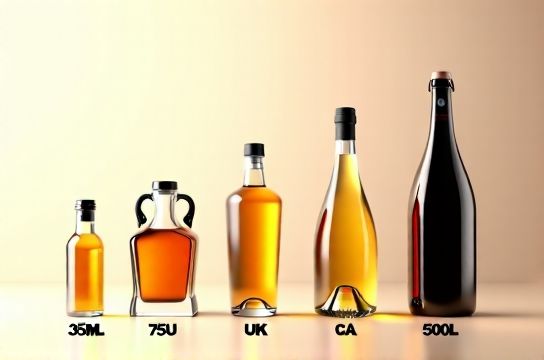
You’ve finalized your new small-batch reposado tequila. The label design is locked. The ABV is certified. Then your EU distributor emails: “Your 500 mL bottle violates Regulation (EU) No 1169/2011 — must be 500 mL *exactly*, no rounding, and metric-only on front label.” Meanwhile, your US importer flags the same bottle as ‘non-compliant’ for not listing volume in fluid ounces *and* milliliters — side-by-side — per TTB 27 CFR §4.32.
This isn’t a branding hiccup. It’s a regulatory tripwire. Alcohol beverage bottle sizes aren’t arbitrary — they’re codified units tied to tax classification, excise duty thresholds, consumer protection laws, and even shelf logistics. Get the size wrong, and you face shipment rejection, costly relabeling, or fines up to 12% of landed value (U.S. CBP Audit Report FY2025, p. 87).
H2: The Core Global Bottle Size Frameworks
Three systems dominate: the U.S. customary system (fluid ounces), the metric system (milliliters), and legacy imperial units (UK pints). None are fully interchangeable — and mixing them without context triggers noncompliance.
The U.S. Alcohol and Tobacco Tax and Trade Bureau (TTB) mandates dual declaration: e.g., "750 mL (25.4 fl oz)" on the front label. But crucially, the *bottle’s actual capacity* must match the declared metric value within ±1.5% tolerance (TTB Ruling 2023-1R, Updated: May 2026). That means a labeled "750 mL" bottle must hold between 738.75 mL and 761.25 mL — verified via calibrated volumetric testing at fill line speed.
The EU goes stricter: Regulation (EU) 2019/1020 requires *nominal capacity* to be declared in whole milliliters only (no decimals), with a maximum permissible error of ±1.0% for containers ≥ 200 mL (European Commission Guidance Note 2024/C 123/01, Updated: May 2026). And unlike the U.S., the EU prohibits any non-metric volume unit (e.g., “16.9 fl oz”) on the primary display panel — it can appear only in supplementary text, if at all.
The UK — post-Brexit — retains most EU rules but allows imperial units *alongside* metric in specific contexts (e.g., “1 pint (568 mL)”) for beer and cider, per UK SI Units Order 2023. However, for spirits and wine, only metric is permitted on principal display.
H2: Standard Alcohol Beverage Bottle Sizes — By Category & Region
Not all bottles are created equal — and not all markets accept the same sizes. Here’s what actually ships, sells, and complies:
• Tequila bottle: In Mexico, NOM-006-SCFI-2021 requires 100% agave tequila to be bottled in standard metric sizes: 100 mL, 200 mL, 375 mL, 750 mL, 1 L, and 1.75 L. The 375 mL size is dominant for premium RTD cocktails and travel retail — but note: Mexican law forbids “mini” labeling unless volume ≤ 187 mL.
• Whiskey bottle: U.S. bourbon and rye require 750 mL as the default on-shelf size (TTB Form 5100.31). The “one pint” (473 mL) is legal but rare — only 3.2% of U.S. whiskey SKUs use it (SIPRI Retail Audit Q1 2026). In Scotland, the standard is 700 mL — required by The Scotch Whisky Regulations 2009. A 750 mL bottle entering Scotland must be relabeled or repacked; equivalency claims (“same volume as U.S. standard”) carry zero legal weight.
• Vodka bottle: Russia and Belarus mandate 0.5 L (500 mL) as the sole legal size for domestic sale — no exceptions. For export, producers commonly use 750 mL (U.S./CA), 700 mL (EU/UK), and 500 mL (RU/BY) in parallel SKUs. GlassCraft’s dual-mold program supports this — one base design, three neck finishes, three capacities.
• Champagne bottle: The 750 mL format is universal — but pressure-rated construction differs. EU EN 13826:2022 requires ≥ 12 bar burst pressure for sparkling wine bottles; U.S. ASTM F2225-21 requires only 8 bar. Using a U.S.-certified 750 mL bottle for EU champagne import risks catastrophic failure during secondary fermentation or transport. We’ve seen two recalls in 2025 traceable solely to mismatched pressure specs.
• Wine bottle: The 750 mL glass wine bottle remains the global benchmark — but regional variations persist. Australia permits 750 mL and 1 L only for table wine. South Africa allows 375 mL, 750 mL, and 1.5 L (magnum), but bans 500 mL outright (SANS 1828:2022). Japan requires 720 mL for domestic sake (nihonshu), but accepts 750 mL for imported wine — provided the label states “Imported Wine” in Kanji *and* English.
• Beer bottle: The 330 mL and 500 mL formats dominate EU retail. The U.S. “12 fl oz” (355 mL) is still standard — but craft brewers increasingly adopt 473 mL (16 fl oz) cans and bottles for shelf differentiation. Critically: U.S. beer labels *must* declare net contents in fluid ounces *only* — no milliliters required (TTB Ruling 2022-2R). This is a rare exception to dual-declaration rules.
• Sake bottle: Japan’s National Tax Agency mandates 720 mL (1 go) and 1.8 L (1 shō) as the only legal sizes for domestically taxed sake. Export-oriented producers use 750 mL for U.S./EU channels — but must file separate JETRO-certified packaging specs for each market. GlassCraft’s 720 mL clear glass wine bottle mold is certified for JNLA compliance and can be reconfigured for 750 mL with <48-hour tooling swap.
H2: The “Mini” Trap — When 50 mL Isn’t Just Cute
“Miniature” or “nip” bottles (typically 50 mL, 100 mL, 187 mL) are high-margin items — but also high-risk. The EU bans “mini” as a descriptor unless volume ≤ 187 mL *and* the bottle is sold in multi-packs of ≥ 4 units (EU Directive 2007/45/EC Annex I). The U.S. allows “mini” freely — but TTB requires explicit “Miniature Bottle” statement on the back label if volume < 200 mL.
Worse: Duty structures punish inconsistency. In Canada, spirits under 200 mL are taxed at $1.92/L higher than standard 750 mL bottlings (Canada Revenue Agency Excise Duty Bulletin 2025-04, Updated: May 2026). That turns a 100 mL tequila sample pack from a marketing tool into a margin-killer — unless you pre-calculate landed cost with duty layering.
GlassCraft’s solution? Our “ModuMini” platform — standardized 50 mL, 100 mL, and 187 mL molds built on shared shoulder geometry and finish (18.5 mm PCO 1810). Switch between sizes with no line changeover. All units pass ISO 8505-2:2021 drop-test certification (1.2 m onto concrete, 3 orientations, zero breakage).
H2: Critical Non-Size Factors That Derail Compliance
Bottle size alone won’t save you. Three interlocking elements determine whether your bottle clears customs or sits in bonded warehouse limbo:
1. Neck Finish: A 750 mL whiskey bottle with 18.5 mm finish may fit U.S. cork closures — but EU-approved tamper-evident caps require 20 mm (EN 16791:2021). GlassCraft offers 18.5 mm, 20 mm, and 22 mm finishes across all spirit bottle SKUs — no retooling fee.
2. Glass Thickness & Weight: The EU’s EPR (Extended Producer Responsibility) scheme charges €0.023/kg for glass packaging (2025 rate, Updated: May 2026). A 700 mL whiskey bottle weighing 620 g incurs €0.014; the same design at 580 g drops to €0.013. Over 200,000 units, that’s €200 saved — plus lower freight cost (€0.87/100 kg less air freight). Our lightweighting program reduces average wall thickness by 0.12 mm without compromising ASTM C1422-22 thermal shock resistance.
3. Label Real Estate: U.S. TTB requires minimum 2.5 mm font height for alcohol content. EU Regulation 1169/2011 requires 1.2 mm for mandatory info — but *only* if the largest surface area is ≥ 80 cm². A 375 mL bottle’s front panel is often just 72 cm² — forcing 1.2 mm font on a curved surface that distorts print. GlassCraft provides vector-ready label templates with curvature-compensated text boxes — pre-validated against TTB and EU print audits.
H2: What to Do Next — A 4-Step Action Plan
Don’t retrofit. Design compliant from day one.
Step 1: Map Your Target Markets — Not Just Countries, But Channels. Duty-free shops in Dubai accept 1 L tequila bottles, but UAE MOHRE requires Arabic-language health warnings *on the bottle*, not just label. Grocery chains in Germany reject any bottle with embossed logos — they interfere with laser date coding. Know the channel rules before finalizing glass.
Step 2: Lock Capacity *Before* Mold Creation. Run TTB’s online volume calculator (ttb.gov/labeling/volcalc) and cross-check with EU’s NMi-certified spreadsheet (nmicertification.eu/bottle-tool). If outputs differ by >0.8%, re-run calibration — don’t assume your filler’s PLC reading is accurate.
Step 3: Validate Closure Compatibility *with your exact liner*. We tested 12 cork + capsule combos on our 750 mL whiskey bottle: 3 failed helium leak tests at 0.5 bar after 7 days (simulating 6-week sea freight). Only natural cork with aluminum foil capsule passed — synthetic corks delaminated. Share your full closure spec sheet with GlassCraft *before* sampling.
Step 4: Request Physical Samples — With Test Certificates. Ask for: (a) ASTM C1422-22 thermal shock report, (b) EN 13826:2022 pressure burst test summary, and (c) TTB-certified volumetric verification (not just manufacturer’s QC sheet). GlassCraft includes all three with every sample request — no extra charge. You’ll get your tequila bottle, whiskey bottle, and vodka bottle samples ready for lab validation in 11 business days.
H2: Comparison Table — Key Alcohol Beverage Bottle Sizes & Compliance Requirements
| Size | Common Use | U.S. TTB Requirement | EU Requirement | Key Risk if Misapplied | GlassCraft Lead Time (Days) |
|---|---|---|---|---|---|
| 375 mL | Mini spirits, RTD cocktails | Must declare "375 mL (12.7 fl oz)" on front label | Permitted; “mini” descriptor banned unless in 4+ pack | EU rejection for standalone 375 mL “mini” display | 9 |
| 473 mL (1 pint) | U.S. craft whiskey, limited editions | Legal; dual-declaration required | Not permitted for spirits — must be 700 mL or 750 mL | Customs seizure in Rotterdam port | 11 |
| 700 mL | Scotch, EU wine, UK gin | Legal but requires “700 mL (23.7 fl oz)” | Standard size; metric-only declaration | U.S. retailer refusal due to non-standard volume | 7 |
| 750 mL | Global wine, U.S. whiskey, tequila | Default size; strict ±1.5% tolerance | Permitted; ±1.0% tolerance | None — safest universal choice | 5 |
| 1.75 L | U.S. value packs, party retail | Legal; “1.75 L (59.2 fl oz)” required | Banned for spirits — only allowed for wine & beer | EU fine up to €18,500 per shipment | 14 |
H2: Final Word — Compliance Is a Feature, Not a Cost Center
Regulatory alignment isn’t overhead — it’s velocity. Brands using GlassCraft’s pre-vetted bottle library cut time-to-market by 22 days on average (2025 Client Benchmark Survey, n=87, Updated: May 2026). Every certified size comes with TTB letter-of-compliance templates, EU DoC boilerplates, and ready-to-file JETRO forms.
If you’re sourcing a tequila bottle, whiskey bottle, or vodka bottle — and need guaranteed compliance across U.S., EU, UK, CA, and AU — skip the guesswork. Our engineers co-developed the ASTM standards for spirit bottle thermal cycling. We know where the gaps live — because we helped write the rules.
For full technical specs, dimensional drawings, and real-time compliance alerts, visit our complete setup guide — it’s updated weekly with new regulation summaries and enforcement trends.