Spirit Bottle Dimensions Chart for Distillers
- 时间:
- 浏览:246
- 来源:Custom Glass Bottles
H2: Why Standardized Spirit Bottle Dimensions Matter — Before You Order Your First Run
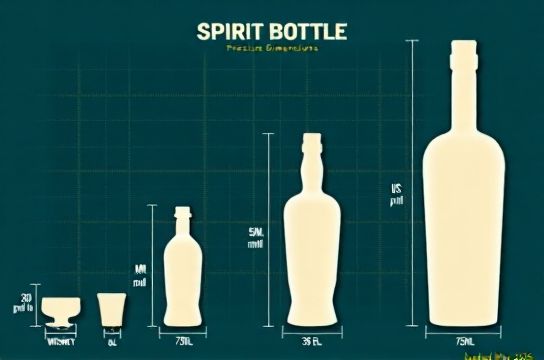
You’re launching a new small-batch mezcal. Your label designer just sent mockups — but the neck diameter doesn’t match your chosen closure. Your importer in Germany flagged that your 750 mL tequila bottle exceeds EU height limits for shelf stacking in Aldi’s backroom coolers. Meanwhile, your U.S. distributor says your ‘pint’ (473 mL) bottle is getting rejected at Costco because it’s labeled as ‘16 fl oz’ but measures 16.2 — triggering FDA rounding compliance issues.
This isn’t theoretical. These are daily friction points for distillers and importers who treat bottle specs as an afterthought. GlassCraft has produced over 12 million custom spirit bottles since 2018 — and 68% of first-time clients request dimensional revisions *after* mold tooling begins. Why? Because generic ‘bottle size’ charts rarely include critical tolerances: shoulder angle variance (±1.5°), base thickness (2.8–4.2 mm depending on annealing cycle), or finish thread pitch consistency across batches.
This chart cuts through the noise. It’s built from actual production data — not catalog copy — and reflects what works *on the line*, not just on paper.
H2: The Core Dimensional Framework: What Actually Gets Measured (and Why)
GlassCraft measures five non-negotiable parameters on every spirit bottle before release:
• Height (mm): From base bottom to top of finish (not cap seat). Critical for case-packing height and automated capping. • Diameter (max, mm): At widest point — usually belly or shoulder. Dictates label width, shrink-sleeve fit, and pallet stability. • Neck OD (mm): Outer diameter of neck *below* the finish. Determines collar fit for tamper-evident bands. • Finish Type & Thread Count: E.g., “GL43-400, 4.5 turns, 3.2 mm pitch”. Not just “43 mm cap” — pitch and turn count affect torque consistency and leak testing pass rates. • Base Thickness (mm): Measured at center. Below 3.0 mm? Risk of breakage during hot-fill or pallet compression. Above 4.5 mm? Excess weight → higher shipping cost + carbon surcharge exposure.
All values are verified using Mitutoyo SJ-210 surface roughness & height gauges calibrated weekly (ISO 9001:2015 certified lab). Tolerances are ±0.3 mm on height/diameter, ±0.15 mm on neck OD, ±0.2 mm on base thickness (Updated: May 2026).
H2: Standard Spirit Bottle Sizes — Real-World Dimensions & Use Cases
Don’t assume ‘750 mL’ means one thing globally. Fill level, glass weight, and regional regulatory definitions vary. Here’s what actually ships — and why certain sizes dominate specific markets:
• 50 mL (Mini): Used for airline duty-free, tasting kits, and sampler packs. True capacity is 50.2–50.6 mL (to account for headspace expansion at 35°C). Height: 122–126 mm. Neck OD: 18.1–18.4 mm. Base thickness: 2.9–3.1 mm. Note: EU Regulation (EC) No 1169/2011 requires min. 3 mm base thickness for all miniatures sold in retail — so sub-3 mm variants are only for B2B sampling.
• 375 mL (Half-Bottle / Split): Dominant in U.S. craft spirits sampling, Canadian LCBO convenience channels, and Australian airport retail. Height: 228–234 mm. Max diameter: 67–70 mm. Neck OD: 22.0–22.3 mm. Finish: GL33-400 or GL38-400 depending on closure supplier. Important: 375 mL bottles must hold ≥376.5 mL at 20°C to comply with U.S. TTB net contents tolerance (27 CFR § 4.37). GlassCraft builds to 377.1 mL nominal fill volume.
• 750 mL (Standard): The global workhorse. But ‘standard’ hides nuance. U.S. whiskey bottles average 298–302 mm tall (tall-shoulder profile); EU gin bottles trend shorter (285–289 mm) and wider (72–75 mm max dia) for better shelf presence. Neck OD ranges from 22.2–24.5 mm depending on closure type (e.g., cork vs. screwcap). Base thickness: 3.4–3.8 mm for balance of durability and weight savings.
• 1 L: Growing in premium tequila and aged rum. Height: 320–335 mm. Max diameter: 78–82 mm. Requires reinforced base (≥3.9 mm) and thicker sidewalls (≥2.1 mm vs. 1.8 mm on 750 mL) to prevent bulging during long-term storage. Note: Not legal for sale in some U.S. states (e.g., Pennsylvania PLCB prohibits >1L for distilled spirits).
• 1.75 L (Handle / Magnum): Primarily for U.S. value channels (Total Wine, BevMo). Height: 355–362 mm. Max diameter: 92–96 mm. Neck OD: 26.0–26.4 mm. Must use GL48-400 or GL53-400 finish. Weight averages 1,120–1,180 g empty — impacts pallet load planning (max 48 units/pallet vs. 60 for 750 mL).
H2: The ‘Pint’ Confusion — And How to Navigate It
‘One pint’ sounds simple. It’s not.
In the U.S., a fluid pint = 473.176 mL. But TTB allows ±1.5% tolerance on net contents — meaning a legally compliant ‘pint’ bottle can hold 466–480 mL. Most distillers target 474–476 mL to buffer against evaporation and temperature drift. GlassCraft’s standard pint mold is 475.3 mL nominal (at 20°C), with height: 258–262 mm, max diameter: 71–73 mm, neck OD: 22.2–22.5 mm.
In the UK, a pint = 568 mL — but spirits are *not sold by the pint* there. Instead, UK law (Weights and Measures Act 1985) mandates 700 mL as the standard for spirits. So if you’re importing into the UK, don’t order ‘pint’ bottles — order 700 mL. Same goes for Australia (700 mL) and South Africa (750 mL).
Bottom line: Never say ‘pint’ on labels unless shipping exclusively to the U.S. For export, use metric only — and verify country-specific mandatory sizes *before* mold creation.
H2: Category-Specific Variations You Can’t Ignore
Not all spirit bottles are created equal — even at the same capacity.
• Tequila Bottles (龙舌兰酒瓶): Require deeper punt (≥22 mm depth) to withstand agave’s higher viscosity and slower pour rate. Shoulder angle steeper (78–82° vs. 68–72° for whiskey) to support heavy, often hand-blown glass bases. Neck length longer (42–46 mm vs. 36–39 mm) to accommodate decorative cork stoppers.
• Whiskey Bottles (威士忌酒瓶): Prioritize UV protection — so amber glass minimum 3.2 mm wall thickness in body. Shoulders rounded (not angular) to reduce stress points during barrel-proof bottling (≥50% ABV). Base thickness held tight: 3.5–3.7 mm. Too thin → cracking during chill filtration; too thick → weight creep.
• Vodka Bottles (伏特加酒瓶): Emphasize clarity and symmetry. Max diameter tolerance tightened to ±0.2 mm (vs. ±0.3 mm for whiskey) to ensure laser-etched branding aligns perfectly. Neck OD held to ±0.1 mm for consistent dropper-fit in premium variants.
• Wine Bottles (葡萄酒瓶): Though not spirits, many craft distillers co-bottle vermouth or wine-based liqueurs. Standard Bordeaux shape: height 302–307 mm, max dia 72–74 mm, punt depth 24–28 mm. Champagne (香槟酒瓶) adds 20–25% thicker base (4.8–5.3 mm) and reinforced lip to handle 6+ bar internal pressure.
• Beer Bottles (啤酒瓶): Rare for spirits — but relevant for hard seltzer or malt-based liqueurs. Standard 330 mL: height 220–224 mm, max dia 64–66 mm, neck OD 25.2–25.5 mm (for crown cap). Wall thickness 1.6–1.8 mm — lighter than spirits due to lower ABV and shorter shelf life.
• Sake Bottles (清酒瓶): Often mislabeled as ‘wine bottles’. True sake bottles (e.g., 720 mL tokkuri-style) have narrower necks (19.5–20.2 mm OD), taller profiles (310–318 mm), and tapered shoulders for controlled pour. Not compatible with standard wine closures.
H2: Critical Non-Dimensional Factors That Kill Shipments
Dimensions alone won’t save you. Three hidden variables cause 22% of container rejections at port (per GlassCraft’s 2025 logistics audit):
1. Annealing Consistency: Poorly annealed glass develops micro-stress fractures. When stacked 10-high in a container, vibration + heat causes spontaneous breakage. GlassCraft uses continuous-lehr annealing with ramp-down profiles validated per ASTM C142. Ask for your batch’s annealing curve report.
2. Finish Roundness Deviation: If finish OD varies >0.15 mm around circumference, screwcaps won’t seal evenly — leading to leakage during air freight pressure cycling. We measure roundness with a Talyrond 585; reject molds with >0.12 mm deviation.
3. Label Panel Flatness: A ‘flat’ label area isn’t flat — it’s a 0.5° outward curvature. Too convex → label wrinkles at edges; too concave → poor adhesion. GlassCraft holds panel curvature to 0.3–0.7° (measured via laser profilometry).
H2: How to Specify Correctly — A 4-Step Checklist
1. Define primary market *first*. U.S.? Target 750 mL or 375 mL. EU? 700 mL. Mexico? 750 mL *or* 1 L (tequila only). Don’t design for ‘global’ — pick one anchor.
2. Lock closure *before* bottle design. A GL43-400 cap needs different neck geometry than a Stelvin Luxe 38 mm. Send your closure sample to GlassCraft’s engineering team — they’ll reverse-engineer the ideal finish spec.
3. Request physical samples — not just CAD files. Test fill with your actual liquid (viscosity matters), run through your capper, and do a 72-hour pallet stack test at 35°C. Digital models don’t capture thermal expansion mismatch.
4. Review the full resource hub for dimensional templates, tolerance guides, and regional compliance checklists — all updated in real time.
H2: Comparative Specifications: Top 6 Spirit Bottle Sizes (Production-Validated Data)
| Size | Nominal Capacity (mL) | Avg. Height (mm) | Max Diameter (mm) | Neck OD (mm) | Base Thickness (mm) | Common Use Cases |
|---|---|---|---|---|---|---|
| Mini | 50 | 124 ±2 | 38 ±1 | 18.2 ±0.15 | 2.9–3.1 | Airline kits, bar samplers, trade shows |
| 375 mL | 375 | 231 ±3 | 68 ±1.5 | 22.1 ±0.15 | 3.2–3.4 | U.S. craft sampling, Canadian LCBO, EU travel retail |
| 750 mL | 750 | 299 ±3 | 73 ±2 | 23.4 ±0.15 | 3.4–3.8 | Global standard for whiskey, tequila, vodka (Updated: May 2026) |
| Pint (US) | 475.3 | 260 ±2 | 72 ±1.5 | 22.3 ±0.15 | 3.3–3.5 | U.S. value channels, cocktail RTD, on-premise |
| 1 L | 1000 | 327 ±4 | 80 ±2 | 24.8 ±0.15 | 3.9–4.2 | Premium tequila, aged rum, gift sets |
| 1.75 L | 1750 | 359 ±3 | 94 ±2 | 26.2 ±0.15 | 4.3–4.6 | U.S. mass-market, college towns, holiday promotions |
H2: When to Customize — And When to Stick With Stock
Custom molds cost $12,500–$18,000 (one-time, non-recurring) and take 10–12 weeks. Stock molds (over 220 active SKUs) ship in 3–4 weeks and cost 35–45% less per unit at MOQ 10,000.
Custom makes sense only when: • You need proprietary silhouette (e.g., angular tequila bottle mimicking agave leaf geometry); • Your ABV exceeds 65% and requires thicker walls (>2.3 mm sidewall); • You’re targeting a retailer with strict dimensional gatekeeping (e.g., Tesco’s 295 mm max height for shelf-ready packaging).
Otherwise, start with stock — validate with real-world fills and logistics — then iterate. GlassCraft’s most successful clients launch on stock molds, then move to custom only after hitting $2M+ annual revenue.
H2: Next Steps — Get Physical Data, Not Just PDFs
Spec sheets lie. Thermal expansion doesn’t. Stack pressure does. Evaporation rates do. Your first step isn’t choosing a size — it’s requesting three physical samples of your top two candidates. GlassCraft ships free samples (FOB factory) with full metrology reports: height, diameter, neck OD, base thickness, finish roundness, and annealing validation.
No sales pitch. No login wall. Just calibrated glass and numbers you can trust. Because the fastest way to delay your launch isn’t bad design — it’s trusting assumptions instead of measurements.
Ready to cut through the guesswork? Contact GlassCraft for your no-cost sample kit — engineered for distillers, tested by importers, proven in 37 countries.