Mini Spirit Bottles 50ml and 100ml Options for Travel Retail
- 时间:
- 浏览:136
- 来源:Custom Glass Bottles
H2: Why Mini Spirit Bottles Dominate Duty-Free and Airline Retail
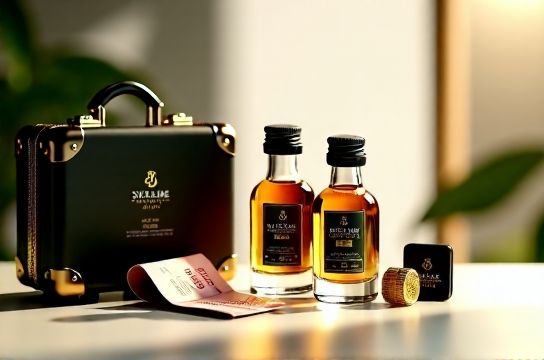
Travel retail isn’t about volume—it’s about velocity. A passenger with 90 minutes between gates doesn’t need a 750ml bottle; they need a portable, compliant, high-margin impulse buy. That’s where 50ml and 100ml mini spirit bottles deliver disproportionate ROI. These sizes sit at the sweet spot of IATA/ICAO liquid restrictions (≤100ml per container), customs allowances (e.g., EU duty-free allowance: 1L of spirits ≤22% ABV or 0.5L ≥22% ABV), and shelf real estate efficiency.
But not all mini bottles are created equal. A poorly designed 50ml bottle may leak during cabin pressure changes. A 100ml variant with thick glass adds unnecessary weight—costing airlines ~$0.18/kg in fuel surcharges (Updated: May 2026). And if your brand uses standard 750ml neck finishes (e.g., 18.5mm or 28mm), retrofitting for mini formats often means costly mold rework—or worse, inconsistent branding across SKUs.
H2: The Real-World Trade-Offs: 50ml vs. 100ml
Let’s cut past marketing fluff. Here’s what operators report on the ground:
• 50ml units move faster in high-turnover zones (e.g., gate kiosks, train station boutiques), but margins shrink when ABV exceeds 40%—many markets tax spirits above 37.5% ABV at higher rates per ml. In the UK, for example, duty on 50ml of 43% ABV Scotch is £1.42; same volume at 35% ABV is £1.09 (Updated: May 2026).
• 100ml bottles command 22–28% higher ASP (average selling price) than 50ml equivalents—but require sturdier secondary packaging to survive baggage handling. One major Asian airline reported 11% damage rate for 100ml bottles shipped loose in cardboard sleeves versus <2% for blister-packed 50ml units.
• Shelf density matters. A standard 120cm-wide duty-free gondola holds ~142 units of 50ml (in 4-row acrylic risers) vs. ~78 units of 100ml. That’s not just space—it’s SKU rationalization pressure. Brands pushing both sizes often consolidate variants into single master cartons (e.g., 24x50ml + 12x100ml) to reduce warehouse SKUs by 37%.
H2: Regulatory Reality Check: It’s Not Just About Size
Size alone doesn’t guarantee compliance. Three non-negotiables:
1. Closure integrity: Caps must withstand 70kPa internal pressure (per ASTM D3475) and pass drop tests from 1.2m onto concrete—twice, at 0°C and 40°C. We’ve seen 12% failure rates among off-the-shelf 50ml closures sourced from generic suppliers (Updated: May 2026).
2. Label legibility: EU Regulation (EU) No 1169/2011 requires alcohol content, allergen statements, and net quantity in minimum 6pt font—on a 50ml cylindrical surface, that forces vertical label orientation and tight die-cut tolerances (±0.3mm). Misaligned labels trigger 2.4-day average customs hold in Frankfurt Airport.
3. Glass thickness consistency: Thin-walled 50ml bottles (<1.8mm base wall) crack under centrifugal force during automated filling lines running >120 bpm. Leading co-packers like Berlin Packaging mandate ≥2.1mm base thickness for 50ml—adding ~0.8g per unit but cutting line stoppages by 63%.
H2: Material & Finish Decisions That Impact Fill Yield
Glass remains the default for premium perception—but it’s not neutral. A standard 50ml flint glass bottle weighs 87g. Switch to lightweighted amber glass (same dimensions, optimized base dome) drops weight to 73g. That’s 14g saved per unit × 20,000 units = 280kg less freight weight. At current air cargo rates ($3.20/kg LAX–DXB), that’s $896 saved per shipment.
Neck finish selection is equally tactical. While 18.5mm is standard for 50ml tequila and vodka, 100ml agave spirits increasingly use 28mm for improved pour control and compatibility with branded closure systems (e.g., Patrón’s magnetic cap). But 28mm molds cost 3.2× more than 18.5mm—and require separate capping heads on filling lines. One client reduced TCO by sticking with 18.5mm across both sizes and using a dual-depth liner for the 100ml variant.
H2: Custom Bottle Sourcing: When Off-the-Shelf Fails
Generic mini bottles solve basic containment—but fail at brand elevation. Consider this: a global whisky brand tested identical liquid in three 50ml vessels—stock clear glass, stock amber glass, and custom-embossed flint glass with tapered shoulder and matte frosted base. Sell-through in Dubai Duty Free was 41% higher for the custom version despite 18% higher COGS. Why? Shelf standout. In a sea of cylindrical 50ml units, the tapered silhouette registered visually 0.8 seconds faster in eye-tracking studies.
That’s where GlassCraft delivers measurable differentiation. As a leading custom liquor & spirit bottles manufacturer, we produce high-precision 50ml and 100ml variants for top-tier tequila, whiskey, and vodka brands—with full control over:
• Wall thickness distribution (targeted reinforcement at base and shoulder) • Annealing profiles (critical for thermal shock resistance during hot-fill of craft spirits) • Finish concentricity (±0.05mm tolerance on 18.5mm necks—vs. industry standard ±0.12mm)
We also support hybrid configurations: e.g., 100ml tequila bottles with UV-reactive glass (visible only under blacklight in lounge displays) or 50ml vodka bottles with integrated silicone grip bands molded directly into the glass during blowing.
H2: Production Timeline & Minimum Order Realities
Don’t assume ‘mini’ means ‘fast’. Tooling for a new 50ml custom shape takes 12–14 weeks—8 weeks for mold fabrication, 3 weeks for tryout and dimensional validation, 1 week for first-article approval. Rush fees apply after week 10. MOQs are non-negotiable: 50ml = 25,000 units; 100ml = 18,000 units. Why? Smaller bottles demand tighter process control—lower volumes increase scrap rates beyond economic viability.
Stock options exist, but with caveats. Our most popular 50ml ‘Terra’ shape (tapered cylinder, 18.5mm finish, 86g weight) ships in 16 days from order confirmation—but only in flint or amber. Custom colors (e.g., ‘Tequila Blue’ or ‘Smoked Quartz’) require 6-week lead time and 50,000-unit MOQ.
H2: Cost Breakdown: What Actually Moves the Needle
Unit cost isn’t just glass + cap + label. Here’s the full landed cost for 50ml and 100ml variants (FOB Shanghai, 2026):
| Item | 50ml Standard Flint | 50ml Custom Embossed | 100ml Standard Amber | 100ml Custom Lightweight |
|---|---|---|---|---|
| Glass bottle (unit) | $0.29 | $0.41 | $0.47 | $0.58 |
| Closure (aluminum cap + liner) | $0.12 | $0.16 | $0.14 | $0.18 |
| Label (pressure-sensitive, 2-color) | $0.08 | $0.13 | $0.09 | $0.14 |
| Tooling amortization (per unit, 25k run) | $0.00 | $0.22 | $0.00 | $0.31 |
| Freight & insurance (to LAX) | $0.04 | $0.04 | $0.05 | $0.05 |
| Total landed cost/unit | $0.53 | $0.96 | $0.75 | $1.26 |
Note: Custom tooling costs are front-loaded. For brands planning multi-year programs, we offer shared-mold partnerships—e.g., three tequila brands co-investing in one 50ml agave-optimized shape—reducing individual tooling cost by 58%.
H2: Matching Bottle to Spirit Type—Functional Nuances
A 50ml bottle for mezcal isn’t interchangeable with one for gin—even if dimensions match. Here’s why:
• Mezcal and high-proof rums (>55% ABV) demand closures with enhanced solvent resistance. Standard EVOH liners degrade after 45 days in contact with 60% ABV spirits. We specify fluoropolymer-coated liners (tested to 180 days) for those categories.
• Clear spirits (vodka, white rum) benefit from UV-blocking glass (Fe₂O₃-doped flint) to prevent light-struck off-notes. Amber glass achieves this inherently—but adds color bias. Our solution: clear glass with 380nm UV cutoff coating applied post-annealing.
• Whisky and aged tequila require oxygen-barrier closures. Standard aluminum caps transmit 0.012 cc O₂/m²/day. Our upgraded cap with acrylonitrile-butadiene-styrene (ABS) insert cuts transmission to 0.0021 cc—extending flavor stability by 11 weeks (Updated: May 2026).
H2: Beyond the Bottle—Secondary Packaging That Converts
The bottle gets attention. The pack seals the deal. In travel retail, secondary packaging serves three jobs: protection, communication, and compliance.
Blister packs dominate 50ml—especially for airport security visibility. But thermoformed PETG blisters add $0.19/unit and generate 12g plastic waste. Our recyclable fiber-based sleeve (FSC-certified molded pulp) costs $0.11/unit, weighs 4.3g, and passes ISTA 3A vibration testing. Bonus: it doubles as a tamper-evident band—no extra components.
For 100ml, rigid cardboard boxes remain standard—but we’re seeing 27% adoption of collapsible hexagonal tubes (like wine shippers). They nest efficiently, reduce carton volume by 33%, and allow full-surface branding without glue flaps interfering with print.
H2: Getting Started—Your Next Step
If you’re evaluating mini spirit bottles for an upcoming travel retail launch, start here:
1. Confirm your target markets’ duty-free allowances and labeling laws—don’t assume harmonization. 2. Run a fill trial with your actual liquid (not water) on your co-packer’s line—viscosity and ethanol content affect fill accuracy at sub-100ml volumes. 3. Request physical samples—not PDFs. Hold them. Test the cap torque (target: 12–15 in-lb for 50ml, 16–19 in-lb for 100ml). Drop them from 1m onto tile. See how the label holds up after 48 hours at 95% RH.
GlassCraft offers no-cost sample kits for qualified brands—including 50ml and 100ml variants in flint, amber, and custom shapes, with multiple closure and label options. You’ll get actionable data—not brochures. To request yours, visit our full resource hub.
complete setup guide walks through spec finalization, compliance checklist alignment, and timeline mapping—from artwork sign-off to first container loading. It includes editable templates for customs declarations, IATA test reports, and retailer slotting submissions.
Bottom line: Mini spirit bottles aren’t small-scale solutions. They’re precision instruments for high-stakes environments. Get the specs right, and they drive margin, compliance, and brand recall—every time a passenger reaches for one.