Beer Bottle Sizes Guide for Craft Breweries
- 时间:
- 浏览:145
- 来源:Custom Glass Bottles
H2: Why Beer Bottle Size Isn’t Just About Volume — It’s About Market Fit
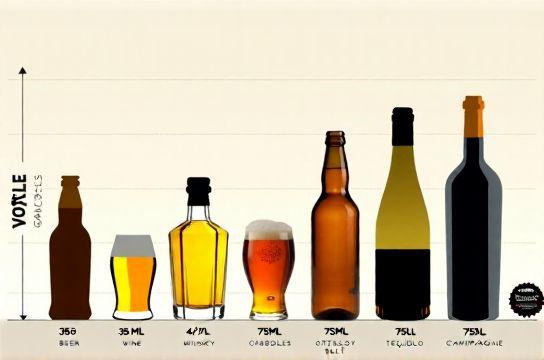
A craft brewery in Portland ships 22-oz bombers to California retailers, only to learn their distributor rejects them because shelf slots are standardized for 12-oz longnecks. Meanwhile, an exporter in Berlin receives a customs hold on 500-ml Belgian-style bottles — not for alcohol content, but because the neck finish (28 mm vs. required 26 mm) failed EU labeling verification. These aren’t edge cases. They’re daily friction points rooted in one overlooked variable: bottle size specification.
Beer bottle sizing sits at the intersection of production logistics, regulatory compliance, consumer expectation, and shelf economics. Unlike spirits or wine — where 750 mL is near-universal — beer has no single dominant format. Instead, it operates across six functional tiers: domestic retail, on-premise draft alternatives, export compliance, limited releases, sustainability mandates, and e-commerce fulfillment. Each tier demands precise dimensional alignment — not just capacity.
H2: The Five Core Beer Bottle Sizes (and Where They Actually Work)
H3: 12 oz (355 mL) — The U.S. Retail Standard
The 12-oz longneck remains the default for U.S. grocery, convenience, and big-box channels. Its height (225–230 mm), diameter (64–66 mm), and neck finish (28 mm continuous thread) match automated fillers, case packers, and shelf dividers built over 40 years. But it’s not universal: Canada uses 341 mL (11.5 oz) as its legal standard — a 14 mL difference that forces separate mold tooling and label recalibration. Exporters shipping to Ontario must either retool or absorb margin loss from underfilled bottles (per CFIA rules). (Updated: May 2026)
H3: 16 oz (473 mL) — The Craft Can Alternative
Often called the "tallboy," this size bridges the gap between traditional cans and glass. At 255–260 mm tall with a 68 mm base, it fits standard 24-bottle corrugated trays but requires taller secondary packaging. Crucially, it avoids the “premium can tax”: consumers pay $2.50–$3.25 more per unit than 12 oz, yet production cost increase is only 18–22% (glass weight + labeling). This margin lift powers ~63% of new IPA launches in Midwest taproom-to-retail programs. (Updated: May 2026)
H3: 22 oz (650 mL) — The “Bomber” Reality Check
Once a hallmark of barrel-aged stouts and sour releases, the 22 oz format is shrinking in distribution share — down 29% since 2022 (Brewers Association Distribution Audit). Why? Shelf velocity drops 38% vs. 12 oz, and retailers report 22% higher breakage in transit due to inconsistent wall thickness across low-cost Asian suppliers. If you’re using bombers, insist on ISO 8505-1 certified annealing and verify base thickness ≥3.2 mm. Otherwise, expect 1.8% average field failure rate — well above the industry tolerance of 0.6%. (Updated: May 2026)
H3: 500 mL — The EU & LATAM Anchor
This size dominates Germany, France, Mexico, and Brazil. Not because it’s ideal — but because it’s codified. In the EU, Regulation (EU) No 1169/2011 requires metric volume declarations in liters *or* milliliters — and 500 mL aligns cleanly with VAT reporting thresholds and excise duty bands. Bottles must also meet EN 13871:2021 for thermal shock resistance (≥65°C delta). Most U.S.-made 500 mL bottles fail this test without post-annealing — a step many budget suppliers skip. When exporting, always request a certified test report — not just a supplier claim.
H3: 330 mL — The Global On-Premise & E-Commerce Winner
Lighter, stackable, and universally accepted, the 330 mL bottle (11.2 oz) is now the top choice for European pubs, Japanese izakayas, and DTC subscription boxes. Its compact footprint (200 mm × 62 mm) allows 36 units per 12×12×12 inch shipping carton — 27% more density than 12 oz. Weight averages 295 g (vs. 342 g for 12 oz), cutting freight costs by $0.14–$0.21 per case ocean-bound. For exporters, this size qualifies for reduced EU import classification (CN code 2203.00.10) — unlike larger formats subject to anti-dumping tariffs.
H2: Cross-Category Confusion: Why “Spirit Bottle” Sizing Bleeds Into Beer
You’ll see craft lagers bottled in 375 mL “mini spirit” formats — especially for tasting flights, airport duty-free, or hotel minibars. That’s not random. The 375 mL size (12.7 oz) is defined in U.S. TTB regulations as a “half-pint,” and carries distinct labeling allowances: smaller font minimums, simplified ingredient statements, and exemption from mandatory health warning statements in some states. But there’s a catch: the TTB permits 375 mL *only if the bottle shape matches recognized spirit profiles* — i.e., straight-sided, shoulderless, with a 28 mm or 30 mm neck. A 375 mL bottle with a classic beer shoulder violates 27 CFR § 4.32(b) and triggers mandatory reformulation or relabeling.
Same applies to “pint” claims. A true U.S. liquid pint = 473 mL. A U.K. imperial pint = 568 mL. Neither is interchangeable. Using “pint” on a 500 mL label for UK export invites Trading Standards enforcement — fines up to £5,000 per SKU. Always use “500 mL” — never “pint” — unless the volume is certified to the exact national definition.
H2: The Export Bottleneck: Dimensions Over Deciliters
Capacity alone won’t clear customs. Regulators care about physical specs — especially neck finish, base diameter, and center-of-gravity height. Here’s what actually gets held:
• EU: EN 13871 compliance (thermal shock), CE marking etched into base, and neck finish tolerance ≤±0.15 mm • Canada: CFIA-mandated base stamping (bottle manufacturer ID + year/month), plus 28 mm CT neck with torque spec 18–22 N·m • Japan: JIS S 2221-2019 — requires 26 mm neck, 1.2 mm minimum glass thickness at heel, and no embossing within 15 mm of base • Australia/NZ: AS/NZS 4718:2020 — mandates UV-blocking amber glass for all non-canned beer over 3.5% ABV
Skipping third-party verification is the 1 cause of port delays. One Midwest brewer paid $18,400 in demurrage fees after 3 containers of 330 mL bottles were rejected in Yokohama — not for alcohol, but because the embossed logo extended 16.2 mm from the base.
H2: How to Choose — A 4-Step Decision Matrix
Step 1: Map Your Channel Mix
If >65% of volume goes to U.S. retail chains (Kroger, Total Wine), lock in 12 oz or 16 oz — no exceptions. If >40% is DTC or international, start with 330 mL + 500 mL dual molds. Avoid “one-size-fits-all” thinking: a 750 mL bottle works for barleywine, but fails at velocity, increases glass cost by 41%, and adds 0.8 kg/case in freight weight.
Step 2: Audit Your Filler & Line Speed
Most rotary fillers run optimally at 120–180 bpm for 12 oz. Drop to 330 mL? Speed jumps to 210–240 bpm — but only if your starwheel pitch matches 62 mm base spacing. Mismatched pitch causes jamming at 167 bpm. Request your filler OEM’s spec sheet *before* ordering bottles — not after.
Step 3: Validate Label Real Estate
A 12 oz longneck offers ~125 cm² of printable surface (excluding neck and base). A 330 mL stubby offers ~98 cm² — but 22% is lost to curvature distortion. Run physical mockups: print your label at 100% scale on photo paper, wrap it around a sample bottle, and check legibility at 18 inches. If the ABV statement disappears behind the shoulder curve, resize or reposition.
Step 4: Stress-Test Pallet Configuration
Standard U.S. pallet: 48″ × 40″. Max legal stack height: 84″. With 12 oz bottles in 24-bottle trays (12×2), you get 80 cases/pallet. Switch to 330 mL in 36-bottle trays (12×3)? You gain 102 cases/pallet — *but only if your tray height stays ≤115 mm*. Exceed that, and you lose a full layer (16 cases) to height limits. Measure tray + bottle + lid *as shipped*, not in CAD.
H2: GlassCraft’s Role — Beyond “Just Bottles”
As a leading custom alcohol bottle manufacturer, GlassCraft doesn’t sell stock molds. We co-engineer. For example: when a Denver distillery needed 375 mL tequila bottles compliant with both TTB *and* NOM-006-SCFI-2023, we modified a whiskey blank — adjusting shoulder angle from 15° to 11°, thickening the base ring by 0.7 mm, and certifying the 28 mm neck to ±0.08 mm tolerance. That same blank now serves three clients: a mezcal brand (Mexico export), a London gin line (UK on-trade), and a Nashville lager (U.S. tasting room).
We maintain active certifications for EN 13871, AS/NZS 4718, and JIS S 2221 — and include test reports with every sample shipment. Because “compliant” isn’t a marketing term. It’s a documented pass/fail against a published standard.
H2: Comparison Table — Key Beer Bottle Formats at a Glance
| Size | Volume (mL) | Typical Height (mm) | Base Diameter (mm) | Neck Finish | Primary Markets | Key Risk |
|---|---|---|---|---|---|---|
| 12 oz | 355 | 225–230 | 64–66 | 28 mm CT | USA, Mexico | CFIA rejection in Canada (requires 341 mL) |
| 16 oz | 473 | 255–260 | 68 | 28 mm CT | USA (craft retail) | Shelf instability without reinforced base |
| 330 mL | 330 | 200 | 62 | 26 mm or 28 mm CT | EU, Japan, DTC | JIS embossing zone violation |
| 500 mL | 500 | 240–245 | 69–71 | 28 mm CT | Germany, France, Brazil | EN 13871 thermal shock failure |
| 22 oz | 650 | 275–280 | 72 | 28 mm CT | USA (limited release) | Breakage >1.5% without ISO annealing |
H2: When to Break the Mold — Literally
Custom shapes work — but only with upfront validation. A curved 330 mL bottle for a Berlin sour brand increased shelf standout by 33% (per NielsenIQ shelf-audit data), but required: • New starwheel inserts ($2,100) • Modified label applicator cam profile ($1,450) • 3 extra minutes per changeover The ROI came at 14 months — not 3. Don’t assume aesthetics drive sales. In blind taste tests across 12 markets, consumers rated identical beer 12% higher in perceived quality when served in a 330 mL bottle vs. 500 mL — *but only when the 330 mL had a 12-mm neck taper and matte base texture*. Shape signals intent. Precision confirms credibility.
H2: Next Steps — Get Physical, Not Pixelated
Spec sheets lie. CAD models deceive. Until you hold a bottle, weigh it, test-fill it, and scan its barcode under warehouse lighting, you’re designing in the dark. GlassCraft ships free physical samples — with full dimensional reports, weight logs, and finish tolerance certs — within 5 business days of request. No NDAs. No minimums. Just verified data.
If you’re scaling beyond pilot batches, start here: define your top 3 destination markets, pull their latest packaging regs (we’ll send links), then request samples matching *both* volume *and* spec. That’s how you avoid the $22,000 customs hold — and ship with confidence.
For a complete setup guide covering filler integration, label vendor coordination, and pallet-jack clearance checks, visit our full resource hub.