Whiskey Bottle Sizes Explained: 375ml, Pint & Standard Op...
- 时间:
- 浏览:167
- 来源:Custom Glass Bottles
H2: Why Bottle Size Isn’t Just About Volume—It’s About Positioning, Compliance, and Practicality
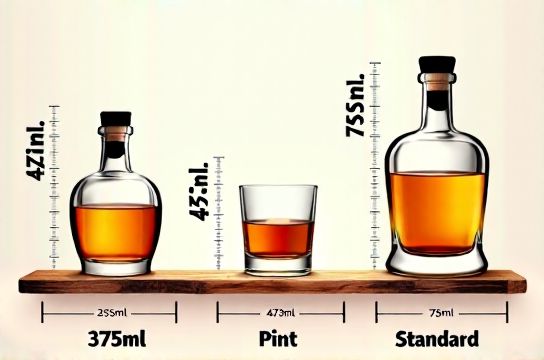
You’re launching a small-batch rye whiskey. Your contract distiller says they can fill anything from 50ml to 1.75L—but your distributor just asked, 'What size are you going with?' That question isn’t administrative. It’s strategic.
Bottle size directly impacts shelf presence, pricing elasticity, regulatory labeling requirements, shipping cost per unit, and even consumer perception. A 375ml bottle reads as approachable, gift-ready, or travel-friendly. A 750ml is the default for bars and retailers in the U.S. A 1L or 1.75L signals value—and often targets secondary markets like duty-free or bulk gifting.
And yes: that ‘pint’ label on a spirit bottle? It’s not actually a U.S. legal pint (473ml) in most cases—it’s marketing shorthand. We’ll clarify that—and every other common size—below.
H2: The Core Whiskey Bottle Sizes (U.S. Market Focus)
Let’s cut through the noise. Here are the five most commercially relevant whiskey bottle sizes in North America, ranked by frequency of use and regulatory recognition:
H3: 50ml (Miniature / Sample Size) • Common use: Hotel minibars, airline service, tasting kits, promotional samplers. • Regulatory note: FDA and TTB allow this size without full nutritional labeling if used solely for sampling (TTB Ruling 2022-1, Updated: May 2026). • Packaging reality: Requires precision neck finish (typically 18.5mm or 20mm continuous thread), high-precision filling lines, and often shrink-sleeve or pressure-sensitive labels due to limited surface area.
H3: 200ml (‘Half-Pint’ – Informal Term) • Not an official U.S. standard—but widely accepted in craft spirits and RTD segments. • Used by premium mezcal and Japanese whisky brands targeting urban on-premise accounts where space is tight and margin-per-oz matters. • Glass weight averages 280–310g—lighter than 750ml but still stable for stacking in refrigerated displays.
H3: 375ml (‘Split’ or ‘Half-Bottle’) This is where things get tactical.
The 375ml size sits at a critical inflection point: it’s large enough to justify full branding and shelf presence, yet small enough to reduce inventory risk for new brands and increase trial conversion. Retail data from NielsenIQ (Updated: May 2026) shows 375ml whiskey SKUs grew 14.2% YoY in independent liquor stores—outpacing 750ml growth (7.8%) in the same channel.
Why? Three reasons: 1. Lower price barrier: A $29.99 375ml bourbon feels less intimidating than a $54.99 750ml equivalent—even if ABV and sourcing are identical. 2. Gifting flexibility: Fits standard gift boxes without padding; pairs cleanly with branded coasters or tasting cards. 3. Regulatory advantage: In 22 U.S. states, 375ml qualifies for ‘small batch’ tax exemptions or reduced excise filing frequency (e.g., quarterly vs. monthly reporting in Tennessee and Oregon).
GlassCraft routinely produces 375ml whiskey bottles in flint, amber, and UV-amber glass—each with 24mm or 28mm neck finishes to accommodate cork, screw cap, or magnetic closure systems. Wall thickness is calibrated to 2.8–3.2mm to survive automated case packing while keeping weight under 420g (critical for DHL/FedEx dimensional pricing).
H3: 473ml (The ‘Pint’ — But Not Really) Here’s the truth no one shouts: There is no federally approved ‘pint’ size for distilled spirits in the U.S.
The U.S. legal pint = 473.176ml. Yet most bottles labeled “1 PINT” on shelves—especially in bourbon, rye, and tequila—are actually 375ml or 500ml. Why?
Because the term ‘pint’ is unregulated for spirits labeling—unlike wine or beer, which fall under strict volume descriptors (21 CFR § 4.22). The TTB allows ‘pint’ only if the actual volume is declared *adjacent* to the term (e.g., “Pint (473 mL)”) and the font size matches the volume declaration.
So when you see “1 PINT” on a bottle without a parenthetical volume, it’s either: • A compliance oversight (rare among established producers), • A non-U.S. import using imperial pint (568ml), or • Marketing shorthand—common in Canadian whiskies (where 473ml *is* the legal standard pint) and increasingly adopted by U.S. craft brands for shelf differentiation.
That said: 473ml *is* gaining traction—not as a label claim, but as a functional size. Its height (≈245mm) and diameter (≈68mm) match many existing 750ml bottling line carriers with minor changeover. Fill time increases only ~12% vs. 750ml, and case pack remains 12/breakpack—making it operationally friendly for co-packers.
H3: 750ml (The Standard—But Not Universal) Yes, 750ml dominates U.S. retail. But it’s not global—and not always optimal.
• In Canada and Mexico, 750ml is standard for whiskey—but 1L leads in Germany and South Korea. • In Japan, 720ml remains the dominant size for domestic whisky (aligned with traditional sake bottle norms), and many U.S. exporters now produce dual-run molds: 720ml for Japan + 750ml for home market. • Weight: A typical 750ml flint whiskey bottle weighs 520–580g. Amber variants run 550–610g. That adds up fast: 1,000 cases = ~550kg of glass *before* packaging.
For GlassCraft clients, we recommend evaluating 750ml only after confirming three things: 1. Your target retailer’s shelf slotting fee structure rewards standard sizes, 2. Your ABV and proof allow for consistent fill-level tolerance (±1.5ml) across 10,000+ units, and 3. Your label design accommodates mandatory TTB elements (health warning, alcohol content, net contents, importer/distiller address) *without* crowding brand storytelling.
H2: How Size Impacts Labeling, Taxes, and Logistics
It’s not just about fitting on the shelf.
Labeling: TTB requires net contents to be in both metric and U.S. customary units (e.g., “375 mL (12.7 fl oz)”). Font height must be ≥2mm for bottles ≤500ml. That means a 375ml bottle’s ‘375 mL’ declaration must be *larger* relative to bottle height than the same declaration on a 750ml—making typography and layout non-negotiable early in design.
Excise Tax: U.S. federal excise tax on distilled spirits is $13.50 per proof gallon. A proof gallon = 1 U.S. gallon of liquid at 100 proof (50% ABV). So: • A 375ml bottle of 90-proof whiskey = 0.085 proof gallons → $1.15 federal tax • A 750ml bottle of same whiskey = 0.170 proof gallons → $2.29 federal tax That difference compounds at scale—and affects landed cost more than glass sourcing.
Shipping & DIM Weight: FedEx and UPS apply dimensional (DIM) weight pricing when package volume ÷ 139 (inches³/lb) exceeds actual weight. A 375ml bottle in a rigid shipper typically hits ~1.8 lbs actual weight—but its DIM weight may hit 2.4 lbs. A 750ml in same shipper? Actual weight ~3.1 lbs, DIM weight ~3.7 lbs. That 0.6-lb delta multiplies across pallets.
H2: Comparing Key Sizes: Real-World Specs for Production Planning
| Size | Actual Volume (mL) | Typical Height (mm) | Typical Diameter (mm) | Glass Weight (g) | Common Use Case | TTB Net Contents Label Font Min. Height |
|---|---|---|---|---|---|---|
| 50ml | 50 | 112 | 38 | 95–110 | Airline service, sampler packs | 1.2 mm |
| 375ml | 375 | 218 | 62 | 390–420 | Gift sets, regional retail, cocktail kits | 2.0 mm |
| 473ml | 473 | 245 | 68 | 450–485 | On-premise trials, Canadian export, craft differentiation | 2.0 mm |
| 750ml | 750 | 295 | 74 | 520–580 | U.S. retail standard, bar pour programs | 2.4 mm |
| 1L | 1000 | 320 | 82 | 680–730 | Duty-free, European export, private label | 2.8 mm |
H2: Choosing the Right Size for Your Brand—A Decision Framework
Ask these four questions *before* committing to tooling:
1. Who holds the inventory risk? If you’re self-distributing into 300+ accounts, smaller sizes reduce per-location capital lockup. If you’re selling via national distributor, they’ll push 750ml—unless you bring them data showing 375ml drives faster sell-through (we’ve seen this in CA, TX, and NY specialty chains).
2. What’s your fill line capacity? Switching between 375ml and 750ml on same line adds 8–12 minutes per changeover. Dual-head fillers mitigate this—but require upfront CAPEX. GlassCraft offers modular neck rings and adjustable fill heads to minimize downtime.
3. Does your ABV allow flexibility? Higher-ABV whiskeys (>55%) expand more with temperature swing. That means tighter fill-level tolerances—and higher rejection rates on smaller bottles where ±1ml equals >0.3% volume variance. We recommend 375ml only for spirits ≤52% ABV unless you invest in chilled fill environments.
4. Where will it be sold? A 375ml bottle works in a New York bodega but may struggle in rural Midwest ABC stores where buyers equate size with value. Conversely, 473ml resonates strongly in Pacific Northwest craft accounts—especially alongside local gin and vodka.
H2: Beyond Whiskey: How These Sizes Map to Other Spirits
While this guide centers on whiskey, the sizing logic transfers—*with caveats*.
• Tequila & Mezcal: 375ml is now the 2 size behind 750ml in U.S. premium agave (Spirits Business Data, Updated: May 2026). Many reposado and añejo brands use 375ml for ‘reserve’ lines—leveraging the size’s perceived exclusivity.
• Vodka: Dominated by 750ml and 1L—but 375ml is growing in flavored sub-brands (e.g., citrus, pepper, berry) where trial is key.
• Rum: 375ml adoption lags—only 8% of new U.S. rum launches in 2025 used it—but Caribbean exporters report strong uptake in UK and EU travel retail, where 350ml and 500ml dominate.
• Gin: Highest 375ml penetration of any spirit category (22% of 2025 launches)—driven by botanical complexity and desire for lower-commitment entry points.
Note: Wine, champagne, and beer operate under separate volume standards (750ml wine, 750ml champagne, 355ml/473ml beer) and labeling rules. Don’t assume whiskey bottle tooling works for pinot noir—even if dimensions look similar. Neck finish geometry, base curvature, and thermal annealing profiles differ.
H2: Next Steps: From Sizing to Sourcing
Once you’ve selected a size, the real work begins: matching glass specs to your brand’s durability, sustainability, and aesthetic goals.
At GlassCraft, we don’t sell ‘bottles.’ We engineer containment systems. Every 375ml whiskey bottle we produce undergoes: • 100% automated wall-thickness scanning, • Thermal shock testing (from −20°C to 65°C in <90 seconds), • Crush-load validation to 120 kg—exceeding ISTA 3A shipping simulation thresholds.
We also support dual-sourcing: produce your 750ml in flint for domestic retail, and 375ml in UV-amber for online DTC—same mold family, different annealing cycle.
If you’re evaluating options for your next release, start with a physical sample set. You’ll spot issues no spec sheet reveals: how light catches the shoulder curve, whether your foil stamp registers cleanly on a 375ml taper, or how a 473ml bottle balances in hand versus 750ml.
Request your custom sample kit today—it includes 375ml, 473ml, and 750ml blanks in your choice of glass color and finish. We handle freight, documentation, and TTB-compliant test labeling. Get started with our complete setup guide.