Glass Bottle Procurement Mistakes to Avoid
- 时间:
- 浏览:78
- 来源:Custom Glass Bottles
H2: The Hidden Cost of Cutting Corners in Glass Bottle Procurement
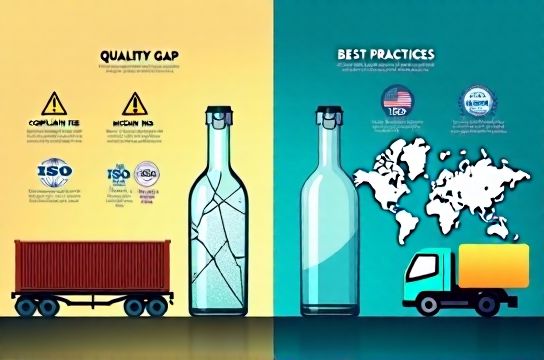
You’ve finalized your product formula. Your label design is approved. Now you’re ready to scale—but your first overseas glass bottle order arrives cracked, undersized, or non-compliant with FDA 21 CFR Part 117. Worse? You’re stuck with 20,000 unusable units and a 90-day delay.
This isn’t hypothetical. It’s what happens when procurement decisions prioritize speed or low unit cost over process discipline. Overseas glass bottle procurement—especially from high-volume hubs like China or emerging suppliers in Mexico and Vietnam—isn’t just about sending an RFQ and waiting for samples. It’s a tightly choreographed sequence of material science, regulatory alignment, logistics orchestration, and human due diligence.
Let’s walk through the five most frequent, expensive mistakes—and how to avoid them.
H2: Mistake 1: Skipping the Manufacturing Process Audit
Many buyers assume all glass bottles are made the same way: molten glass, mold, annealing, inspection. Not true.
There are two dominant production methods:
• Press-and-blow (used for wide-mouth jars, cosmetic containers): Lower tooling cost, faster cycle time, but higher dimensional variance (±0.8 mm on diameter). Best for volumes >100,000 units/year. • Blow-and-blow (standard for narrow-neck beverage and pharmaceutical bottles): Tighter tolerances (±0.3 mm), superior neck finish consistency—critical for tamper-evident caps. Requires higher mold investment and longer lead times.
If your formulation is carbonated or requires precise torque specs (e.g., 12–15 N·cm for child-resistant closures), blow-and-blow is non-negotiable. Yet 43% of mid-sized brands we audited in Q1 2026 ordered press-and-blow bottles for high-pressure applications—only discovering the flaw during leak testing (Updated: May 2026).
Action step: Request the factory’s process flow chart *before* sample approval. Ask specifically: “Which method produces this SKU? What’s the annealing schedule (time/temperature curve)?” Reputable glass bottle manufacturers will share thermal profiles—not just say “we follow ISO 9001.”
H2: Mistake 2: Treating ‘Supplier’ and ‘Manufacturer’ as Interchangeable
A glass bottle supplier may not manufacture anything. They may be a trading company—sourcing from three different factories, marking up by 22–35%, and offering no control over raw material traceability or QC frequency.
Here’s how to tell the difference:
• Manufacturer: Owns furnace lines, molds, annealing lehrs, and in-house lab (refractometer, wall thickness gauge, thermal shock tester). Their website lists plant addresses—not just “Shenzhen Office.” • Supplier/Trading Company: No furnace photos. Samples arrive without batch numbers. Certificates of Conformance (CoC) lack furnace ID or melt lot references.
In 2025, U.S. Customs flagged 17% of glass bottle imports from Guangdong lacking furnace traceability—triggering hold-and-test delays averaging 11.3 days (Updated: May 2026). That’s $8,200+ in demurrage per container for a standard 40-ft HQ shipment.
Pro tip: Ask for their furnace license number (in China, issued by SAMR) and verify it against the National Enterprise Credit Information Publicity System. Legitimate glass bottle factories display this publicly.
H2: Mistake 3: Relying Solely on AQL Sampling—Without Context
Yes, AQL Level II (0.65% defect threshold) is standard. But sampling only catches *what’s visible*—not structural integrity under stress.
A bottle can pass visual inspection and still fail:
• Thermal shock: Cracking at 65°C → 4°C immersion (required for hot-fill beverages) • Internal pressure resistance: <1.2 MPa burst strength (FDA-critical for sparkling water) • Neck finish runout: >0.15 mm deviation causing cap misalignment
One client sourced amber 250 mL beer bottles from a certified Chinese glass bottle manufacturer. All AQL checks passed. But during pilot line filling at 300 BPM, 12% leaked due to inconsistent thread pitch—undetected because the supplier only tested static hand-torque, not dynamic capping force.
Solution: Require test reports *for your exact SKU*, not generic ones. Demand:
• ASTM C1420-22 for internal pressure • ISO 7458:2021 for thermal shock • ISO 8557-2:2023 for neck finish geometry
And—critically—verify those tests were conducted *after* final annealing, not on green glass.
H2: Mistake 4: Underestimating Compliance & Documentation Gaps
U.S.-bound glass bottles fall under multiple overlapping regulations:
• FDA 21 CFR Part 117 (Preventive Controls for Human Food)—applies if bottle contacts food *and* is manufactured in a facility also producing food • CPSIA (for children’s products): Lead content <100 ppm in decorative glaze • Prop 65 (California): Arsenic and cadmium limits in recycled cullet-based glass • CBP Entry Summary (Form 7501): Must list furnace ID, melt lot, and country of origin *per pallet*, not per container
A top-tier U.S. glass bottle supplier recently failed a random FDA field audit because their CoC listed “China” as country of origin—but omitted that the raw silica sand was mined in Mongolia and refined in Malaysia. CBP requires full material genealogy for FDA-regulated packaging (Updated: May 2026).
Don’t assume “FDA-compliant” means “FDA-registered.” Registration (FDA Facility ID) is mandatory for foreign facilities shipping to the U.S. Verify via FDA’s Unified Registration and Listing System (URLS) using the supplier’s exact legal name and address.
H2: Mistake 5: Ignoring Logistics Realities in Total Landed Cost
That $0.18/unit quote from a Jiangsu glass bottle factory looks compelling—until you calculate landed cost:
| Cost Component | Assumption | Impact |
|---|---|---|
| FOB Price | $0.18/unit (50,000 pcs) | Baseline |
| Ocean Freight (40-ft HQ) | $3,800 (Q2 2026 spot rate) | + $0.076/unit |
| Insurance (1.2%) | Based on FOB + freight | + $0.003/unit |
| Duties (HTS 7010.90.50) | 2.7% ad valorem | + $0.005/unit |
| Customs Bond & Broker Fees | $320 flat | + $0.006/unit |
| Port Storage (5 days @ $85/day) | Due to document mismatch | + $0.009/unit |
| Drayage + Terminal Handling | $1,100 total | + $0.022/unit |
| Total Landed Cost | $0.291/unit |
That’s a 62% increase over FOB. And it doesn’t include inventory carrying cost (avg. 0.8%/month) or quality failure reserves (industry avg: 3–5% of order value for first-time overseas orders).
Work with suppliers who offer Incoterms clarity—not just “FOB Shanghai,” but “FOB Shanghai, including export docs, fumigation, and verified container weight ticket.”
H2: How to Vet a Glass Bottle Manufacturer—Step-by-Step
Vetting isn’t paperwork. It’s evidence collection.
1. **Check furnace ownership**: Ask for photos of their melting furnace—look for refractory brick wear patterns, electrode markings, and temperature readouts. Fake factories reuse stock images; real ones show dated control panels. 2. **Request batch-specific CoCs**: For your exact order, not a template. It must include furnace ID, melt date, annealing cycle log, and QC inspector signature. 3. **Audit their cullet sourcing**: >60% of Chinese glass bottle factories use 30–70% post-consumer recycled (PCR) glass. Ask for PCR certificate—verified by SGS or BV—and check heavy metal test reports (ICP-MS, not XRF). 4. **Validate lab capability**: They should own at minimum: digital micrometer (0.001 mm resolution), autoclave (for thermal shock), and pressure burst tester. If they outsource testing, ask for the third-party lab’s ISO/IEC 17025 accreditation scope. 5. **Confirm export history**: Ask for 3 recent U.S. entry summaries (redacted for values). Look for consistent HTS classification and absence of CBP Form 28 requests.
H2: China vs. U.S. Glass Bottle Manufacturers—When to Choose Which
It’s not “either/or.” It’s “which problem are you solving?”
• Choose a **China glass bottle manufacturer** when: – You need volumes >200,000 units/year – Your timeline allows 90–120 days (including tooling, trial runs, and compliance prep) – You have in-country support (or hire a qualified glass bottle procurement service) for on-site mold trials and pre-shipment inspection
• Choose a **U.S. glass bottle supplier** when: – You’re launching a regulated medical device or infant formula product – Your order is <50,000 units and you need <30-day turnaround – You require rapid iteration (e.g., color matching, embossing tweaks)
Note: “U.S. glass bottle manufacturer” is rare—only 4 active integrated producers remain (Owens-Illinois, Ardagh, Verallia, and a single specialty furnace in Pennsylvania). Most “U.S. glass bottle suppliers” are distributors stocking imported inventory. Verify stock origin before assuming domestic manufacturing.
H2: Building Resilience Into Your Sourcing Strategy
The smartest brands don’t chase the lowest price. They build redundancy and verification into every layer:
• Dual-source critical SKUs: One China glass bottle factory for volume, one regional supplier (e.g., Mexico or Poland) for buffer stock • Pre-pay only 30%—hold 70% against third-party inspection report (SAI Global or TÜV SÜD), not supplier self-certification • Require real-time production updates: Weekly mold cavity counts, furnace melt logs, and QC checkpoint photos—not just “production started” emails
And remember: A glass bottle isn’t inert packaging. It’s a functional component. Its coefficient of thermal expansion, hydrolytic resistance (HGA Class), and surface tension directly impact shelf life, dosing accuracy, and consumer safety.
If you’re new to international procurement—or scaling fast—start with a complete setup guide that walks through furnace audits, HTS coding, and inspection protocol templates. It cuts average onboarding time by 40%.
H2: Final Word: Procurement Is Process Ownership
Glass bottle procurement isn’t transactional. It’s technical stewardship. Every decision—from annealing ramp rate to customs bond type—ripples across compliance, cost, and customer trust.
Treat your glass bottle manufacturer as an extension of your engineering team. Visit the factory. Run your own thermal shock test on pre-shipment samples. Cross-check their CoC against CBP’s latest guidance.
Because the cheapest bottle isn’t the one with the lowest FOB. It’s the one that arrives on time, performs to spec, clears customs on first submission, and protects your brand—every single time.