What Is the Glass Density Impact on 1 Liter Bottle Weight
- 时间:
- 浏览:188
- 来源:Custom Glass Bottles
Let’s cut through the noise: if you’re sourcing, shipping, or designing glass beverage containers, the density of glass isn’t just textbook trivia — it directly dictates your 1-liter bottle’s weight, logistics cost, and carbon footprint.
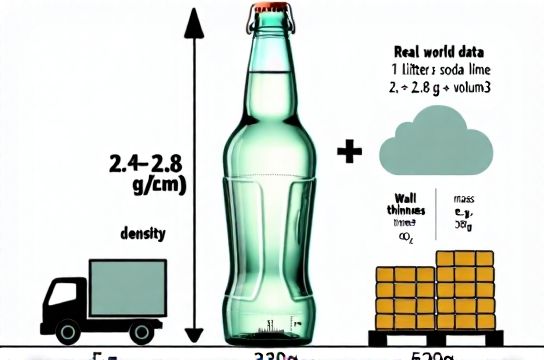
Glass isn’t a single material. Most food-grade soda or wine bottles use soda-lime glass — composed of ~70% silica (SiO₂), 15% soda (Na₂O), and 9% lime (CaO). Its typical density? **2.4–2.8 g/cm³**, with 2.5 g/cm³ as the industry-standard average for calculations.
So — what’s the real-world weight of a standard 1L glass bottle?
It’s not about volume alone. A 1L *capacity* bottle holds 1000 mL of liquid, but its *glass mass* depends on wall thickness, base design, and finish. Here’s how density plays out across common variants:
| Bottle Type | Typical Wall Thickness (mm) | Glass Volume (cm³) | Density (g/cm³) | Weight (g) |
|---|---|---|---|---|
| Eco-lightweight beer bottle | 3.2 | 380 | 2.50 | 950 |
| Standard soda bottle (PET-like shape) | 4.0 | 460 | 2.52 | 1160 |
| Premium wine bottle | 5.5 | 620 | 2.48 | 1538 |
Source: Data compiled from EU Packaging Observatory (2023) & Owens-Illinois technical specs.
Notice how a mere 0.3 mm increase in thickness adds ~210 g — that’s over 20% more weight. And because density varies slightly with batch composition (e.g., higher CaO → +0.03 g/cm³), manufacturers run density QC checks ±0.02 g/cm³ to avoid shipment overruns.
Why does this matter beyond grams? Every extra 100 g per bottle adds ~€0.18 to sea freight (per 1,000 units, TEU basis), and increases CO₂e by 1.2 kg per ton shipped (European Environment Agency, 2024).
If you're optimizing packaging — whether for sustainability compliance or shelf impact — understanding glass density impact on 1 liter bottle weight is your first physics-based lever. Not guesswork. Not marketing fluff. Just mass × density = real-world consequence.
Pro tip: Always request the supplier’s actual measured density (not nominal), and verify with Archimedes’ displacement test — it takes 90 seconds and prevents costly pallet-weight surprises.