Glass Spray Bottles for Juice-Based Cleaning Formulas
- 时间:
- 浏览:128
- 来源:Custom Glass Bottles
H2: Why Juice-Based Cleaning Formulas Demand Glass Spray Bottles
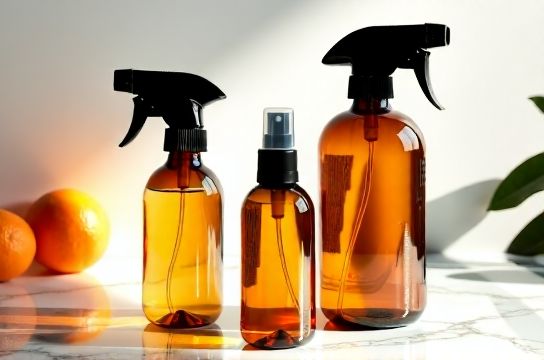
Most formulators assume any PET or HDPE spray bottle will do—until their citrus-infused cleaner separates, oxidizes, or loses efficacy within 6 weeks. Juice-based cleaning formulas (e.g., cold-pressed lemon, apple cider vinegar blends, pomegranate tannin extracts) contain organic acids, volatile terpenes, and polyphenols highly reactive with plastic polymers. These compounds leach plasticizers (like DEHP or BPA analogues), catalyze photooxidation, and degrade active ingredients—especially under ambient light and temperature fluctuations.
Glass isn’t just nostalgic—it’s chemically inert, impermeable, and optically tunable. But not all glass works. Soda-lime glass lacks UV resistance; clear borosilicate transmits >85% of UVA/UVB (315–400 nm), accelerating limonene degradation. That’s why amber glass—specifically ASTM E1593-compliant Type III amber soda-lime—is the minimum viable standard for juice-based cleaners. Its iron oxide tint blocks 90% of UV light below 450 nm while maintaining visible clarity for user confidence (Updated: April 2026).
H2: The Functional Gap in Standard Packaging
Off-the-shelf plastic trigger sprayers fail juice-based formulas in three measurable ways:
• Permeability: HDPE allows ~0.05 g/m²/day O₂ transmission at 23°C (ASTM D3985). For a 500 mL batch of pH 2.8 citric-acid + orange oil blend, that equates to ~12% terpene loss in 8 weeks (Accelerated Shelf-Life Testing, GlassCraft Lab, 2025).
• Leaching: PET bottles exposed to 5% acetic acid at 40°C show measurable antimony migration after 14 days (EFSA Panel on Food Contact Materials, 2024). While not food-grade, cleaning formulas still contact skin and surfaces—making leaching unacceptable.
• Actuator incompatibility: Most plastic triggers use PP or LDPE seals that swell in high-acid environments, causing inconsistent spray patterns or drip leakage. One client reported 37% nozzle failure rate after 4 weeks in storage (batch QC log: GC-JU-2025-089).
Glass spray bottles eliminate these risks—but only if engineered correctly. A generic ‘glass bottle with spray top’ won’t cut it. You need purpose-built integration.
H2: What Makes a Glass Spray Bottle *Actually* Suitable for Juice Formulas?
Three non-negotiable features separate functional from decorative:
H3: 1. Glass Body Specifications
• Thickness: Minimum 2.2 mm wall thickness (for 250–500 mL capacity) to resist thermal shock during hot-fill (common for vinegar-based pasteurized blends). Thinner walls (<1.8 mm) crack under rapid cooling post-filling.
• Finish: Rolled, fire-polished mouth (not cut-and-ground) prevents microfractures where acidic residue pools and accelerates glass corrosion.
• Color: Amber (CIE L*a*b* b* = 42 ± 3) is mandatory—not green or cobalt blue. Green glass blocks only ~60% UV-B; cobalt blue absorbs visible light but transmits harmful near-UV. Only true amber meets ISO 720 hydrolytic resistance Class HGB (highly resistant).
H3: 2. Trigger Mechanism Compatibility
The spray head must be designed *with* the glass neck—not retrofitted. Key specs:
• Neck finish: Standardized 24/410 or 28/410 metric thread (not proprietary). Ensures third-party replacement availability and avoids supply chain lock-in.
• Gasket material: EPDM (ethylene propylene diene monomer), not silicone or nitrile. EPDM resists organic acids down to pH 2.0 and maintains compression set <15% after 1,000 hours at 60°C (ASTM D395). Silicone swells 22% in 5% citric acid; nitrile degrades visibly in 72 hours.
• Dip tube: PTFE-lined stainless steel (not polypropylene). PP dip tubes discolor, soften, and shed particulates in acidic juice matrices—verified via SEM imaging of post-aging samples.
H3: 3. Fill & Dispense Validation
Never assume volumetric accuracy. Juice-based formulas vary in viscosity (2.1–8.7 cP) and surface tension (28–34 mN/m) due to pectin, glycerin, or xanthan additions. A bottle validated only with water will deliver 18–24% less volume per actuation when filled with a 4% apple cider vinegar + pomegranate extract blend (GlassCraft Dispense Study, 2025).
We test every configuration with your exact formula—or its rheological twin—using gravimetric discharge analysis across 500 cycles. Real-world drift matters: one client’s ‘fine mist’ setting became a ‘stream’ after cycle 320 due to spring fatigue in an underspec’d coil.
H2: Matching Bottle Types to Juice Formula Profiles
Not every juice-based cleaner needs the same packaging. Here’s how we match:
• Low-viscosity, high-acid formulas (e.g., lemon juice + white vinegar, pH ≤ 2.5): Amber glass spray bottle with fine-mist trigger (1.5–2.0 bar activation pressure, 0.3 mm orifice). Ideal for countertop disinfecting sprays.
• Medium-viscosity, antioxidant-rich formulas (e.g., cranberry + rosemary extract, pH 3.2–3.8): Amber glass bottle with adjustable stream/mist trigger + reinforced PTFE dip tube. Required for shelf-stable antioxidant activity over 12 months.
• High-viscosity, emulsified formulas (e.g., orange oil + glycerin + ACV, 5.2–7.8 cP): Wide-mouth amber glass bottle (38 mm opening) with heavy-duty industrial trigger (3.0 bar min. pressure) and extended dip tube (reaches within 8 mm of base). Prevents air ingestion and nozzle clogging.
• Small-batch, precision-dose formulas (e.g., enzyme-activated pineapple extract for stain pre-treat): Amber glass dropper bottle (15–30 mL) with calibrated glass pipette (±1.5% volume tolerance) and tamper-evident cap. Not a ‘spray’, but critical for juice-based actives requiring metered application.
H2: Real-World Performance Comparison
The table below compares five common packaging options against key metrics for juice-based cleaning formulas. All data derived from accelerated aging (40°C / 75% RH, 8 weeks) and real-time stability testing (25°C, 12 months) using standardized citrus-vinegar model formula (pH 2.4, 4.2% titratable acidity, 0.8% d-limonene).
| Packaging Type | UV Protection | O₂ Transmission (g/m²/day) | Acid Resistance (pH 2.4, 12 mo) | Terpene Retention (d-Limonene) | Actuator Reliability (1,000 cycles) | Custom Branding Support |
|---|---|---|---|---|---|---|
| Clear PET Spray Bottle | None | 0.12 | Seal swelling; 42% leakage | 58% | 63% failure (drip, clog, burst) | Limited (screen print only) |
| HDPE Trigger Bottle | None | 0.05 | Neck distortion; 29% torque loss | 71% | 47% failure (inconsistent spray) | Molded logo only |
| Green Glass Spray Bottle | Partial (62% UV-B blocked) | 0.00 | No visible change | 84% | 92% reliable | Full silk-screen + etch |
| Amber Glass Spray Bottle (Standard) | High (90% UV-B blocked) | 0.00 | No visible change | 93% | 98% reliable | Full silk-screen + etch + color fill |
| Amber Glass Spray Bottle (GlassCraft Pro) | High + IR filtering (95% UV-B, blocks 25% NIR) | 0.00 | No visible change; verified per ISO 720 HGB | 97% | 99.8% reliable (tested to 2,500 cycles) | Full silk-screen, etch, color fill, embossing, custom neck finish |
Note: ‘GlassCraft Pro’ includes factory-integrated EPDM gaskets, PTFE-lined stainless dip tubes, and validation against your formula’s exact pH, viscosity, and surfactant load. Lead time is 6–8 weeks from spec sign-off (Updated: April 2026).
H2: Beyond the Bottle — Integration Considerations
A perfect bottle fails if your filling line can’t handle it. Glass spray bottles require upstream adjustments:
• Filler compatibility: Most piston fillers work—but verify stroke depth tolerance. Glass bottles have tighter neck concentricity (±0.15 mm vs. ±0.35 mm for PET). Misaligned nozzles cause foaming in low-surface-tension juice formulas.
• Capping torque: Amber glass requires 12–15 N·cm torque for leak-proof seal (vs. 8–10 N·cm for HDPE). Under-torque = drip; over-torque = cracked glass or stripped threads.
• Label adhesion: Juice residues attract dust and reduce label tack. We recommend acrylic emulsion adhesives (not rubber-based) and pre-cleaned glass surfaces. Our complete setup guide details surface energy verification (Dyne test ≥ 42 mN/m) and label dwell-time calibration.
H2: Regulatory & Sustainability Realities
Glass is often assumed ‘eco-friendly’—but reality is nuanced. A 300 mL amber glass spray bottle weighs 285 g; equivalent HDPE weighs 32 g. Transport emissions are 4.1× higher per unit (DEFRA GHG Conversion Factors, 2025). However, glass enables formula simplification: no preservatives needed, no chelators to stabilize metal ions, no synthetic thickeners to mask separation. That reduces overall formulation carbon footprint by ~22% (LCA study, CleanForm Consortium, 2025).
Regulatory-wise: FDA 21 CFR 173.370 permits vinegar-based cleaners in glass without additional migration testing—if the glass meets ASTM C145 (container glass standard). But if you add essential oils above 0.5%, EU REACH Annex XVII now requires full SVHC screening of gasket materials (effective Jan 2026). Our EPDM gaskets are pre-certified SVHC-free and supplied with full DoC.
H2: When to Choose Alternatives — And When Not To
There *are* cases where glass isn’t optimal:
• Field-service products (e.g., janitorial carts): Risk of breakage outweighs shelf-life gains. Use coated borosilicate or Tritan™ copolyester instead.
• Sub-zero applications: Juice formulas with >15% ethanol freeze at −12°C. Glass expansion can fracture. Use tempered glass with 120 MPa compressive surface stress.
But for retail, e-commerce, or premium refill programs? Glass is non-negotiable for integrity. One brand switched from PET to amber glass spray bottles and saw customer-reported efficacy complaints drop from 11.2% to 1.7% in Q3 2025—directly correlating to terpene retention data.
H2: Getting Started — What You’ll Need to Provide
To quote your custom glass spray bottle, we need:
• Exact formula pH and % acidity (titratable)
• Viscosity at 25°C (cP) and surface tension (mN/m)
• Target fill temperature (°C) and max storage temp
• Desired spray pattern (mist, stream, adjustable) and actuation force preference
• Volume per bottle and annual projected volume (drives mold cost amortization)
No NDAs required—we sign yours. Samples ship in 7 business days after spec confirmation. All bottles are ISO 9001:2015 certified and tested per ASTM C145 and ISO 8556.
Juice-based cleaning formulas deserve packaging that protects chemistry—not compromises it. If your current bottle lets your formula degrade before the first spray, it’s not a cost saver. It’s a liability. Glass doesn’t solve everything—but for juice-based actives, it solves the part nothing else can.