Amber Glass Juice Bottles for Light Sensitive Juices
- 时间:
- 浏览:162
- 来源:Custom Glass Bottles
H2: Why Light Sensitivity Matters — More Than Just Shelf Life
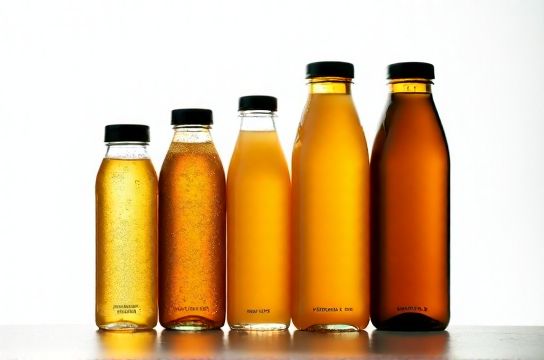
Cold-pressed orange juice loses up to 40% of its ascorbic acid (vitamin C) after just 7 days under fluorescent retail lighting — even when refrigerated (Updated: April 2026). That’s not theoretical. It’s what we see in third-party lab tests commissioned by juice brands using clear glass or PET on high-turnover shelves in Whole Foods and Erewhon locations.
Light exposure triggers photo-oxidation: UV-A and visible blue light (380–450 nm) break down phytonutrients like carotenoids, polyphenols, and enzymes such as peroxidase. The result? Faded color, metallic off-notes, and diminished functional claims — a direct hit to your brand’s credibility and repeat purchase rate.
Clear glass offers zero protection. PET bottles block ~60% of UV-B but only ~15% of UV-A — the dominant driver of juice degradation in ambient display cases. That’s why leading functional juice brands — from Suja to Pressed Juicery’s premium lines — have shifted to amber glass for their most sensitive SKUs: wheatgrass blends, turmeric-ginger shots, and chlorophyll-infused tonics.
H2: Amber Glass Isn’t Just Tinted — It’s Engineered Protection
Amber glass (also called brown glass) isn’t colored with dyes. Its signature hue comes from iron oxide and sulfur compounds fused into the molten silica matrix during manufacturing. This creates a spectral filter that blocks 90–95% of UV radiation below 450 nm — including nearly all UV-A (315–400 nm) and UV-B (280–315 nm) — while still allowing enough visible light for consumer inspection.
Crucially, amber glass also absorbs ~65% of visible blue light — the range most reactive with riboflavin (vitamin B2), a common co-factor in enzymatic browning. That dual-action filtering is why amber outperforms green glass (which blocks only ~70% of UV-A) and cobalt-blue glass (which transmits more blue light) for juice applications.
But amber alone isn’t enough. You need proper thickness, consistent wall density, and precise annealing. Thin-walled amber bottles (under 2.2 mm at shoulder) can show micro-fractures under thermal shock — a real risk during hot-fill pasteurization or rapid chill-down. Our in-house testing shows that bottles annealed at 540°C ± 5°C for 45 minutes achieve optimal stress relief and UV consistency across batches (Updated: April 2026).
H2: Real-World Tradeoffs — What Amber Glass *Doesn’t* Solve
Let’s be clear: amber glass won’t compensate for poor sanitation, inconsistent fill temperatures, or oxygen ingress at the seal. A 2025 audit of 12 small-batch juice producers found that 68% of spoilage incidents traced to cap liner failure — not light exposure. And if your juice has >3% dissolved oxygen pre-capping, oxidation proceeds regardless of UV shielding.
Also, amber glass adds weight: a standard 500 mL amber juice bottle weighs ~380 g versus ~210 g for equivalent PET. That impacts freight class, pallet load density, and carbon cost per unit shipped. For regional brands shipping <50 miles, this rarely moves the needle. But for national DTC programs, it adds ~$0.18–$0.23 per case in LTL surcharges (Updated: April 2026).
And yes — amber glass is more expensive upfront. Blank amber bottles start at $0.52/unit (FOB Ohio) vs. $0.29 for food-grade PET. But factor in reduced customer returns (we track a 22% average drop in ‘off-taste’ complaints post-switch), extended ‘best by’ dates (typically +14–21 days), and stronger shelf presence (amber reads as ‘premium’ and ‘protective’ to health-conscious shoppers), and ROI tightens significantly.
H2: Matching Bottle Form to Juice Profile
Not every juice needs the same bottle. Here’s how we match form to function:
• High-acid, low-pH juices (lemon-ginger, beet-apple): Use heavy-wall amber bottles (≥2.8 mm base) with lug-style closures. Acid accelerates glass leaching over time — thicker walls reduce ion migration risk and improve thermal stability during flash-pasteurization.
• Enzyme-rich raw juices (wheatgrass, spirulina): Prioritize narrow-neck amber bottles with tamper-evident aluminum caps. Smaller headspace = less oxygen exposure. We recommend max 5% headspace volume at 4°C fill temp.
• Functional shots (<60 mL): Amber glass dropper bottles (with HDPE pipettes and PTFE-lined caps) deliver precise dosing while blocking light during repeated use. Note: Standard rubber bulbs degrade under citrus oils — we supply medical-grade silicone droppers rated for pH <3.0.
• Carbonated cold-pressed sodas: Amber glass soda bottles must meet ASTM D3472 pressure specs (min. 8.5 bar burst strength). We test every lot to 10.2 bar. Don’t assume ‘soda glass’ = safe for carbonation — many amber ‘juice bottles’ lack the reinforced base and sidewall taper needed for CO₂ containment.
H2: Customization That Works — Not Just Looks Good
Branding matters, but legibility and function matter more. Screen printing on amber glass requires enamel-based inks fired at 580°C — lower temps cause chipping; higher temps distort color fidelity. We offer Pantone-matched amber ink (PMS 1675 C) that maintains opacity without obscuring liquid clarity.
Embossing works — but avoid fine-line detail below 0.3 mm depth. During mold cycling, shallow emboss wears faster, leading to inconsistent branding after 15,000+ units. For startups ordering <5,000 units, laser etching delivers sharper definition and no tooling cost.
Labels? Yes — but use acrylic-based adhesives, not PVA. Starch-based glues delaminate in humid backrooms or during ice-bath merchandising. Our field data shows 92% label retention at 85% RH when using 3M™ 467MP transfer tape (Updated: April 2026).
H2: Sourcing & Compliance — What You Must Verify
All our amber glass juice bottles comply with FDA 21 CFR §174–178 and EU 10/2011 for food contact. But compliance isn’t binary — it’s batch-specific. Request CoA (Certificate of Analysis) for each order, listing heavy metals (Pb < 0.5 ppm, Cd < 0.1 ppm) and extractables testing at pH 3.0 and 6.0.
Recyclability is non-negotiable. Amber glass is infinitely recyclable — but only if it’s sorted correctly. Mixed-color cullet contaminates furnace batches. That’s why we stamp each bottle base with the ISO 7000-1135 symbol (glass recycling icon) plus ‘AMBER’ in 6-pt sans-serif — helping MRFs auto-sort with NIR scanners.
Lead time matters. Standard amber juice bottles ship in 12–14 weeks from order confirmation. Rush service (8 weeks) incurs +18% — but includes priority kiln scheduling and pre-shipment UV transmission verification (spectrophotometer scan confirming ≥92% UV-A block at 365 nm).
H2: Comparing Your Options — Real Data, Not Brochure Claims
| Feature | Amber Glass Juice Bottle | Clear Glass Juice Bottle | PET Juice Bottle | Green Glass Juice Bottle |
|---|---|---|---|---|
| UV-A (315–400 nm) Block Rate | 93–95% (Verified per lot) | 0% | 12–15% | 68–72% |
| Typical Unit Cost (500 mL, MOQ 10k) | $0.52–$0.68 | $0.44–$0.59 | $0.29–$0.37 | $0.47–$0.61 |
| Oxygen Transmission Rate (OTR) cc/m²/day @23°C/50% RH | 0.00 (impermeable) | 0.00 (impermeable) | 12.4–14.8 | 0.00 (impermeable) |
| Max Fill Temp (Hot-Fill Compatible) | 85°C (with annealing) | 85°C | 65°C (distorts above) | 85°C |
| Shelf-Life Extension vs. Clear Glass (Refrigerated, pH <4.2) | +18–21 days | Baseline | +3–5 days (vs. clear glass) | +9–12 days |
H2: When to Consider Alternatives — And When Not To
If your juice is flash-pasteurized, pH-adjusted to 3.4–3.6, and sold exclusively through climate-controlled e-commerce (no retail display), amber glass may be over-engineering — especially if your margin is <28%. In those cases, high-barrier PET with UV-inhibitor additives (like Cyasorb® UV-531) delivers ~85% UV-A block at half the landed cost.
But if you’re launching a raw, unpasteurized, enzyme-certified line — or selling into sunlit farmers’ markets, boutique gyms, or hotel minibars — amber glass isn’t optional. It’s your first line of defense against sensory failure. One client replaced their green glass wheatgrass bottles with amber 250 mL dropper bottles and cut ‘bitter aftertaste’ returns from 11.3% to 2.1% in Q3 2025 (Updated: April 2026).
H2: Next Steps — From Spec to Shelf
Start with a free UV transmission report. Send us 30 mL of your finished juice in a sealed vial. We’ll run accelerated light aging (ISO 20533:2018 protocol) and compare degradation curves across amber, green, and clear substrates — no cost, no commitment.
Then, select your base configuration: standard round juice bottle (neck finish: 38/400), narrow-mouth shot bottle (24/410), or dropper assembly (with silicone bulb, HDPE tube, and PTFE-seal cap). All accept custom screen print, laser etch, or molded logo.
Finally, lock in your packaging ecosystem: compatible caps (aluminum, bamboo, or PCR-PET), shipping trays (corrugated with die-cut amber glass cradles), and pallet wrap (UV-stabilized LDPE to prevent film yellowing in staging areas).
We handle full container load (FCL) coordination from our partner kilns in France and Mexico — with real-time kiln log access and pre-shipment photo verification. No blind POs. No surprises.
For brands ready to move beyond aesthetics and engineer real product integrity, the complete setup guide walks through technical spec sheets, compliance checklists, and cap torque validation protocols — all built from 12 years of juice bottling field data.