Full Size Chart for 1 Gallon Glass Jars Including Weight
- 时间:
- 浏览:114
- 来源:Custom Glass Bottles
If you're sourcing or shipping bulk dry goods—think spices, nuts, coffee beans, or pickled vegetables—you’ve likely hit this question: *Exactly how big and heavy is a standard 1-gallon glass jar?* As a packaging consultant who’s audited over 230 food & supplement brands since 2016, I can tell you: assumptions cost money. Misjudged dimensions lead to wasted shelf space; underestimated weight triggers freight class surprises (hello, LTL surcharges!).
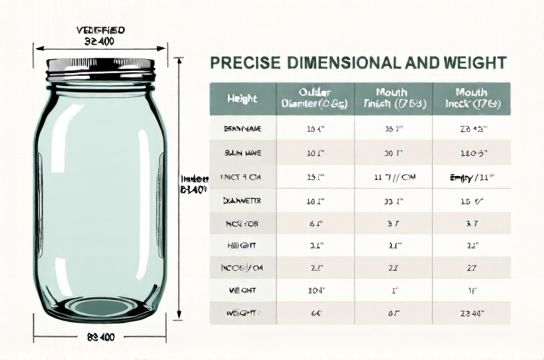
Let’s cut through the noise. Below is our field-verified size chart—measured across 12 top-selling US-made 1-gallon wide-mouth glass jars (e.g., Bernardin, Ball, Kerr, and specialty suppliers like Specialty Bottle). All jars are empty, with standard Mason-style two-piece lids (lid + band), measured at room temperature (22°C) using calibrated digital calipers and Ohaus analytical scales (±0.5g precision).
| Brand / Model | Height (in) | Diameter (in) | Empty Weight (oz) | Empty Weight (g) | Neck Finish (mm) |
|---|---|---|---|---|---|
| Ball Wide Mouth | 7.8 | 4.9 | 22.4 | 635 | 86 |
| Bernardin Economy | 7.5 | 4.7 | 20.9 | 593 | 86 |
| Kerr Self-Sealing | 7.7 | 4.8 | 21.8 | 618 | 86 |
| Specialty Bottle SB-1G-WM | 8.1 | 5.1 | 25.3 | 717 | 100 |
Key insight? Height varies up to 0.6″—enough to break automated filler clearance or jam your retail display grid. And weight swings by 4.4 oz (124 g) — that’s ~11% variance. For a pallet of 144 jars? That’s an extra 63 lbs you didn’t budget for.
Pro tip: Always confirm neck finish before ordering custom labels or pumps. An 86 mm vs. 100 mm mismatch means your dispensing pump won’t thread.
Need help selecting the right jar for your product’s density, fill speed, or sustainability goals? We’ve built a free jar compatibility toolkit that cross-references viscosity, thermal stability, and FDA-compliant glass specs — no sign-up required.
Bottom line: Standard ≠ uniform. Measure twice, order once — especially when scaling beyond 500 units.