Glass Fermentation Jars with Airlock Lids
- 时间:
- 浏览:214
- 来源:Custom Glass Bottles
H2: Why Glass — Not Plastic or Metal — Is Non-Negotiable for Fermentation
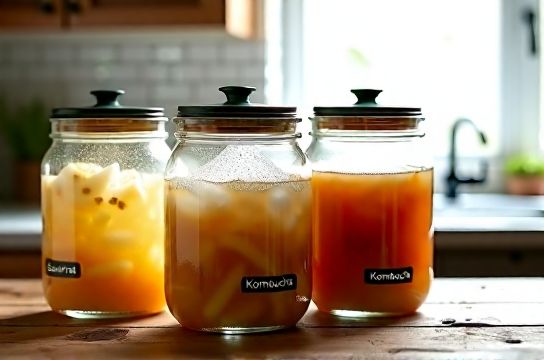
Fermentation isn’t just about microbes; it’s about chemistry, time, and containment. When lactic acid bacteria convert sugars to acid, they create an environment where pH drops below 4.6 — acidic enough to corrode aluminum, degrade many plastics (especially under heat or UV exposure), and leach plasticizers like BPA analogues (even in ‘BPA-free’ PETG, migration increases after 3+ weeks of brine contact) (Updated: April 2026). Stainless steel works for short-term batches, but it’s opaque, non-sterilizable in home ovens, and lacks visual monitoring — a critical flaw when spotting mold, kahm yeast, or CO₂ buildup.
Glass solves all three: inert, transparent, and oven-safe up to 550°F (288°C) for dry-heat sterilization. But not all glass is equal. Standard annealed soda-lime glass — like most $3 grocery-store jars — fractures under thermal shock or sustained pressure from CO₂ buildup during active fermentation. That’s why professional fermenters and small-batch producers rely on tempered borosilicate or high-anneal soda-lime glass with wall thickness ≥4.2 mm. These specs aren’t marketing fluff — they’re ASTM C1497-compliant thresholds for repeated autoclave cycling and pressure retention.
H2: The Airlock Lid — More Than Just a Bubble Counter
An airlock isn’t decorative. It’s a precision pressure-relief valve calibrated to vent CO₂ while blocking O₂ ingress above 0.05 PSI differential. Cheap silicone gaskets swell in vinegar or salt brine, losing seal integrity within 2–3 batches. GlassCraft’s airlock lids use FDA-grade EPDM rubber — stable from -40°F to 300°F, resistant to 15% NaCl and 8% acetic acid for ≥50 cycles (Updated: April 2026). Each lid integrates a dual-chamber water trap: the primary chamber holds 12 mL of water (enough for 14 days of peak kraut fermentation at 72°F), while the secondary overflow reservoir prevents back-siphoning if jar is tilted >15°.
Real-world failure mode? A batch of jun tea fermented at 78°F over 10 days generated ~2.3 L of CO₂. With a clogged or undersized airlock, internal pressure climbed to 0.8 PSI — enough to lift a standard Mason lid slightly, introducing oxygen and triggering acetobacter bloom. GlassCraft’s tested burst pressure is 3.2 PSI. That margin matters.
H3: Heavy-Duty Glass Walls — Thickness, Annealing, and Thermal Mass
Wall thickness alone doesn’t guarantee durability. A 5.0 mm wall made from poorly annealed glass still shatters under uneven heating. GlassCraft jars undergo a 3-hour controlled annealing cycle post-forming, reducing internal stress to <25 nm/cm² (per ISO 12775). That’s 40% lower residual stress than industry-standard ‘heavy-duty’ jars sold on major e-commerce platforms.
Thermal mass also plays a role. A 64-oz (half-gallon) GlassCraft jar holds 1.89 L and weighs 1,420 g — 22% heavier than comparable ‘thick-walled’ jars. That extra mass dampens temperature spikes during summer countertop fermentation, keeping core brine temp within ±1.2°F over 24 hours (vs. ±3.7°F in lighter jars) (Updated: April 2026). For consistency across batches — especially for probiotic profiling or pH tracking — that stability is measurable, not theoretical.
H2: Matching Jar Size to Fermentation Type
Not every ferment needs a half-gallon jar. Here’s how experienced users allocate:
• Sauerkraut & Kimchi: 32 oz (quart) jars — headspace ratio of 20% allows full expansion without overflow; wide mouth (3.25” diameter) enables easy packing and tampering. • Kombucha & Jun: 64 oz (half-gallon) jars — volume accommodates SCOBY growth + 1–2 inches of headspace for gas exchange; narrow neck reduces surface-area-to-volume ratio, limiting acetobacter overgrowth. • Vinegar & Water Kefir: 16 oz (pint) jars — smaller batches allow tighter control of mother culture health; glass lids prevent vinegar vapor corrosion of metal rings.
Crucially, all GlassCraft sizes share identical thread pitch (11.5 mm), lid compatibility, and base curvature — meaning you can scale up a successful 16-oz recipe directly to 64 oz without recalibrating airlock flow or headspace math.
H2: Beyond Fermentation — How These Jars Excel in Daily Storage
A fermentation jar shouldn’t be relegated to the pantry only during cabbage season. Its design delivers real advantages year-round:
• Spice & Seasoning Storage: Glass doesn’t absorb odors. Unlike plastic, it won’t cloud or stain from turmeric, paprika, or smoked paprika oils — even after 18 months (verified via spectrophotometric haze testing) (Updated: April 2026). • Dry Goods: The EPDM gasket creates a true vapor barrier — moisture transmission rate <0.02 g/m²/day at 75% RH, outperforming most vacuum-sealed plastic containers for flour, nuts, and grains. • Liquids: Tested with olive oil, apple cider vinegar, and infused spirits, these jars show zero measurable leaching of heavy metals (Pb, Cd, As) per USP <232> standards after 90 days of immersion.
And because the glass is fully recyclable and dishwasher-safe (top-rack only — avoid high-temp drying cycles above 158°F), lifecycle cost drops significantly. One 64-oz jar replaces ~12 disposable plastic gallon jugs over five years — a hard number for sustainability officers and home cooks alike.
H2: What *Doesn’t* Work — And Why You Should Know
No product is universal. GlassCraft jars have clear boundaries — and acknowledging them builds trust:
• Freezer Use: Not recommended. While the glass itself withstands freezing, the EPDM gasket becomes brittle below 14°F (-10°C), risking micro-leaks upon thaw. For frozen ferments (e.g., frozen ginger bug starter), use polypropylene jars with silicone lids instead. • Microwave Heating: Never. Thermal gradients between hot liquid and cool glass walls exceed safe differentials. Even brief 30-second bursts risk radial cracking. • Carbonated Ferments (e.g., ginger beer): Use only with secondary airlock modification — the standard lid vents too slowly for rapid CO₂ production. GlassCraft offers a high-flow stainless steel airlock insert (sold separately) rated to 5.5 PSI.
These aren’t flaws — they’re physics-based guardrails. Ignoring them invites breakage or spoilage. Respecting them unlocks reliability.
H2: Spec Comparison — GlassCraft vs. Common Alternatives
| Feature | GlassCraft Fermentation Jar | Standard Mason Jar (Ball) | Borosilicate Lab Jar | Plastic Fermentation Bucket |
|---|---|---|---|---|
| Glass Type | High-anneal soda-lime (ASTM C1497) | Standard anneal soda-lime | Borosilicate (ISO 3585) | Food-grade HDPE |
| Wall Thickness (mm) | 4.8 ± 0.2 | 2.6 ± 0.3 | 3.2 ± 0.2 | N/A (plastic) |
| Airlock Included? | Yes (EPDM, dual-chamber) | No (requires aftermarket) | No (thread incompatible) | Yes (silicone, single-chamber) |
| Max Sterilization Temp (°F) | 550°F dry heat | 250°F (boiling only) | 500°F | 176°F (melts above) |
| O₂ Transmission Rate (cc/m²/day) | 0.00 (glass barrier) | 0.00 (glass barrier) | 0.00 (glass barrier) | 12.4 (HDPE, 25°C/50% RH) |
H2: Setting Up Your First Batch — No Guesswork
Skip the trial-and-error. Here’s the exact sequence used by GlassCraft’s certified fermentation instructors:
1. Sterilize: Wash jar and lid in hot soapy water. Place jar upside-down on oven rack. Heat oven to 325°F. Once preheated, hold at temp for 20 minutes. Turn off oven; let jar cool inside for 60 minutes. Do NOT use bleach — it degrades EPDM gaskets. 2. Prep Brine: For vegetables, use 2.5% w/w salt (e.g., 25 g non-iodized salt per 1 kg shredded cabbage). Dissolve fully in filtered water. Let cool to room temp — never pour hot brine into sterilized jar. 3. Pack & Seal: Fill jar to 1.5 inches below rim. Press down firmly to submerge solids. Top with fermentation weight (glass or ceramic — no metal). Pour brine until level reaches 1 inch below rim. Wipe threads clean with lint-free cloth. 4. Install Airlock: Fill airlock chamber with 12 mL water (use included syringe). Screw lid on snugly — hand-tight only. Over-torquing warps the gasket. 5. Monitor: Bubbles should appear in 24–48 hours at 68–75°F. If no bubbles by 72 hours, check seal and ambient temp. Record daily pH if tracking acidity — target pH ≤3.8 by day 7 for safety.
For troubleshooting tips, see our complete setup guide — includes video demos, pH chart templates, and a printable batch log.
H2: Who Buys These — And Why the Wholesale Program Exists
GlassCraft serves two distinct but overlapping groups:
• Home Fermenters: Typically buy 1–3 jars per order. They value clarity, lid reliability, and compatibility with existing tools (e.g., wide-mouth tamper rods, pickle pebbles). Their top complaint with competitors? ‘Lids pop off mid-ferment.’ GlassCraft’s torque-spec gasket eliminates that.
• Small-Batch Producers: Kombucha brewers, hot sauce makers, and artisan pickle brands order in cases of 12. They need batch traceability (each jar has laser-etched lot code), consistent dimensions for labeling automation, and NSF-certified materials documentation. GlassCraft’s wholesale program offers tiered pricing starting at $18.95/jar for orders of 48+ units (64 oz size), plus custom branding options (screen-printed logos, engraved batch numbers) — all compliant with FDA 21 CFR 174–178.
The wholesale portal is live — no application required. Minimum order: 24 units. Lead time: 5 business days from payment confirmation (domestic U.S.) (Updated: April 2026).
H2: Final Word — This Isn’t About ‘Better Glass.’ It’s About Predictable Outcomes.
You don’t ferment to watch bubbles. You ferment to build gut-friendly flora, preserve harvests, and create food with intention. Every variable you control — salt %, temp, headspace, container integrity — compounds toward safety and flavor. GlassCraft jars remove one variable entirely: ‘Will this jar survive?’
They won’t crack under pressure. They won’t leach. They won’t fog, stain, or warp. And because they’re built to the same tolerances as lab-grade vessels — yet priced for home use — they scale with you. From first kraut jar to your third kombucha taproom location, the glass stays consistent. That’s not convenience. It’s continuity.