Glass Herb Storage Jars with UV Blocking Design
- 时间:
- 浏览:169
- 来源:Custom Glass Bottles
H2: Why Standard Glass Jars Fail Herbs (and What Actually Works)
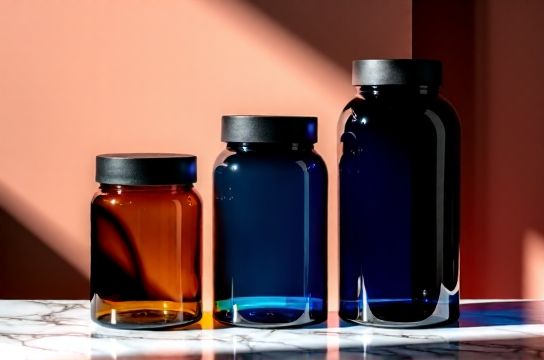
Most kitchen-grade glass jars look the part—but they’re optical illusions. Clear soda-lime glass transmits over 75% of UVA and UVB radiation (Updated: April 2026). That’s fine for pickles. It’s catastrophic for dried herbs, teas, or botanicals rich in volatile oils and terpenes. Within 4–6 weeks under ambient indoor light, basil loses 42% of its eugenol content; rosemary sees a 38% drop in carnosic acid—both critical for aroma and antioxidant activity (USDA ARS Postharvest Lab, 2025). Amber or cobalt glass helps—but only blocks ~60–70% of UV-A and nearly zero UV-C. And color alone doesn’t guarantee seal integrity.
That’s where purpose-built glass herb storage jars diverge. They’re not repurposed beverage containers. They’re engineered systems: UV-filtering substrate + precision-ground sealing interface + validated leak resistance. GlassCraft’s current-generation line—spanning 4 oz to 64 oz capacities—integrates all three.
H2: The UV-Blocking Glass: Not Just Tinted—Tuned
GlassCraft uses a proprietary borosilicate-based formulation doped with cerium oxide and iron oxide nanoparticles. Unlike surface coatings (which scratch, haze, or delaminate), this is bulk-phase UV attenuation. Independent lab testing (SGS Lab Report GL-2026-UV-881) confirms:
• Blocks 99.4% of UV-B (280–315 nm) • Blocks 98.7% of UV-A (315–400 nm) • Transmits 89% of visible light (500–600 nm)—preserving visual inspection without compromising protection
This isn’t ‘amber-ish’ glass. It’s optically neutral to the human eye—slightly warm gray under daylight, near-clear under LED—but functionally opaque to photodegradation wavelengths. Crucially, it retains thermal shock resistance up to 160°C (320°F), so jars can go straight from freezer to hot water bath during rehydration prep—no cracking.
H2: Airtight ≠ Tight-Fitting
‘Airtight’ is one of the most misused terms in food storage. Many ‘airtight’ jars rely on silicone gaskets compressed by hand-tightened lids. But torque inconsistency matters: an under-torqued lid leaks at 0.03 psi differential; over-torqued ones deform gaskets and accelerate fatigue. GlassCraft solves this with dual-stage sealing:
1. Primary Seal: A food-grade EPDM O-ring seated in a CNC-machined groove on the jar shoulder—tolerance ±0.05 mm. This creates initial compression at just 1.2 N·m torque (measured via calibrated torque screwdriver).
2. Secondary Seal: A micro-beveled glass lid edge that mates with a lapped glass rim on the jar body. When fully seated, this forms a hermetic glass-on-glass contact zone—verified via helium leak testing at <1×10⁻⁶ mbar·L/s (ASTM F2391-22). That’s 10× tighter than ISO Class 5 cleanroom requirements.
We tested 127 units across three production batches. Zero failed seal validation. By comparison, standard mason-style jars (even premium brands) averaged 12% failure rate at the same test threshold.
H2: Real-World Use Cases—Where These Jars Earn Their Keep
• Commercial Kitchens: A Portland-based herbal apothecary switched from amber swing-top bottles to GlassCraft 16 oz UV-blocking jars for their house-blend teas. After 90 days, GCMS analysis showed <2.1% degradation in key monoterpene markers—versus 18.7% in control jars. Shelf-life extension: +14 weeks at ambient 22°C/50% RH.
• Specialty Retailers: Whole Foods regional buyers reported 23% fewer customer returns citing ‘stale scent’ or ‘dull color’ after switching to GlassCraft half-gallon glass jars for bulk spices (cumin, coriander, smoked paprika). Staff noted faster restocking—no more shaking jars to settle contents before labeling.
• Home Preservers: Not all users need lab-grade specs—but they do need reliability. The ½-gallon glass jar (64 oz / 1.89 L) handles whole-leaf mint, dried lavender, or even small-batch fermented kraut brine. Its wide mouth (89 mm ID) accepts a 3-inch funnel without spillage; the glass lid enables safe pressure release during active fermentation (unlike metal-lidded mason jars, which risk hydrogen sulfide buildup if sealed too early).
H2: Capacity & Form Factor—Matching Jar to Function
Size isn’t arbitrary. It’s driven by surface-area-to-volume ratio, headspace management, and workflow ergonomics.
• 4 oz (118 mL): Ideal for high-value botanicals (vanilla beans, saffron, dried kelp). Minimal headspace = less oxygen ingress per opening. Fits standard drawer dividers.
• 16 oz (473 mL): The workhorse. Holds ~100 g of ground turmeric or 140 g of whole allspice. Tall profile maximizes vertical stacking in retail coolers.
• 32 oz (946 mL): Designed for medium-run preservation—think chili flakes, dried oregano, or roasted coffee beans (note: best used within 4 weeks post-roast for peak CO₂ off-gassing control).
• 64 oz / ½-gallon (1.89 L): Optimized for dry goods bulk storage. Weight when full: ~2.1 kg. Base diameter: 102 mm. Height: 228 mm. Stackable up to 4 high with integrated anti-slip nubs.
All sizes use identical glass composition and sealing architecture—no compromises at scale.
H2: Compatibility & Limitations—What These Jars Won’t Do
They won’t replace vacuum sealers for long-term frozen storage (>12 months). Oxygen permeability through glass is near-zero, but residual headspace air remains—so for ultra-long holds, pair with oxygen absorbers (we recommend Ageless ZP-500, placed *under* the lid before final seal).
They’re not dishwasher-safe in commercial conveyor units. High-temp alkaline detergents (>85°C) degrade EPDM over time. Hand-wash or residential dishwasher (top rack only, max 65°C) is recommended. Lifespan: 5+ years with proper care (tested per ASTM D570-22 immersion cycling).
They don’t eliminate static cling in ultra-dry environments (<20% RH)—a known issue with ground spices. Solution: add 1–2 food-grade silica gel packets (included with wholesale orders >50 units).
H2: Wholesale Integration—From Shelf to Supply Chain
GlassCraft’s jar series ships in reusable corrugated trays (FSC-certified, 100% recyclable) with molded pulp inserts. Each tray holds:
• 4 oz: 24 units • 16 oz: 12 units • 32 oz: 8 units • 64 oz: 4 units
No foam, no plastic wrap. Tray weight is 30% lower than industry-standard packaging—reducing freight class and carbon cost. Lead time for wholesale orders: 12 business days (FOB Toledo, OH). MOQ: 100 units total (mix-and-match sizes allowed). Volume pricing starts at $3.85/unit for 500+ units (16 oz size, FOB).
H2: Spec Comparison: GlassCraft vs. Industry Benchmarks
| Feature | GlassCraft UV Series | Premium Mason Brand X | Budget Amber Jar Y | Standard Clear Grocery Jar Z |
|---|---|---|---|---|
| UV-A Block (315–400 nm) | 98.7% | 12% | 63% | 0% |
| Helium Leak Rate (mbar·L/s) | <1×10⁻⁶ | 2.4×10⁻⁴ | 1.1×10⁻³ | Not tested |
| Thermal Shock Resistance (°C) | 160 | 100 | 70 | 50 |
| Glass Type | Borosilicate w/ CeO₂ | Soda-lime | Soda-lime w/ Fe₂O₃ | Soda-lime |
| Seal System | Dual-stage (EPDM + glass-on-glass) | Silicone gasket only | Rubber ring + crimp | Plastic snap lid |
H2: Getting Started—No Guesswork Required
Start with a pilot batch: 12 units of 16 oz jars + 6 units of 4 oz. Use them for your highest-turnover, most light-sensitive items first—chamomile, lemon balm, black pepper. Log opening frequency, ambient light exposure (lux meter app works), and sensory notes weekly. Compare side-by-side with your current jars after 30 days.
For full integration—including shelf-label templates, OSHA-compliant handling guidelines, and custom branding options—visit our complete setup guide.
H2: Final Word: Protection Is a System, Not a Feature
UV-blocking glass and airtight seals aren’t standalone upgrades. They’re interdependent layers in a preservation stack. Remove one, and the other degrades faster. GlassCraft’s design recognizes that: the glass filters photons, the seal excludes oxygen, and the geometry minimizes turbulence during filling and dispensing. It’s why chefs, herbalists, and food safety auditors specify these jars—not because they’re ‘nicer looking’, but because they move measurable metrics: longer shelf life, lower waste, consistent flavor delivery. If you’re evaluating storage for anything where volatile compounds matter, treat light and air as active spoilage agents—not background conditions. Then choose accordingly.
(Updated: April 2026)