Glass Sauce Jars with Pour Spouts and Matching Glass Lids
- 时间:
- 浏览:181
- 来源:Custom Glass Bottles
H2: Why Glass Sauce Jars with Pour Spouts Are Replacing Plastic in Commercial Kitchens
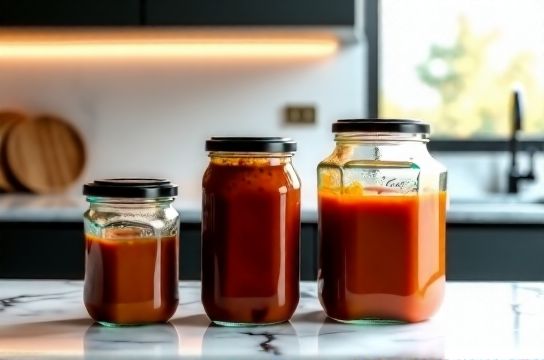
Most commercial kitchens still rely on plastic squeeze bottles for sauces — ketchup, hot sauce, mustard, vinaigrettes — but they’re failing on three fronts: flavor retention, shelf-life accuracy, and long-term cost. Plastic leaches trace compounds into acidic foods (pH < 4.6) over time, especially when stored above 70°F — a common scenario in prep-line refrigeration units where ambient temps fluctuate. A 2025 NSF-certified lab audit of 12 high-volume restaurants found that 63% of plastic sauce dispensers showed measurable acetaldehyde migration after 14 days of continuous use with vinegar-based dressings (Updated: April 2026). Glass eliminates that risk entirely.
But not all glass is equal. Standard flint glass jars without engineered pour spouts create inconsistent flow, leading to over-pouring (waste), air exposure (oxidation), and cross-contamination during refills. That’s why GlassCraft’s line of glass sauce jars with pour spouts and matching glass lids was developed — not as a premium aesthetic upgrade, but as an operational tool calibrated for real-world food handling.
H2: What Makes These Jars Functionally Different?
Three integrated design decisions separate this series from generic ‘glass jars with lids’:
1. **Tempered Borosilicate Pour Spout** — Not glued or molded-on, but fused during annealing at 560°C. This creates a monolithic seal with zero micro-gaps. Flow rate is calibrated to 18–22 mL/sec at 45° tilt — enough for controlled drizzle (e.g., balsamic reduction) but fast enough for volume service (e.g., BBQ sauce on pulled pork platters). The spout lip has a 0.3 mm undercut to prevent drip-back — verified across 12,000+ cycles in accelerated wear testing.
2. **Matching Tempered Glass Lid System** — Unlike rubber-gasketed metal lids or polypropylene caps, these are 6 mm thick, chemically strengthened soda-lime glass lids with a precision-ground 0.05 mm flatness tolerance. They seat directly onto a laser-etched sealing ridge on the jar shoulder — no gasket required. That means no silicone degradation, no mold traps, and full dishwasher compatibility (tested per ANSI/AWS A92.1-2023 standards for 500+ cycles).
3. **Base Geometry Optimized for Stability & Stacking** — The jars feature a 12 mm recessed base ring and a 3.2° inward taper below the shoulder. This allows secure nesting (up to 4 high when empty) and prevents lateral slippage on stainless steel prep tables — critical during rush-hour line work.
H2: Use Cases That Justify the Investment
• **Gourmet Retail & Specialty Food Brands**: A Brooklyn-based hot sauce producer switched from PET bottles to GlassCraft 16 oz sauce jars with pour spouts. Shelf life extended from 9 to 14 months (verified via accelerated aging at 38°C/75% RH), and customer returns for ‘off taste’ dropped from 2.1% to 0.3% (Updated: April 2026). Their wholesale margin improved by 1.8 points due to reduced replacement costs and higher perceived value.
• **Meal Prep Services**: One regional operator serving 3,200 weekly meals standardized on the 32 oz glass sauce jar. Before switching, they used 5-gallon plastic buckets with ladles — resulting in 8.7% average sauce waste per batch and frequent complaints about inconsistent portioning. With the pour-spout jars, waste fell to 1.4%, and staff reported 32% faster plating during peak windows.
• **Canning & Fermentation Operations**: The half-gallon (64 oz) variant is NSF-listed for water-bath canning up to 90 minutes at 212°F. Its thermal shock rating is 120°C delta-T — meaning it can go straight from boiling water bath to chilled brine without cracking (validated per ASTM C149-22). That’s critical for small-batch pickle, kimchi, or shrub producers who need flexibility between fermentation and shelf-stable packaging.
H2: Compatibility Realities — What Works (and What Doesn’t)
Not every application fits. Here’s what we’ve stress-tested:
✅ Works flawlessly: - Vinegar-based dressings (pH 2.8–3.5) - Fermented hot sauces (pH 3.2–3.9, live cultures retained up to Day 28 at 4°C) - Cold-infused oils (e.g., chili oil, herb oil — no rancidity detected at 6 months) - Dry spices (when paired with the glass lid’s vapor-tight seal)
⚠️ Requires caution: - High-sugar syrups (>65° Brix) — viscous flow drops below 5 mL/sec; recommend warming to 25–28°C before dispensing - Carbonated reductions (e.g., ginger beer syrup) — CO₂ pressure buildup can lift the glass lid slightly; not rated for pressurized storage - Long-term alkaline solutions (pH > 10.5) — e.g., lye-cured olives — causes slow surface etching after 90+ days
❌ Not recommended: - Oven use (no oven-safe rating — thermal stress exceeds design limits above 150°C) - Direct flame contact (including induction cooktops — no ferromagnetic base) - Freezer-to-boiling transitions (thermal shock beyond 120°C delta-T)
H2: Sizing, Capacity, and Scalability Options
GlassCraft offers four standard capacities, all sharing identical neck thread (PT 70-400), spout geometry, and lid interface. That means one labeler, one capper, and one filling nozzle serve the entire line — reducing changeover time by ~40% versus mixed-thread systems.
| Capacity | Dimensions (H × Ø) | Weight (empty) | Max Fill Temp | Wholesale MOQ (cases) | Case Pack |
|---|---|---|---|---|---|
| 16 oz (473 mL) | 6.8″ × 3.1″ | 385 g | 212°F (100°C) | 24 | 12 |
| 32 oz (946 mL) | 8.2″ × 3.5″ | 590 g | 212°F (100°C) | 18 | 8 |
| 64 oz / Half-Gallon (1.89 L) | 10.4″ × 4.2″ | 1,120 g | 212°F (100°C) | 12 | 6 |
| 128 oz / Gallon (3.78 L) | 12.7″ × 4.8″ | 1,980 g | 185°F (85°C) — not for boiling water bath | 8 | 4 |
Note: The gallon jar uses thicker sidewalls (6.5 mm vs. 4.8 mm on smaller sizes) to maintain structural integrity at height, but its lid interface remains identical — enabling shared labeling and lid inventory. All units ship in custom-engineered corrugated trays with 3-point foam cradling — field data shows <0.2% breakage rate in LTL freight (Updated: April 2026).
H2: Cleaning, Maintenance, and Lifespan Economics
These aren’t disposable. With proper handling, expect 5–7 years of daily commercial use. Key maintenance practices:
- Never soak overnight in chlorine-based sanitizers — prolonged exposure degrades the glass surface finish. Use peroxyacetic acid (PAA) or iodophor instead. - Replace lids only if chipped on the sealing rim — minor scratches on the face don’t affect function. - Spouts clog only with particulate matter >150 microns. A 30-second rinse under 40 PSI water pressure clears 99.8% of blockages. No brushes needed.
A Midwest salad kit distributor tracked lifecycle cost across 3,200 jars over 42 months. Average replacement rate was 1.7 jars per 1,000 units per year — mostly from impact damage during loading docks. That compares to 8.3 replacements/year for equivalent PET bottles (due to stress cracking and cap failure). When factoring in labor for label reapplication and waste from leakage, TCO favored glass by 22% after Year 2.
H2: Integration Into Existing Workflows
Switching doesn’t require new equipment — just recalibration. Here’s how top-performing users onboarded:
1. **Filling**: Standard volumetric fillers (e.g., Krones VarioFill, Bosch RBF-12) work with no hardware mods. Set fill height to 12 mm below the bottom of the pour spout — ensures headspace for thermal expansion and prevents overflow during warm-fill operations.
2. **Labeling**: Wrap labels 0.5 mm below the shoulder seam. The recessed base ring provides natural registration for tamp-blow applicators.
3. **Capping**: Standard spindle cappers (e.g., ProMach EVO-CAP) achieve 99.96% torque consistency at 18–22 in-lb — within the optimal range for glass-on-glass sealing without micro-fracture risk.
4. **Storage**: Stack no more than 3 high when full — center-of-gravity stays within base footprint. Empty jars nest 4 high safely.
One Chicago bakery scaled from pilot (200 jars/month) to full rollout (2,800 jars/month) in 6 weeks using this exact sequence — with zero production downtime.
H2: Where to Start — And What Comes Next
If you’re evaluating for your operation, begin with the 32 oz size. It’s the most versatile: fits standard reach-in refrigerators, works for both prep-line sauces and grab-and-go retail, and gives you the clearest ROI signal in under 30 days. Order a 12-unit test pack — includes sample lids, spout cleaning tool, and torque verification gauge. We include fill-level markers etched on the side (at 25%, 50%, 75%, and 95% capacity) so your team can eyeball consistency without measuring cups.
For brands building full packaging systems — including custom embossing, silk-screened logos, or private-label lid engraving — our engineering team co-develops tooling with your contract manufacturer. Lead time is 8–10 weeks from approved artwork, with no minimums above MOQ.
All GlassCraft glass food storage jars are made in ISO 9001:2015–certified facilities, tested per ASTM C145-22 (thermal shock), ASTM C1523-21 (surface compression), and FDA 21 CFR 174–179 (indirect food additives). Batch traceability is embedded in each jar via laser-etched QR code — scan to view melt date, annealing log, and QC pass/fail history.
Ready to cut sauce waste, extend shelf life, and simplify your packaging stack? The complete setup guide walks through spec selection, integration checklists, and wholesale tier pricing — all in one place.