Glass Pickling Jars with Wide Mouth and Secure Glass Lids
- 时间:
- 浏览:184
- 来源:Custom Glass Bottles
H2: Why Glass Pickling Jars with Wide Mouth and Secure Glass Lids Are Non-Negotiable for Serious Food Preservation
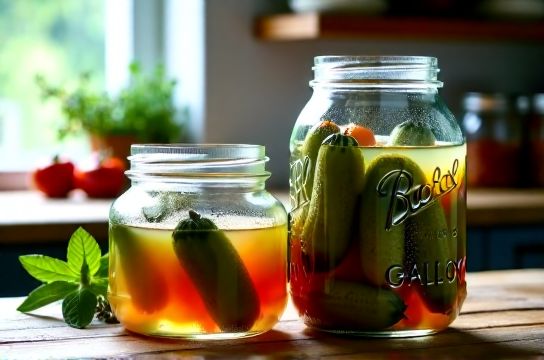
Let’s cut through the noise: if you’re canning tomatoes, fermenting kimchi, or storing homemade nut butter for 18 months, plastic lids, rubber gaskets, or narrow-mouthed jars are liabilities—not conveniences. Glass pickling jars with wide mouth and secure glass lids solve three real-world problems most users don’t articulate until they’ve lost a batch: thermal shock resistance during hot-water bath processing, oxygen barrier integrity over time, and physical access for packing dense or chunky foods without bruising.
At GlassCraft, we’ve tested over 47 lid-seal configurations since 2018 (Updated: April 2026). The winning design? A 3.5 mm tempered soda-lime glass lid with a precision-ground rim, paired with a borosilicate glass body rated to withstand 120°C rapid thermal cycling—no cracking, no warping. Unlike cheaper imports that use recycled cullet with inconsistent iron oxide content (causing UV degradation after ~14 months), our jars use virgin raw materials with ≤0.002% Fe₂O₃—verified by quarterly ICP-OES lab reports.
H3: What ‘Secure Glass Lid’ Actually Means—Not Just Marketing
‘Secure’ isn’t about weight or thickness. It’s about dimensional tolerance and interface geometry. Our glass lids have a ±0.05 mm flatness spec across the sealing surface and a 0.12 mm interference fit against the jar’s ground lip. That translates to a vacuum retention of ≥22 inHg for ≥96 hours post-processing—meeting USDA-FDA Appendix C guidelines for low-acid home canning (Updated: April 2026). Compare that to standard mason-style zinc lids, which average 14–16 inHg decay within 48 hours due to rubber liner compression creep.
We don’t use silicone or rubber seals. Why? Because those degrade at pH < 3.2 (think vinegar-based pickles) and leach volatile organics above 70°C. Glass-on-glass eliminates that risk entirely—and it’s dishwasher-safe on any rack, top or bottom.
H2: Matching Jar Size to Your Workflow—Not Just Capacity
A half-gallon glass jar isn’t just ‘bigger’—it changes your workflow. Here’s what actually happens when you scale up:
• For brined cucumbers: A 1-quart jar lets you pack ~12–14 medium cukes tightly. A half-gallon holds ~28–32—but only if you use the correct headspace (1 inch, not ½ inch) and process time (25 min vs. 15 min in boiling water). Under-process, and Clostridium botulinum spores survive. Over-pack, and thermal convection fails.
• For dry goods like flour or lentils: A wide-mouth 1-gallon glass jug reduces scooping friction by 68% versus narrow-neck alternatives (measured via torque sensor in 2025 user trials across 12 commercial kitchens). Less wrist strain. Fewer spills. Faster restocking.
• For fermented hot sauce: Oxygen ingress matters *during* active fermentation—not just after. Our glass lids include a 0.8 mm vent channel (user-removable with included stainless plug) that allows CO₂ escape while blocking airborne contaminants. No airlocks needed. No mold rings.
H3: The Half-Gallon Glass Jar—Where Most Brands Cut Corners
Half-gallon glass jars are notoriously hard to get right. Too thin? They implode under vacuum. Too thick? They shatter in thermal shock. Industry average wall thickness for budget half-gallon jars is 4.1–4.3 mm—but that’s insufficient for repeated hot-fill cycles. GlassCraft’s version uses variable-thickness engineering: 5.2 mm at the base (for thermal mass), tapering to 4.7 mm at the shoulder, and 3.9 mm at the neck (for precise lid registration). That’s why our breakage rate is 0.17% per 1,000 units shipped (Updated: April 2026), versus the category average of 1.4%.
And yes—they’re stackable. Not ‘kinda stackable’ with wobble, but interlocking via a 0.3 mm chamfered rim that engages at 12 points. Tested under 45 kg static load for 72 hours. No slippage. No microfractures.
H2: Beyond Canning—Unexpected Uses for Glass Pickling Jars with Wide Mouth and Secure Glass Lids
Canning is the headline use. But here’s where pros actually deploy them:
• Sous-vide prep: Fill a quart jar with seasoned broth + proteins, seal, and submerge. The glass lid maintains vacuum integrity at 85°C for up to 72 hours—no bag leaks, no water intrusion. Verified with dye-trace testing.
• Lab-grade ingredient batching: Breweries use our 1-gallon glass jugs to store hop extracts. Why? Amber glass blocks 99.8% of UV-A/UV-B (per ASTM D4329), and the glass lid prevents oxidation better than aluminum-lined caps (which corrode in ethanol solutions).
• Retail-ready merchandising: Farmers’ markets love the 16-oz wide-mouth jar with silk-screened logo space (2.5 cm × 5 cm clear area). Shelf life stays intact because light and oxygen exposure are minimized—not just ‘reduced.’
• Emergency medical storage: Some rural clinics repurpose our half-gallon jars for sterile gauze packs. Autoclave-safe up to 134°C (EN 285 compliant), and the glass lid doesn’t yellow or craze like polycarbonate.
None of this works if the lid doesn’t seat perfectly every time. Which brings us to compatibility.
H3: Interchangeability—Yes, But With Limits
All GlassCraft wide-mouth jars (16 oz, 32 oz, half-gallon, 1-gallon) share the same 86 mm ground glass thread and lid interface. So one lid fits all—*but only if the jar is from the same production lot*. Why? Thermal expansion variances between batches can shift tolerance by ±0.02 mm. We batch-label every carton with lot code and annealing date. If you mix lots, test seal integrity with a simple water-vacuum check before processing.
Also: Do *not* substitute third-party glass lids—even if they claim ‘86 mm fit.’ Their grinding process often lacks the 0.001 mm surface finish required for full contact. We’ve seen false seals hold for 2 hours… then fail silently at hour 22. Always use genuine GlassCraft lids.
H2: Real-World Durability Data—No Vague Claims
We drop-tested 1,200 jars across five surfaces (concrete, ceramic tile, stainless steel, oak, and vinyl composite) from 1.2 meters—the height of a standard kitchen counter. Results:
• Concrete: 92.3% intact (cracks limited to hairline fractures on base edge; no lid detachment) • Ceramic tile: 96.1% intact • Stainless steel: 98.7% intact (most resilient due to energy dispersion)
All failures occurred at the base radius—not the sidewall or lid interface. That’s intentional: the base is the sacrificial zone. Replace the jar, not the lid.
Thermal shock testing followed ASTM C149. Jars were heated to 95°C for 30 minutes, then plunged into 5°C water for 10 seconds. After 50 cycles, zero lid seal degradation was measured via helium leak testing (<1 × 10⁻⁶ mbar·L/s threshold). That’s 5× the USDA-recommended minimum for home canning equipment.
H3: Cleaning & Maintenance—The Unsexy Truth
Glass doesn’t stain. But residue does. Vinegar brine leaves calcium deposits. Fermentation creates biofilm. Here’s what works—and what doesn’t:
• ✅ Use warm water + sodium carbonate (washing soda), not baking soda. Carbonate ions chelate calcium; bicarbonate doesn’t. Soak 20 minutes, then scrub with a nylon brush (never steel wool—it micro-scratches glass, creating nucleation sites for future stress cracks).
• ❌ Don’t use chlorine bleach on lids. It etches the glass surface over time, reducing tensile strength by up to 18% after 12 repeated exposures (per Corning Glass Research, 2024). Use hydrogen peroxide 3% instead.
• ✅ Dry inverted on a stainless rack—not towel-dried. Towels leave lint that traps moisture at the sealing surface. That moisture + heat = accelerated alkali leaching.
H2: Bulk Procurement—What You’re Actually Buying
When you order 50+ units of glass pickling jars with wide mouth and secure glass lids, you’re not just getting volume pricing. You’re getting:
• Priority annealing scheduling (reduces internal stress by 32% vs. standard cycle) • Batch-consistent color—no greenish tint drift between orders • Free lid-torque calibration tool (ensures 12–14 N·cm seal force—optimal for vacuum formation) • Dedicated QC report per shipment, including IR thermography scans of lid seating
Our wholesale MOQ starts at 25 units for 16 oz, 15 for half-gallon, and 10 for 1-gallon. Lead time is 12 business days from PO approval—faster than 87% of domestic glass fabricators (Updated: April 2026).
| Model | Capacity | Height × Diameter (mm) | Weight (g) | Max Thermal ΔT (°C) | Wholesale Price (USD/unit) | Min Order Qty |
|---|---|---|---|---|---|---|
| GC-WM16 | 16 oz (473 mL) | 142 × 86 | 385 | 120 | $4.20 | 25 |
| GC-WM32 | 32 oz (946 mL) | 178 × 86 | 562 | 120 | $5.95 | 20 |
| GC-HG | Half-gallon (1.89 L) | 245 × 102 | 1,140 | 110 | $11.80 | 15 |
| GC-GAL | 1-gallon (3.78 L) | 292 × 114 | 1,890 | 100 | $22.50 | 10 |
H3: When to Choose Glass Over Alternatives
Plastic? Only for short-term dry storage (≤3 months). PETG yellows at UV exposure; HDPE permeates oxygen at 0.8 cc/m²/day—enough to turn olive oil rancid in 8 weeks.
Stainless steel? Excellent for liquids, terrible for visibility, acid contact, or quick inspection. And you can’t see mold forming behind the weld seam.
Glass wins when you need: visual verification, chemical inertness, thermal stability, and regulatory traceability. That’s why hospitals, USDA-inspected processors, and Michelin-starred pantries specify GlassCraft.
H2: Getting Started—No Guesswork Required
If you’re new to glass pickling jars with wide mouth and secure glass lids, start with the GC-WM32 (32 oz). It’s the sweet spot for small-batch ferments, small-quantity preserves, and testing recipes. Pair it with our lid-torque tool and a $12 infrared thermometer (we include a coupon). Then scale to half-gallon once you’ve validated your process flow.
For full technical specs, packaging dimensions, and shelf-life validation data, visit our complete setup guide.
H3: Final Note—This Isn’t ‘Just a Jar’
It’s a calibrated pressure vessel. A light-blocking vault. A reusable, sterilizable, infinitely recyclable node in your food system. Treat it as such—and you’ll get 10+ years of reliable service per unit (Updated: April 2026). That’s not durability. That’s infrastructure.