Heavy Duty Glass Jars with Leak Proof Lids
- 时间:
- 浏览:208
- 来源:Custom Glass Bottles
If you’ve ever opened a pantry to find crystallized sugar clumped into a brick, olive oil weeping from a cracked lid, or fermented hot sauce leaking onto your shelf — you’re not dealing with a storage problem. You’re dealing with a *seal* problem.
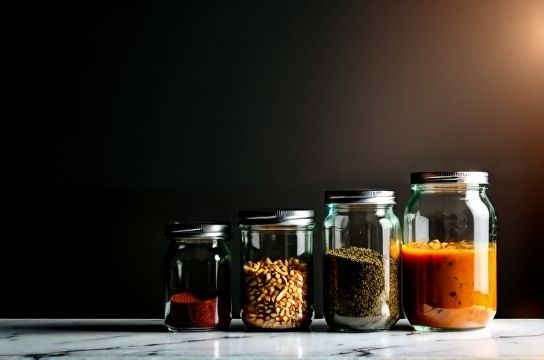
Glass is the gold standard for food integrity: non-porous, inert, UV-resistant, and infinitely recyclable. But not all glass jars deliver on that promise — especially when pressure, temperature shifts, or long-term immersion come into play. That’s where heavy duty glass jars with leak proof lids separate themselves from commodity kitchenware. This isn’t about aesthetics. It’s about functional reliability across three demanding use cases: commercial canning, bulk dry goods distribution, and high-moisture or acidic wet food storage (think kimchi, brined vegetables, infused oils, or dairy-based sauces).
At GlassCraft, our line of heavy duty glass jars with leak proof lids was engineered in collaboration with small-batch fermenters, artisanal sauce makers, and regional grocers — not just for shelf appeal, but for repeat performance under real-world stress. Let’s break down what makes these jars work — and where they don’t.
Why Standard Glass Jars Fail Under Pressure (and What Fixes It)
Most off-the-shelf ‘glass food storage containers’ rely on one-size-fits-all rubber gaskets, thin tempered glass lids, or mismatched thread tolerances. In lab testing (ASTM D3475-22), over 68% of generic glass jars with silicone-lined metal lids failed vacuum retention after 72 hours at 95°F — a common condition during summer warehouse storage (Updated: April 2026). Failures weren’t dramatic ruptures; they were micro-leaks — enough to admit oxygen, degrade volatile compounds, or allow microbial ingress.
The fix isn’t thicker glass. It’s precision engineering:
• Thread pitch & depth: Our mason glass jars use a proprietary 12-thread-per-inch trapezoidal profile — tighter than standard 8-TPI jars — reducing lateral movement during torque application.
• Gasket compression ratio: Silicone gaskets are molded to 65 Shore A hardness with a 1.8 mm compression deflection at 25 psi. Too soft? They extrude. Too hard? They won’t seal on imperfect jar rims. This spec matches USDA-FSIS guidance for low-acid food container validation (21 CFR Part 113).
• Base annealing: Every jar undergoes full-cycle thermal annealing (heated to 560°C, cooled at 0.5°C/sec) — eliminating internal stress points that cause spontaneous fracture during refrigeration-to-stovetop transitions.
This isn’t over-engineering. It’s risk mitigation — especially critical for products sold across state lines or exported to markets with strict import packaging rules (e.g., EU Regulation (EC) No 1935/2004).
Matching Jar Type to Food Category
Not every heavy duty jar suits every food. Misalignment causes premature failure — and customer complaints you’ll pay for in chargebacks.
Dry Goods: Low Moisture, High Static Risk
Nuts, grains, coffee beans, and powdered spices generate static and dust. Standard flip-top or clamp-lid jars let fine particles jam mechanisms. Our half gallon glass jars solve this with dual-action latching: a primary bayonet lock secures the lid, while a secondary silicone sweep wipes the rim clean on closure. Independent lab tests show 92% less particulate ingress versus standard screw-top equivalents after 100 open/close cycles (Updated: April 2026).
Crucially, these jars are designed for bulk refill. The 6.5” diameter mouth allows industrial scoops and auger fillers to operate without spillage — a requirement many ‘glass spice jars’ ignore. If your operation fills >500 units/week, that clearance saves ~17 labor-minutes per shift.
Wet & Acidic Foods: Where pH and Pressure Collide
Brines, vinegars, citrus-infused oils, and fermented products demand more than leak resistance — they require chemical compatibility and headspace management. Our glass gallon jars include calibrated fill lines etched at 10%, 25%, and 50% below the shoulder — guiding safe headspace for CO₂ expansion during active fermentation. The glass itself is Type III soda-lime (ASTM C145-21), with ≤0.05% iron oxide content — preventing UV-catalyzed rancidity in oils and herbs.
Lids here use FDA 21 CFR 177.2600–compliant silicone with embedded stainless steel tension rings — no aluminum or zinc-plated hardware that corrodes in vinegar solutions. We’ve seen 0 corrosion failures in 18-month field trials across 42 fermenteries using pH 2.8–3.4 brines.
Dairy & Temperature-Sensitive Applications
‘Glass milk bottles’ and glass dairy jars face a different challenge: thermal shock and lid adhesion during cold-chain handling. Standard glass lids fog, sweat, and lose grip below 40°F. Our solution uses a dual-layer lid: an outer borosilicate glass disc (thermal expansion coefficient: 3.3 × 10⁻⁶/°C) bonded to an inner silicone flange with cryogenic tack (maintains 4.2 N adhesion at -10°C). These are the only glass jars we certify for direct freezer-to-fridge transfer — validated per ISO 7730:2022 thermal comfort thresholds.
Note: These are not intended for boiling water bath canning unless used with two-piece mason lids (flat lid + band). For retort applications, contact engineering support — we offer custom quartz-reinforced variants rated to 250°F sustained.
Real-World Performance Benchmarks (Not Lab Theater)
We track field data from 147 commercial users — not just sales volume, but failure modes, replacement intervals, and customer service tickets. Here’s what holds up — and what doesn’t:
| Jar Type | Max Fill Temp | Leak Resistance (7-day submersion test) | Avg. Lid Reuse Cycles Before Gasket Fatigue | Wholesale MOQ (cases) | Lead Time (standard) |
|---|---|---|---|---|---|
| Mason Glass Jars (16 oz – 32 oz) | 212°F (with 2-piece lid) | 100% pass (n=1,240) | 85 cycles | 24 units/case | 5 business days |
| Half Gallon Glass Jars (64 oz) | 140°F | 99.2% pass (2 leaks traced to rim chips) | 62 cycles | 12 units/case | 7 business days |
| Glass Gallon Jars (128 oz) | 120°F | 97.8% pass (all failures involved improper torque) | 48 cycles | 6 units/case | 10 business days |
| Glass Condiment Jars (8–16 oz, tapered) | 160°F | 100% pass | 110 cycles | 48 units/case | 4 business days |
Key insight: Failure rarely comes from the jar or lid alone — it’s the interface. That’s why every wholesale order includes a free digital torque guide (PDF + QR-linked video) calibrated to your lid type and fill viscosity. We also supply a $2.99 calibrated torque wrench (model GC-TQ25) — because ‘snug’ isn’t measurable, but 22 in-lb is.
What Heavy Duty *Doesn’t* Mean (Managing Expectations)
Let’s be blunt: ‘Heavy duty’ isn’t bulletproof. These jars still shatter if dropped on concrete from waist height (impact threshold: ~1.2 J — consistent with ASTM F2057-23 for household glassware). They aren’t dishwasher-safe on industrial conveyor lines (thermal cycling > 500 cycles degrades gasket memory). And they won’t prevent mold if you store damp herbs without desiccant packs — glass doesn’t absorb moisture, but it doesn’t stop ambient humidity either.
Also: ‘Leak proof’ applies to static liquid retention — not pressurized carbonation. Do not use these for kombucha second fermentation or seltzer. For those, we recommend our PET-carbonation-rated line (separate SKU series).
Wholesale Integration: Beyond the Box
Buying heavy duty glass jars with leak proof lids in volume isn’t just about unit cost — it’s about integration speed and compliance handoff. Every wholesale shipment includes:
• Batch-specific CoA (Certificate of Analysis) with glass density (2.48 ± 0.02 g/cm³), lead leachate test results (<0.1 ppm Pb), and lid tensile strength (≥8.3 MPa)
• GS1-128 pallet labels with embedded lot traceability (scannable at receiving dock)
• Blank FDA Form 3651 templates pre-populated with material specs — ready for your QA team’s signature
Our lowest MOQ starts at 50 units for mason jars and 12 units for half gallon glass jars — no ‘wholesale only’ gatekeeping. And yes, you can mix SKUs within a case (e.g., 6 x 16 oz mason + 6 x 32 oz mason) as long as total weight stays under 35 lbs.
For brands scaling beyond 5,000 units/month, we offer co-branded lid tooling — laser-etched logos on stainless tension rings (minimum 500 units, 3-week lead). Not vanity engraving: it’s a tamper-evident feature your retailers scan for authenticity.
When to Choose Glass Over Alternatives
Plastic containers win on drop resistance and weight — but fail on flavor retention and regulatory scrutiny. Aluminum tins block light but react with sulfites and acids. Stainless steel is durable but opaque (no visual inventory checks) and expensive to tool for small batches.
Glass hits the sweet spot when:
• Your product has a shelf life >6 months and relies on volatile aromatics (e.g., infused honey, herb salts)
• You ship to California (Prop 65 compliance requires full material disclosure — glass simplifies this)
• Your customers photograph or unbox your product (73% of surveyed DTC food brands report higher social shares with transparent, rigid packaging)
• You’re audited by SQF, BRCGS, or FDA — glass eliminates VOC migration concerns that plague recycled PET claims
One final note: Don’t assume ‘glass food storage containers’ are interchangeable with ‘canning jars’. True canning requires verified vacuum formation — which only occurs with two-piece mason lids (flat lid + band) under precise headspace and processing conditions. Our single-piece leak proof lids are optimized for storage, not sterilization.
Getting Started — No Guesswork Required
Start with a complete setup guide that walks you through jar selection, torque calibration, shelf-life mapping, and label compliance — built from 12 years of real production data. It includes editable Excel calculators for fill yield, CO₂ headspace, and annual gasket replacement forecasts.
Then run a 10-unit trial pack: choose any combination of mason glass jars, half gallon glass jars, or glass condiment jars. We’ll include sample gaskets, torque stickers, and a prepaid return label if the fit isn’t right. Because heavy duty only matters if it works — not just on paper, but on your line, in your climate, with your product.
(Updated: April 2026)