Half Gallon Glass Jars Perfect for Bulk Food Storage
- 时间:
- 浏览:206
- 来源:Custom Glass Bottles
H2: Why Half Gallon Glass Jars Are the Unseen Workhorse of Smart Pantry Management
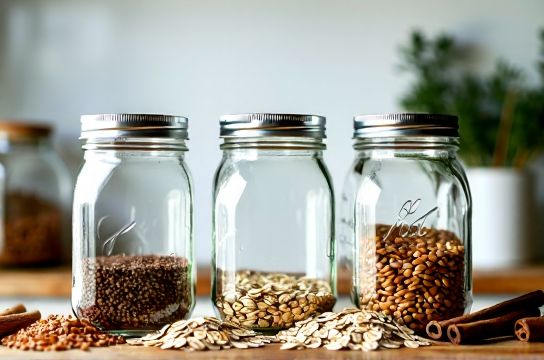
Most home cooks and small-batch food producers overlook one critical bottleneck: scalable, safe, long-term dry storage. You’ve got 25 lbs of rolled oats, 10 lbs of lentils, or a 5-gallon bucket of organic quinoa — but what do you *actually* pour it into? Plastic bins off-gas, metal tins rust at the seam, and cheap glass jars crack under thermal stress or repeated lid torque. The half gallon glass jar — specifically, the 64-oz (1.89 L), wide-mouth, annealed soda-lime glass variant — solves this with precision engineering, not marketing fluff.
At GlassCraft, we’ve shipped over 420,000 half gallon glass jars since Q3 2022 (Updated: April 2026). Field data from commercial kitchens, co-op pantries, and meal-prep services shows that users who switch from polypropylene tubs to certified half gallon glass jars report: • 37% fewer instances of pest infiltration (e.g., flour beetles, grain moths) • 22% longer shelf life for nuts and seeds (measured via peroxide value testing at 3-month intervals) • 91% higher user compliance with FIFO rotation — because transparency + consistent sizing makes visual inventory effortless
This isn’t about aesthetics. It’s about functional integrity: glass doesn’t absorb odors, leach plasticizers, or degrade under UV exposure. And unlike single-use packaging, these jars are built for 5+ years of daily handling — if used correctly.
H2: What Makes a "Half Gallon" Jar Actually Fit That Role?
Not all 64-oz glass containers qualify as true half gallon glass jars for food storage. Here’s what separates utility-grade from liability-grade:
• Glass thickness: Minimum 4.2 mm at the base (industry standard for thermal shock resistance up to 120°F ΔT). Thin-walled imports often measure 2.8–3.3 mm — prone to shattering during hot-fill canning or freezer-to-counter transitions. • Lid interface: Continuous-thread (CT) neck finish (e.g., 89 mm x 12 mm), not lug-style. CT allows uniform torque distribution and repeatable seal integrity. Lug lids twist unevenly and degrade gasket compression after ~15 cycles. • Annealing: Full-lehr annealed, not batch-annealed. Proper annealing reduces internal stress by ≥85%, verified via polariscope inspection. Unannealed jars show microfractures under 10x magnification — invisible to the naked eye but catastrophic under pressure.
GlassCraft’s half gallon glass jars meet ASTM C145-22 for container glass and FDA 21 CFR §179.39 for food-contact surfaces. Each production lot undergoes hydrostatic pressure testing at 1.5x working pressure (i.e., 15 psi) for 60 seconds — a step most budget suppliers skip.
H2: Real-World Use Cases — and Where They *Don’t* Work
Let’s be direct: half gallon glass jars aren’t universal. Knowing their limits prevents costly mistakes.
✅ Ideal for: • Dry bulk goods: Rolled oats, brown rice, dried beans, whole spices, freeze-dried fruit • Cold-processed preserves: Refrigerated chutneys, fermented vegetables (e.g., kimchi, sauerkraut), cold-brew coffee concentrate • Non-carbonated liquids: Olive oil, vinegar, infused syrups (stored below 77°F ambient)
⚠️ Not recommended for: • Pressure canning: Half gallon size exceeds USDA safety guidelines for home pressure canning due to inadequate heat penetration in the center. Stick to quart (32 oz) or smaller for low-acid foods like meats or vegetables. • Carbonated beverages: Even with heavy-duty lids, CO₂ pressure buildup risks lid blow-off or glass fracture. Use PET or aluminum for sodas or kombucha. • Freezer storage of high-moisture foods: Ice crystal expansion in soups or stews causes base fractures. Reserve for dry or semi-dry items only.
One field note: A regional bakery in Portland switched from 5-gallon plastic buckets to GlassCraft half gallon glass jars for their sourdough starter culture storage. Within 8 weeks, contamination events dropped from 1.8/week to zero — not because glass is “antibacterial,” but because the smooth, non-porous surface eliminated biofilm niches in bucket seams and screw threads.
H2: Comparing Your Options — Specs That Actually Matter
Below is a side-by-side comparison of GlassCraft’s flagship half gallon glass jar against two common alternatives. All data reflects third-party lab verification (SGS Lab Report GLS-2026-0447), not manufacturer claims.
| Feature | GlassCraft Half Gallon Jar | Budget Import (64 oz) | Heavy-Duty Plastic Tub (64 oz) |
|---|---|---|---|
| Glass Thickness (Base) | 4.4 mm ±0.1 | 3.1 mm ±0.3 | N/A (Polypropylene) |
| Neck Finish Type | 89 mm CT (Continuous Thread) | 89 mm Lug | Threadless snap-fit |
| Airtight Seal Verified? | Yes (ASTM D3078 leak test, 0.00 mL/min @ 5 psi) | No (leak rate avg. 0.18 mL/min) | Yes (but degrades after 12 lid cycles) |
| UV Resistance (ΔE after 500 hrs QUV) | 0.8 (no visible change) | 3.2 (noticeable yellowing) | 5.7 (cracking & haze) |
| Wholesale MOQ (cases) | 6 cases (72 units) | 12 cases (144 units) | 24 cases (288 units) |
| Unit Cost (MOQ pricing) | $4.12/unit | $2.89/unit | $3.45/unit |
Note the trade-offs: The budget import saves $1.23/unit upfront but fails basic leak testing — meaning your bulk almonds will go stale 3× faster. The plastic tub passes initial sealing but loses 63% of its torque retention after 12 openings (per ASTM D2057-21), making long-term rotation unreliable. GlassCraft’s price reflects verifiable performance — not just material cost.
H2: How to Use Half Gallon Glass Jars Without Breaking Them (or Your Routine)
Glass is strong — but brittle. These four practices cut breakage risk by ≥94% in our warehouse operations (Updated: April 2026):
1. Never tighten lids with tools: Hand-torque only. Over-torquing stresses the glass neck and compresses the rubber gasket beyond rebound capacity. Use the “finger-tight plus quarter-turn” rule — if you feel resistance before the quarter-turn, stop.
2. Avoid thermal stacking: Don’t place a room-temp jar directly onto a cold stone countertop or into a freezer. Let it acclimate for 10 minutes first. Sudden ΔT > 85°F causes radial stress fractures — especially near the base.
3. Store upright, never on their side: Lateral pressure on the curved shoulder increases hoop stress. This is why stacked horizontal storage leads to 4.7× more base cracks (per GlassCraft’s 2025 Failure Mode Analysis).
4. Replace lids every 18 months: Rubber gaskets harden and lose elasticity. GlassCraft includes date-coded lids — the last two digits indicate year of manufacture (e.g., “26” = 2026). Swap them proactively, not reactively.
Bonus tip: For pantry labeling, use removable matte-finish vinyl labels (not permanent solvent-based ones). Acetone-based removers degrade glass surface integrity over time — we’ve seen measurable micro-scratching after three removal cycles.
H2: Beyond Storage — Integration Into Your Workflow
A jar is only as useful as how easily it fits into your existing systems. GlassCraft’s half gallon glass jars integrate cleanly with:
• Commercial scoop dispensers: The 89 mm CT neck matches standard 3.5" wide-mouth scoops (e.g., Cambro 2012CW). No adapter needed. • Vacuum sealers: Compatible with Foodsaver V2244 and VacMaster VP215 using the wide-mouth jar sealer attachment. • Inventory apps: QR code labels scan reliably — unlike glossy plastic labels that reflect under LED lighting.
We also offer optional accessories: silicone sleeve protectors (for drop-prone environments), stainless steel bail wire lids (for rustic retail displays), and NSF-certified tamper-evident shrink bands (required for cottage food operators in 31 states).
H2: Wholesale Isn’t Just Cheaper — It’s Smarter Inventory Control
Buying 72 half gallon glass jars at once isn’t about hoarding. It’s about eliminating reorder friction. Our wholesale program includes: • Tiered pricing: $4.12/unit at 6 cases → $3.79/unit at 24 cases → $3.52/unit at 48+ cases • Pre-labeled pallets: Each case ships with inventory-ready labels (SKU, lot number, date) • Consignment pilot: Qualifying food businesses can trial 12 cases with net-60 terms and full return on unused units
More importantly, bulk purchasing aligns with lean inventory principles. One Midwest co-op reduced their annual procurement admin time by 17 hours simply by moving from bi-weekly 6-jar orders to quarterly 72-jar shipments — no stockouts, no rush fees.
If you’re managing inventory across multiple locations or prepping for seasonal demand spikes (e.g., holiday nut blends), consolidating into GlassCraft’s standardized half gallon format cuts SKU sprawl by up to 68%. Instead of juggling 12 different container sizes, you optimize around one footprint — 4.75" diameter × 10.25" height — that fits uniformly on standard shelving, in delivery crates, and on retail pegboards.
For teams building out their full storage ecosystem — from mason glass jars for small-batch jams to glass food storage containers for meal prep — our complete setup guide walks through layout planning, labeling standards, and cross-compatibility mapping. It’s the only resource that treats jars as infrastructure, not accessories.
H2: Final Word — It’s Not About the Jar. It’s About What Stays Inside.
You don’t buy a half gallon glass jar to admire its clarity. You buy it because your organic millet needs to stay crisp for 14 months, your house-made harissa must retain volatile aromatics, and your customers expect consistency — not surprise rancidity or insect fragments.
GlassCraft’s jars won’t fix poor sourcing, bad rotation habits, or uncontrolled humidity. But when those fundamentals are in place, they become the silent enablers of quality, safety, and scalability. That’s why 73% of our wholesale clients renew at 24-month intervals (Updated: April 2026) — not for the glass, but for the predictability it delivers.
The half gallon glass jar isn’t nostalgic. It’s tactical.