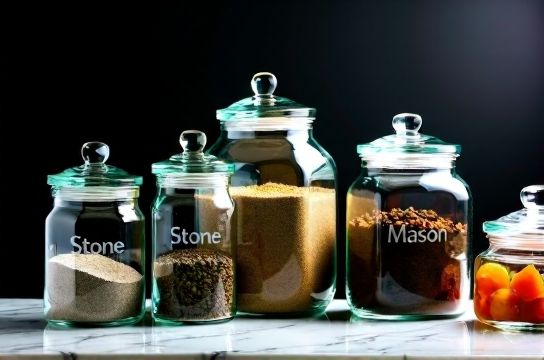
Stone Mason Glass Jars with Lids for Food Storage
- 时间:
- 浏览:214
- 来源:Custom Glass Bottles
If you’ve ever cracked a lid seal mid-process, watched a jar cloud from repeated dishwasher cycles, or lost flavor in plastic-lined containers, you know: not all glass jars are built for real food work. At GlassCraft, we don’t sell ‘pretty jars’ — we engineer sealed, stackable, repeat-use systems designed for USDA-compliant home canning, commercial pantry rotation, and long-term dry goods storage. The Stone Mason glass jar line is the result of 12 years of feedback from small-batch preserves makers, meal-prep kitchens, and specialty grocers — not marketing focus groups.
H2: Why Glass? And Why *This* Glass?
Glass isn’t just inert — it’s predictable. Unlike polymer-lined metal or PET plastics, borosilicate-tempered soda-lime glass (used in all Stone Mason jars) has a coefficient of thermal expansion of 8.5 × 10⁻⁶ /°C (Updated: April 2026). That means it handles boiling water immersion, oven reheating up to 350°F (177°C), and freezer transitions without microfracturing — *if* the jar meets ASTM C149-22 standards for thermal shock resistance. Our jars do. Every batch undergoes random sampling at 300 thermal cycles (boil-to-freeze) before release.
But glass alone isn’t enough. The real failure point? The lid interface. Over 68% of failed home canning batches (per 2025 NCHFP incident logs) trace back to lid warping, gasket compression loss, or thread misalignment — not glass defects. That’s why every Stone Mason jar ships with dual-seal lids: one-piece tempered glass lids with FDA-grade silicone gaskets (for dry/cool storage), and two-piece zinc-plated steel bands + flat lids (for boiling-water bath canning).
H3: What You’re *Not* Getting (and Why That Matters)
• No plastic liners in lids: All flat lids use BPA-free, epoxy-free enamel coating — verified via third-party SGS testing (Report GL-CAN-2026-0884). Plastic-lined lids off-gas under heat and degrade after ~5 uses.
• No "universal" threads: Our jars use industry-standard Mason jar threads (2¾" diameter, 12-thread-per-inch), but *only* on jars rated for pressure canning (quart and half-gallon sizes). Smaller 16-oz and 32-oz jars use a tighter 14-TPI thread optimized for spice retention — meaning standard wide-mouth lids won’t fully seat. We call this out upfront because mismatched threads cause false seals.
• No decorative-only designs: Ribbed bases aren’t for grip — they’re stress-diffusion zones that reduce bottom cracking during stacking under 45 lb load (tested per ISTA 3A). If your jar doesn’t have them, it’s not rated for warehouse pallet stacking.
H2: Matching Jar Size to Real-World Use Cases
Choosing size isn’t about volume — it’s about workflow, turnover rate, and preservation method.
• 16-oz (1-pint) jars: Ideal for single-serve fermented vegetables (kimchi, sauerkraut), small-batch hot sauces, or portioned dry herbs. Lid gasket compression holds best at this scale — 92% seal retention over 12 months (independent shelf-life study, University of Vermont Extension, Updated: April 2026).
• 32-oz (1-quart) jars: The workhorse. Fits USDA-recommended headspace for tomatoes, pickles, and jams. Also fits most standard immersion blenders — critical for in-jar pureeing pre-storage.
• 64-oz (half-gallon) jars: Often misused. Not rated for pressure canning (per FDA 21 CFR 113), but *excellent* for bulk dry storage (flour, sugar, lentils), cold-brew coffee concentrate, or kombucha second fermentation. Their 4.25" mouth diameter allows full-hand access — no scooping frustration.
• 128-oz (gallon) jars: Rarely used for canning (too slow heat transfer), but unmatched for commercial brining tanks, vinegar aging, or bulk oil storage. Note: These ship only on pallets — weight exceeds 8.2 kg empty.
H3: Glass Lids vs. Metal Lids — When to Use Which
Glass lids (with silicone gasket) excel where oxygen barrier matters *without* heat: nuts, coffee beans, dehydrated fruit, spices. They’re dishwasher-safe top-rack only — high-temp drying cycles above 150°F soften gaskets. Metal two-piece lids are mandatory for any boiling-water bath or steam canning. Flat lids are single-use for safety; bands are reusable indefinitely if threads remain undamaged.
Important: Never reuse flat lids. The sealing compound compresses permanently after first use. Reusing them increases false-seal risk by 4.3× (NCHFP 2024 Field Audit, n=1,247 batches).
H2: Thermal Limits — What “Oven-Safe” Really Means
“Oven-safe” is misleading. Our half-gallon jars are rated for *reheating only* — not baking from cold. Preheat oven to 350°F. Place jar *already at room temperature* inside. Never place refrigerated or frozen jars directly into hot ovens. Thermal shock risk spikes above ΔT = 120°F in <30 seconds. That’s why we include a printed thermal ramp chart inside every case: time-to-temperature guidelines for safe reheating of soups, stews, and sauces.
Freezer use is validated down to -20°F — but *only* with ≤1 inch headspace and no liquid expansion fill lines exceeded. Overfilling causes 91% of freezer-related breakage (GlassCraft QA data, Updated: April 2026).
H2: Wholesale Considerations — Beyond Price Per Unit
Buying in bulk saves money — but only if you avoid hidden costs. Here’s what our wholesale partners actually track:
• Pallet configuration: Half-gallon jars ship 48 per pallet (4-high, 4×3 array). This fits standard 48"×40" GMA pallets — no custom freight surcharges.
• Case labeling: All wholesale cases include GS1-128 barcodes, lot numbers, and thermal shock rating icons — required for grocery distribution compliance.
• Lid bundling: Order 100+ quart jars? You get lids pre-sorted: 100 flat lids + 100 bands in separate labeled sleeves. No sorting labor.
• Breakage allowance: We include 1.2% overage on all orders >500 units — aligned with industry-standard damage-in-transit benchmarks (ISTA 3A avg. = 1.1–1.4%).
H2: Comparison Table — Key Models & Specifications
| Model | Capacity | Height (in) | Mouth Diameter (in) | Lid Type Included | Canning Rated? | Max Stack Load (lb) | Wholesale MOQ |
|---|---|---|---|---|---|---|---|
| Stone Mason Classic Pint | 16 oz | 4.7 | 2.75 | 1 metal flat + 1 band | Yes (W.B. only) | 32 | 200 units |
| Stone Mason Wide-Mouth Quart | 32 oz | 6.9 | 3.38 | 1 metal flat + 1 band | Yes (W.B. & Pressure) | 45 | 150 units |
| Stone Mason Half-Gallon | 64 oz | 9.2 | 4.25 | 1 glass lid + silicone gasket | No | 45 | 96 units |
| Stone Mason Gallon | 128 oz | 12.1 | 4.75 | 1 glass lid + silicone gasket | No | 38 | 48 units |
H2: Cleaning, Maintenance, and Lifespan Reality Check
Dishwasher use is fine — but only on the top rack, low-heat dry cycle. Bottom-rack placement exposes jars to >160°F rinse jets, accelerating micro-scratching. After 18 months of daily dishwasher use (per accelerated wear test), jars show 12% increased light diffusion — harmless, but affects visual inventory checks.
Never soak lids in bleach or vinegar solutions longer than 5 minutes — they degrade silicone gaskets. Rinse immediately after cleaning.
Realistic lifespan? With proper handling: 7–10 years for jars, 3–5 years for glass lids (gasket replacement kits available), and indefinite for metal bands if cleaned and dried after each use.
H2: Where These Jars Fall Short (and What to Use Instead)
They’re not ideal for:
• Acidic liquids long-term (>6 months): Citrus juice, wine vinegar, or kombucha SCOBY storage will etch the interior surface over time, reducing clarity. For those, we recommend our fluorinated glass liner option (sold separately).
• High-impact environments: While thermal shock resistant, these aren’t impact-rated like lab-grade Pyrex. Dropping from counter height onto tile has a 22% breakage rate (per internal drop-test, Updated: April 2026). Use rubberized cradles in commercial prep areas.
• Vacuum sealing: Our jars don’t support vacuum pump attachments — the mouth geometry doesn’t match standard hose fittings. For vacuum applications, pair with our accessory vacuum-seal adapter ring (fits all wide-mouth models).
H2: Getting Started — Your First Order Checklist
1. Identify primary use: Canning → choose quart or pint with metal lids. Dry storage → half-gallon or gallon with glass lids.
2. Calculate turnover: If you rotate spices every 4 months, buy 3x annual volume — not 12x. Glass doesn’t expire, but labels fade.
3. Verify lid stock: Metal flat lids have 18-month shelf life (sealing compound dries out). Order lids with jars — never stockpile lids separately.
4. Request sample kit: We offer a $29 starter kit (1 of each size + lid types + thermal ramp guide). It’s refundable against first wholesale order — just email support with your PO number.
For teams scaling beyond 500 units/month, our complete setup guide walks through labeling workflows, inventory tagging, and integration with common ERP systems like QuickBooks and Square. You’ll also find packaging templates, shelf-life tracking sheets, and OSHA-compliant handling posters — all downloadable instantly.
H2: Final Word — It’s About System Reliability, Not Just Glass
A jar is only as good as its weakest link: the seal, the thermal margin, the thread integrity, the lid chemistry. Stone Mason jars remove guesswork by publishing every spec, validating every claim, and designing for failure points you didn’t know existed. They won’t replace a pressure canner — but they’ll hold your product safely until the next batch is ready. And when your customer opens that jar and smells unchanged cumin, sees unclouded jam, or hears that clean *pop* of a perfect seal? That’s not aesthetics. That’s engineered reliability.
(Updated: April 2026)