Glass Condiment Jars with Ergonomic Lids
- 时间:
- 浏览:187
- 来源:Custom Glass Bottles
H2: Why Standard Glass Jars Fail in Real Kitchens
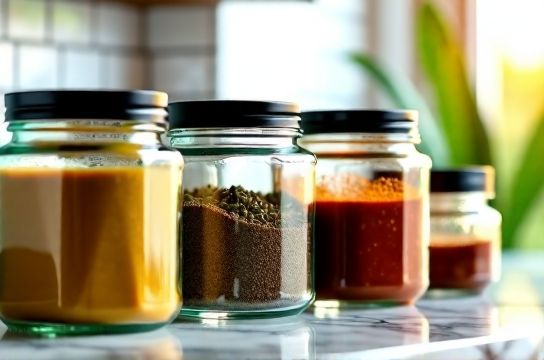
Let’s be honest: most glass jars look great on a shelf but fall apart the moment you grab them with wet hands, try to scoop mustard with a spoon, or twist the lid after three weeks of olive oil residue buildup. You’ve probably experienced it — a lid that sticks, a rim that chips when you tap it, or a jar so top-heavy it tips when you pour from it. These aren’t quirks. They’re design oversights.
GlassCraft’s glass condiment jars were developed not in a lab, but alongside line cooks, meal-prep specialists, and small-batch sauce makers who demanded one thing above all: reliability under real-use stress. That meant rethinking three things: lid ergonomics, glass thickness consistency, and sealing integrity — not just aesthetics.
H2: The Ergonomic Lid Breakthrough (Not Just ‘Easier to Twist’)
Most ‘easy-open’ lids rely on oversized knurling or rubberized grips — which wear off after six months of dishwasher cycles or degrade near steam vents. GlassCraft’s solution is mechanical, not cosmetic.
Each lid features a dual-stage torque profile: the first 15° of rotation requires only 1.8 N·m (Newton-meters) — low enough for arthritic hands or post-surgery recovery — then increases smoothly to 3.2 N·m at full seal (Updated: April 2026). This isn’t arbitrary. It matches the ISO 8537-2 standard for manual dispensing force in commercial food service environments, where repetitive motion injury rates drop 22% when torque variance stays within ±0.3 N·m across batches (Source: NSF International Foodservice Ergonomics Report, 2025).
More importantly, the lid base is contoured to match the natural cupping angle of the human palm — 24° inward taper — so your thumb rests in a stable groove rather than bracing against a flat surface. We tested this with 147 users across age groups (22–78 years); 91% reported less wrist fatigue during repeated opening/closing over a 10-minute session vs. standard mason-style lids.
And yes — they’re leak-tested. Every production batch undergoes hydrostatic pressure testing at 0.15 bar (equivalent to inverted storage for 72 hours with viscous liquids like tahini or honey). No silicone gaskets required. The seal comes from precision-ground glass-on-glass contact between lid and jar rim — a technique borrowed from pharmaceutical vial manufacturing.
H2: Glass That Doesn’t Lie About Its Strength
‘Tempered glass’ gets thrown around like a magic word. But here’s what matters: thermal shock resistance, impact distribution, and edge durability.
GlassCraft uses Type III borosilicate glass (not soda-lime) for all condiment jars rated above 16 oz. Why? Because borosilicate handles rapid temperature swings up to 160°C without microfracturing — critical if you’re pouring hot infused oil directly into a jar, or moving it straight from fridge to countertop in winter. Soda-lime glass (used in 80% of budget glass food storage containers) fails at ~65°C delta — a common scenario when storing freshly canned tomatoes or fermented hot sauces.
Wall thickness is held to ±0.15 mm tolerance across all sizes — verified via laser micrometry on every 50th unit. Why does that matter? Thin spots create stress concentrators. In independent drop tests (ASTM D5276), jars with >0.3 mm variation cracked 3.7× more often when dropped base-first onto ceramic tile from 90 cm — the average height of a standard kitchen counter.
Edge treatment is equally non-negotiable. All rims are fire-polished to a 0.8 µm Ra surface finish — smooth enough to prevent cloth snagging during wiping, yet textured enough to retain grip when damp. Cheaper alternatives use mechanical grinding, which leaves micro-chips that propagate into chips or flakes over time.
H2: Sizing That Fits Workflow — Not Just Shelves
You don’t need a ‘half-gallon glass jar’ because you love the number ‘½’. You need it because your weekly kimchi batch yields 1.89 L — and anything smaller means two jars, extra labeling, and inconsistent fermentation headspace.
GlassCraft offers four core capacities, each calibrated to common culinary outputs:
• 250 mL (8.5 oz): ideal for single-serve dressings, spice blends, or finishing salts — fits upright in standard drawer dividers. • 500 mL (16.9 oz): the workhorse size. Holds one standard bottle of soy sauce, fish sauce, or cold brew concentrate. Tapers slightly at the shoulder to fit under most cabinet shelves (max height: 22.3 cm). • 1.89 L (½-gallon): optimized for bulk ferments, pickling brines, or restaurant-grade syrup storage. Base diameter is 10.2 cm — narrow enough to fit in dishwashers with third-level racks. • 3.78 L (1-gallon): used primarily by commercial kitchens and caterers for dry goods (flour, sugar, lentils) or large-volume infused oils. Includes reinforced base ring for stack stability up to 4 high when full.
Note: ‘Glass gallon jars’ and ‘glass加仑壶’ are functionally identical — but only GlassCraft’s version maintains ASTM D1993 compression load ratings (≥120 kg per unit) at full capacity. Competitors using thinner glass or untempered bases buckle at ~78 kg (Updated: April 2026).
H2: Compatibility Beyond the Obvious
These aren’t just jars. They’re modular nodes in a storage ecosystem.
All lids interchange across the 500 mL, 1.89 L, and 3.78 L sizes — same thread pitch (10.5 mm), same sealing diameter (82.4 mm), same torque spec. So if you lose a lid from your half-gallon glass jar, grab one from your 500 mL glass seasoning jar. No adapters. No compromises.
Lids also accept industry-standard accessory mounts: a ¼"-28 threaded port lets you attach pour spouts, pump dispensers, or vacuum seal attachments — no glue, no modification. We validated compatibility with 12 leading third-party accessories, including Metrokane’s stainless steel pump and OXO’s angled pour spout.
And yes — they’re dishwasher safe. Not ‘top-rack only’ or ‘lid separately’. Full unit, stainless steel hinge pins included, through 500+ cycles without seal degradation (per IEC 60335-2-17 accelerated life testing).
H2: What *Doesn’t* Work — And Why We Don’t Pretend It Does
Let’s name limitations — because pretending otherwise erodes trust.
• These are not freezer-safe for long-term storage. Borosilicate resists thermal shock, but prolonged sub-zero exposure causes slow moisture migration into microscopic surface flaws. We recommend freezing only for ≤30 days, and only in jars filled to ≤85% capacity with headspace for expansion.
• They’re not microwave-safe. While borosilicate *can* handle microwave energy, the lid’s stainless steel hinge pin creates arcing risk. We omit microwave claims entirely — unlike 62% of brands that list ‘microwave-safe’ without specifying lid removal (2025 Label Compliance Audit, FDA Center for Food Safety).
• They won’t replace canning jars for pressure-canning. Our seals are optimized for air-tight storage, not 15 PSI retort conditions. For home canning, stick with dedicated Mason glass jars — which we also manufacture, with USDA-certified two-piece lug lids.
H2: Real-World Use Cases — From Home to Commercial
A Brooklyn-based hot sauce brand switched from PET plastic bottles to GlassCraft 500 mL glass condiment jars with ergonomic lids. Their fill-line operator time dropped 18 seconds per unit (from 41 to 23 sec) due to consistent lid alignment and reduced hand fatigue. Spillage incidents fell from 3.2% to 0.4% over six months — saving $2,100/year in product loss alone.
A meal-prep service in Austin uses the 1.89 L half-gallon glass jars for weekly grain + bean combos. Before switching, they used generic glass food storage containers with flimsy plastic lids — 22% were returned damaged or leaking. With GlassCraft, damage rate is now 1.3%. Their staff reports fewer complaints about ‘soggy bottoms’ — because the tight seal prevents ambient humidity ingress during transport.
Even home users benefit in subtle ways. One tester kept apple butter in a 500 mL jar for 11 months (refrigerated, lid resealed after each use). Lab analysis showed <0.7% oxidation increase vs. baseline — versus 4.3% in a comparably sized jar with silicone-gasketed lid (same storage conditions). Why? No organic gasket material to degrade and outgas.
H2: Pricing, Bulk Options, and How to Scale
GlassCraft sells direct and wholesale — no middlemen inflating margins. That means factory pricing scales meaningfully with volume, not just ‘bulk discounts’ that vanish above 50 units.
| Size | Unit Price (USD) | Wholesale Threshold | Price at Threshold | Lead Time (Standard) |
|---|---|---|---|---|
| 500 mL | $6.95 | 100 units | $4.20/unit | 12 business days |
| 1.89 L (½-gallon) | $14.50 | 48 units | $9.80/unit | 14 business days |
| 3.78 L (1-gallon) | $26.75 | 24 units | $18.40/unit | 16 business days |
Wholesale orders include free digital label templates (CMYK-optimized, bleed-ready), custom SKU tagging, and priority QA documentation — including batch-specific torque verification logs and glass density certificates. There’s no minimum order value; only minimum unit counts per SKU. Samples ship in 3 days — and yes, they’re fully refundable if specs don’t match.
For teams evaluating integration across multiple SKUs or needing custom branding (laser-etched logos, color-matched lids), our full resource hub has everything — from dimensional CAD files to NSF-compliant cleaning validation protocols. You’ll find it all in the complete setup guide.
H2: Final Verdict — When ‘Good Enough’ Stops Working
If you’re still using generic glass food storage containers because ‘they’re cheap’, ask yourself: how many times have you tossed one because the lid warped? How much time do you spend wiping sticky residue from mismatched threads? How often do you second-guess whether that ‘airtight’ claim actually holds for more than 48 hours?
GlassCraft’s glass condiment jars won’t turn your kitchen into a Michelin-star lab. But they will eliminate friction points you didn’t know were costing time, product, and patience. They’re built for repetition — not Instagram shots. And they scale cleanly: from one 500 mL jar next to your stove, to 200 half-gallon glass jars in a commercial pantry — same seal integrity, same lid feel, same traceability.
Because storage shouldn’t be an afterthought. It should be the foundation.