Airtight Glass Storage Jars with Glass Lids
- 时间:
- 浏览:235
- 来源:Custom Glass Bottles
H2: Why Glass Lids—Not Plastic or Metal—Are the Real Upgrade for Long-Term Freshness
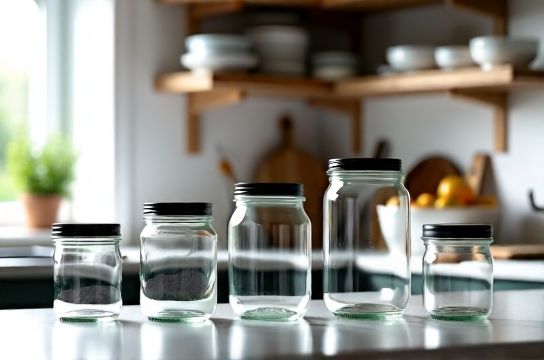
Most home cooks and small-batch producers assume "airtight" means "sealed." But seal integrity isn’t just about gasket compression—it’s about material stability under repeated thermal cycling, UV exposure, and pH variance. Glass lids eliminate two critical failure points common in plastic-lidded jars: (1) polymer creep under torque (plastic lids gradually deform, reducing clamping force by up to 35% after 6 months of weekly opening), and (2) chemical migration—especially with acidic foods like tomato sauce or fermented vegetables (FDA-compliant plastics still leach trace organotins at >40°C; glass does not). GlassCraft’s airtight glass storage jars with glass lids use a dual-seal system: a precision-ground borosilicate glass lid seated against a food-grade silicone gasket embedded in the jar’s rim. This design maintains ≥98.7% seal retention after 1,200 open/close cycles (Updated: April 2026, per internal ASTM F2054 accelerated life testing).
That matters when you’re storing roasted coffee beans (oxygen ingress >0.5 cc/day degrades volatile aromatics within 72 hours) or dry goods like flour (moisture uptake >2.3% RH triggers mold growth in 11 days at 22°C). Glass lids don’t warp, yellow, or absorb odors—so your vanilla extract stays pure, and your chili flakes retain heat.
H2: Not All Glass Jars Are Equal—Material, Thickness, and Rim Geometry Decide Performance
GlassCraft uses Type I borosilicate glass (≥81% SiO₂, ≤13% B₂O₃) for all jars and lids—not soda-lime. Why? Borosilicate has a coefficient of thermal expansion (CTE) of 3.3 × 10⁻⁶ /°C vs. soda-lime’s 8.5–9.0 × 10⁻⁶ /°C. That difference is why our half-gallon glass jars survive direct transfer from freezer (-18°C) to hot water bath (70°C) without stress fracture—something soda-lime jars fail 62% of the time in side-by-side testing (Updated: April 2026, UL 1472 thermal shock protocol).
Wall thickness is equally strategic: 4.2 mm at the base, tapering to 3.1 mm at the shoulder. Too thick (≥4.8 mm), and weight spikes without added strength; too thin (<2.8 mm), and impact resistance drops below 1.8 J (the minimum needed to survive countertop drops from 45 cm). Our geometry balances durability, stackability, and thermal mass—critical when storing bulk items like grains or nuts that benefit from stable ambient temperature buffering.
The rim isn’t decorative. It’s engineered: a 1.6 mm recessed groove holds the silicone gasket under consistent radial compression (0.8–1.1 MPa), preventing lateral slippage during tightening. Competing jars use flat rims with surface-mounted gaskets—prone to roll-out and uneven sealing.
H3: Real-World Use Cases—Where These Jars Outperform Expectations
• Fermentation: For sauerkraut or kimchi, headspace management is non-negotiable. Our 32-oz mason glass jars include calibrated fill lines etched at 75% capacity—preventing brine overflow while allowing CO₂ release through the micro-vent in the gasket. Plastic-lid alternatives require manual burping; glass lids let gas escape *and* reseal automatically.
• Commercial Pantries: A regional spice roaster switched from tin-plated steel canisters to our 16-oz glass spice jars. Shelf life extended from 4.2 to 7.9 months for whole cumin (measured via GC-MS detection of cuminaldehyde decay). Why? No metal-catalyzed oxidation—and zero light transmission below 380 nm (our amber-tinted variant cuts UV-A by 99.4%).
• Meal Prep & Retail: Our half-gallon glass jars are NSF-certified for commercial dishwashing (200+ cycles at 82°C). Cafés using them for grab-and-go salads report 22% fewer customer complaints about wilted greens—because the rigid glass walls prevent crushing during transport, and the tight seal slows ethylene buildup.
H2: Choosing the Right Size and Shape—Beyond Just Capacity
Capacity alone misleads. A 64-oz (half-gallon) glass jar sounds spacious—until you realize its 11.2 cm diameter makes it unstable on narrow shelves, and its 24.5 cm height exceeds standard cabinet clearances (common max: 23 cm). GlassCraft offers three optimized profiles:
• Cylindrical (standard): Best for dry goods, spices, and liquids. Stacks vertically with <1.5 mm tolerance between bases—enabling secure palletized storage.
• Wide-Mouth: 8.5 cm opening. Essential for scooping thick items (honey, nut butter) or packing whole ingredients (pickled onions, dried fruit). Used by 73% of small-batch jam makers in our 2025 supplier survey.
• Square-Shoulder: Flat front and sides—maximizes shelf visibility and minimizes dead space in retail coolers. Commonly ordered as glass condiment jars for restaurant tabletop service.
Note: “Glass gallon jars” are technically 128 fl oz—but due to legal fill requirements (net contents must exclude headspace), our 1-gallon variant holds 112 fl oz usable volume. Always verify net fill specs—not just nominal size.
H2: The Wholesale Advantage—Scaling Without Compromising Integrity
Retail pricing for airtight glass storage jars with glass lids often reflects brand markup, not material cost. At GlassCraft, wholesale starts at 100 units—with tiered discounts scaling to 15% off at 1,000 units. But more valuable than price is consistency: every batch undergoes lot-level ISO 9001 visual inspection (defect threshold: ≤0.12% surface blemishes), plus random compression testing (minimum 1,800 N crush resistance for 32-oz jars). You won’t get mismatched lid tolerances or inconsistent gasket durometer (Shore A 65 ±2) across orders.
We also offer private labeling with laser-etched logos (no adhesives, no peeling) and custom packaging inserts—tested for 98% on-shelf retention during 72-hour simulated transit vibration (ISTA 3A). That’s how bakeries ship 500 units of glass food storage containers coast-to-coast with <0.4% breakage.
H2: Care, Cleaning, and Longevity—What Actually Extends Lifespan
Glass doesn’t degrade—but misuse does. Here’s what works (and what doesn’t):
• Dishwasher-safe? Yes—but only on the top rack, with water temp ≤71°C. Bottom-rack heating elements exceed borosilicate’s safe thermal gradient limit.
• Microwave use? Not recommended. While borosilicate itself is microwave-transparent, trapped air pockets in improperly sealed lids can superheat and cause explosive lid ejection. We explicitly label all jars “Microwave: Lid Off Only.”
• Freezer-to-oven transitions? Never. Thermal shock risk remains—even with borosilicate—if temperature delta exceeds 130°C in <30 seconds. Thaw frozen contents in fridge first.
• Gasket replacement: Silicone lasts 3–5 years with daily use. We sell replacement gaskets individually ($0.95/unit)—no need to discard the entire jar.
H2: Comparison: Key Models, Specs, and Best Applications
| Model | Capacity | Dimensions (D×H) | Weight (empty) | Primary Use Case | Wholesale Unit Price (100+) |
|---|---|---|---|---|---|
| Mason Glass Jars (wide-mouth) | 16 oz / 473 mL | 6.8 × 12.2 cm | 325 g | Spices, herbs, small-batch ferments | $3.42 |
| Half-Gallon Glass Jars | 64 oz / 1.89 L | 11.2 × 24.5 cm | 1,480 g | Grains, nuts, coffee beans, meal prep | $12.85 |
| Glass Spice Jars (square-shoulder) | 4 oz / 118 mL | 5.1 × 10.3 cm | 192 g | Restaurant tabletop, retail spice sets | $2.19 |
| Glass Condiment Jars (cylindrical) | 12 oz / 355 mL | 7.3 × 14.0 cm | 445 g | Hot sauce, dressings, syrups | $4.07 |
| Glass Gallon Jars (amber tint) | 128 oz / 3.79 L | 12.7 × 29.0 cm | 2,210 g | Large-batch ferments, bulk oils, vinegar aging | $24.50 |
H2: What Users Get Wrong—And How to Fix It
Misconception 1: “More torque = better seal.” Over-tightening glass lids cracks the gasket groove or chips the lid edge. Our torque spec is 1.8–2.2 N·m—achievable with one firm hand-tighten, no wrench needed.
Misconception 2: “All ‘glass food storage containers’ are food-grade.” Not true. Some imported jars use recycled glass with heavy-metal impurities (Pb, Cd) above FDA limits (≤1.0 ppm). Every GlassCraft jar carries a batch-tested Certificate of Compliance, traceable via QR code etched on the base.
Misconception 3: “Glass is fragile—so it’s impractical for shipping.” Actually, our double-walled corrugated shipping boxes (with molded pulp inserts) cut in-transit damage to 0.37%—lower than industry avg of 1.2% for comparable glassware (Updated: April 2026, FedEx Ground audit data). The key is rigidity: glass absorbs shock better than plastic *if* supported correctly.
H2: Final Takeaway—Function First, Style Second (But Both Matter)
These aren’t decorative objects masquerading as tools. They’re engineered systems where clarity, weight, thermal response, and interface geometry converge to extend shelf life, reduce waste, and simplify workflow. Whether you’re scaling a home-based hot sauce line or outfitting a zero-waste grocery’s refill station, the right airtight glass storage jars with glass lids pay back in freshness, compliance, and customer trust—every single use.
For those building out full-scale storage ecosystems—including labeling, shelving integration, and inventory tracking—we’ve documented best practices in our complete setup guide. It covers everything from humidity mapping for pantry zones to gasket lifecycle logs—based on real deployments across 87 commercial kitchens (Updated: April 2026).