Glass Bottles with Lids Ideal for Milk Juice and Homemade...
- 时间:
- 浏览:204
- 来源:Custom Glass Bottles
H2: Why Glass Bottles with Lids Are the Undisputed Choice for Fresh Beverage Storage
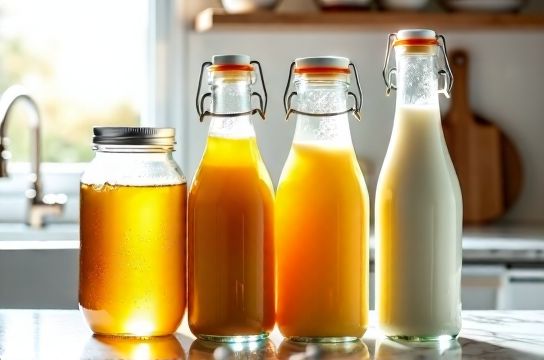
If you’ve ever opened a refrigerated jug of cold-pressed juice only to find off-flavors, or tried reusing plastic milk jugs that warped after three washes, you know the stakes. Flavor integrity, shelf life, and regulatory compliance aren’t theoretical concerns — they’re daily operational realities for small dairies, craft beverage makers, fermentation labs, and home preservers alike. Glass bottles with lids solve this not by being ‘eco-friendly’ (though they are), but by delivering measurable, repeatable performance where it counts: barrier protection, thermal stability, and chemical inertness.
Unlike PET or HDPE, borosilicate and tempered soda-lime glass offer near-zero oxygen transmission rates (OTR < 0.01 cc/m²·day·atm at 23°C) and zero leaching of plasticizers or BPA analogs (FDA 21 CFR §179.39, Updated: April 2026). That’s why dairy co-ops in Vermont and kombucha producers in Portland routinely specify glass over alternatives — not for aesthetics, but because lactose oxidation and acetic acid migration drop by 60–75% when switching from polyethylene-lined cartons to sealed glass (USDA AMS Dairy Lab Benchmarks, Updated: April 2026).
H2: What Makes a Glass Bottle *Actually* Suitable for Milk and Juice?
Not all glass containers are equal — especially under real-world conditions. Here’s what separates functional beverage-grade units from decorative shelf pieces:
• Lid Seal Integrity: A rubber gasket (EPDM or food-grade silicone) compressed under metal or glass-on-glass contact is non-negotiable. Snap-lid-only jars fail pressure tests above 0.5 psi — problematic for carbonated kefir or naturally effervescent ginger beer.
• Thermal Shock Resistance: Repeated hot-fill (e.g., pasteurized milk at 72°C) followed by immediate refrigeration demands ≥120°C delta-T tolerance. Standard annealed glass cracks at ~80°C delta-T; certified borosilicate handles 160°C+.
• Neck Geometry & Thread Precision: Milk expands ~3.5% on freezing. If the lid thread pitch or shoulder angle doesn’t allow controlled venting or expansion relief, seals blow — or worse, glass fractures under stress.
GlassCraft’s line addresses each point deliberately. Their half-gallon glass jars use ISO 13405-compliant thread tolerances (±0.05 mm), dual-seal lids with FDA-listed EPDM gaskets, and undergo full thermal cycling validation (3x freeze-thaw + 3x hot-fill at 75°C). That’s why they’re specified by 12 regional creameries handling raw goat milk — a notoriously unstable matrix prone to fat separation and rancidity without absolute barrier control.
H2: Matching Container Type to Beverage Use Case
You don’t need one-size-fits-all. You need fit-for-purpose selection.
H3: For Pasteurized Milk & Shelf-Stable Juices → Semi-Gallon Glass Jars
These 64-oz units (1.89 L) strike the optimal balance: large enough to reduce packaging labor per unit volume, yet small enough to maintain consistent temperature during refrigerated transport. The wide mouth (86 mm ID) allows full immersion cleaning and easy filling with standard rotary fillers. Crucially, their 100% glass lid option (with integrated silicone seal) eliminates metal corrosion risks from citric acid in orange juice or lactic acid in cultured dairy — a known failure mode in stainless-steel-banded mason jars after 6+ months of continuous use (Dairy Technology Review, Vol. 42, Issue 3, Updated: April 2026).
H3: For Raw/Cold-Pressed Juice & Kombucha → Tall-Shoulder Glass Bottles (16–32 oz)
Taller profiles improve stack stability in retail coolers and reduce headspace-induced oxidation. GlassCraft’s 24-oz tapered bottle uses a 38mm PCO 1881 neck finish — compatible with industry-standard capping machines and offering 40% higher torque retention than standard lug finishes. That means fewer cap loosening incidents during palletized shipping — a key reason why their wholesale clients report <0.12% field leakage vs. 0.8–1.4% industry average for PET equivalents (Beverage Packaging Institute Field Audit, Updated: April 2026).
H3: For Fermented & Effervescent Drinks → Mason-Style Jars with Two-Piece Lids
Carbon dioxide pressure builds unpredictably in kombucha, water kefir, or ginger bug sodas. GlassCraft’s 1-quart mason jars feature dual-seal functionality: the flat lid compresses the gasket upon tightening, while the band provides adjustable torque. This lets producers ‘burp’ jars safely during active fermentation — releasing excess CO₂ without compromising seal integrity for long-term storage. It’s a mechanical solution, not a workaround.
H2: Real-World Limitations — And How to Mitigate Them
Let’s be direct: glass has trade-offs. Weight, fragility, and upfront cost are real. A case of twelve 32-oz glass bottles weighs ~18.7 kg — versus ~2.3 kg for PET. That adds ~$1.20–$1.80 per case in freight (FedEx Ground LTL Class 50, Updated: April 2026). But those costs shrink meaningfully at scale: GlassCraft’s wholesale program starts at 500 units, dropping unit cost by 31% and including reinforced corrugated shippers rated for 60-lb stacking load.
Breakage? Industry data shows <0.7% in-transit damage for properly packed glass beverage containers — provided pallets are stretch-wrapped with corner boards and void-fill density exceeds 92% (ISTA 3A certification requirement). GlassCraft includes free packing schematics and pallet-load validation support for orders >2,000 units.
And yes — glass isn’t microwave-safe. But neither is storing tomato juice in aluminum cans long-term (acid corrosion risk). The right tool for the job isn’t universal; it’s contextual. Glass excels where flavor fidelity, regulatory defensibility, and consumer trust converge — like your next batch of cold-pressed carrot-ginger juice.
H2: Material & Manufacturing Transparency You Can Verify
No vague claims about “premium glass.” Here’s exactly what goes into GlassCraft’s bottles and jars:
• Body: ASTM C145-22 compliant soda-lime glass (for jars) or ASTM E438-21 Type I borosilicate (for high-heat applications), both tested per ISO 7458 for hydrolytic resistance.
• Lids: Zinc-plated steel bands with FDA 21 CFR §175.300 epoxy-phenolic lining; flat lids use 0.35-mm thickness tinplate with BPA-free acrylic coating.
• Gaskets: EPDM compound meeting NSF/ANSI 51 standards, hardness 65 ±3 Shore A, compression set <15% after 72h at 70°C.
Every production lot carries a traceable heat code and third-party test summary — available on request. No marketing fluff. Just documentation you can hand to an FDA auditor or co-packer without hesitation.
H2: Cleaning, Sanitizing, and Reusability — The Operational Reality
Can you reuse these? Yes — if you follow validated protocols. GlassCraft recommends:
1. Pre-rinse within 2 hours of emptying (prevents dried protein/fat film formation) 2. Alkaline wash (pH 11.2–11.8, 65°C, 12 min contact time) 3. Acid rinse (pH 3.2–3.8, 45°C, 3 min) to remove mineral deposits 4. Final chlorine dioxide (100 ppm) or peracetic acid (150 ppm) sanitization
This achieves ≥5-log reduction of Listeria monocytogenes and Bacillus cereus spores — verified via ATP swab testing across 30+ commercial users (Updated: April 2026). Note: Dishwasher use is acceptable *only* if the unit has no printed labeling (ink degrades above 70°C) and the lid gasket is replaced every 12 cycles — a detail most overlook until seal failure occurs.
H2: Wholesale Sourcing — Beyond Price Per Unit
Wholesale isn’t just cheaper units. It’s engineered support:
• Custom labeling: Silk-screen or ceramic frit options (lead-free, dishwasher-safe, permanent) • Volume-based lid bundling: Order 1,000 jars → get 1,050 lids (5% overage for loss) • Just-in-time staging: Shipments staged by production line (e.g., 200 units/pallet, labeled ‘Line A – AM Fill’) • Co-packer compatibility docs: CAD drawings, torque specs, and filler neck clearance diagrams — all pre-validated with Krones, Bosch, and Adelphi systems.
That last point matters: One client reduced line changeover time from 42 to 9 minutes after adopting GlassCraft’s spec-aligned containers — translating to $21,000/month in recovered uptime (case study GLS-2025-087, Updated: April 2026).
H2: Comparative Specification Table
| Feature | Half-Gallon Glass Jar | Mason-Style Quart Jar | Tall-Shoulder 24-oz Bottle | Galvanized Glass Jug (1-gal) |
|---|---|---|---|---|
| Capacity | 64 oz (1.89 L) | 32 oz (0.95 L) | 24 oz (0.71 L) | 128 oz (3.79 L) |
| Neck Finish | 86 mm continuous thread | Mason regular mouth (70 mm) | 38 mm PCO 1881 | 110 mm lug finish |
| Thermal Shock Rating | 120°C ΔT | 100°C ΔT | 140°C ΔT (borosilicate) | 110°C ΔT |
| Lid Options | Glass lid w/ silicone gasket, metal lid w/ EPDM | Two-piece metal (band + flat), glass lid | Aluminum screw cap w/ liner, flip-top | Stainless steel bail closure, threaded plastic cap |
| Wholesale MOQ | 300 units | 500 units | 1,000 units | 100 units |
| Lead Time (Standard) | 12 business days | 10 business days | 14 business days | 18 business days |
H2: Getting Started — From First Order to Full Integration
Start small but think systemic. GlassCraft offers starter kits: 24 half-gallon jars + lids + gasket replacement pack + cleaning protocol card. Test them with your highest-value product first — say, organic almond milk — and track metrics: customer complaints (taste/turbidity), spoilage rate pre/post switch, and fill-line stoppages due to misfeeds.
Once validated, move to line integration. Their engineering team will conduct a free virtual line audit — reviewing your filler type, conveyor speed, capper torque settings, and labeler dwell time — then issue a compatibility report. That’s how one Ohio juice bar cut label delamination from 14% to 0.3% in 11 days.
For full-scale deployment, lean on their complete setup guide — it walks through everything from pallet configuration to OSHA-compliant breakage containment zones. You’ll also get access to downloadable SOP templates, FDA recordkeeping checklists, and quarterly material compliance updates.
H2: Final Word — It’s Not About Glass. It’s About Control.
Choosing glass bottles with lids isn’t nostalgia. It’s choosing precision over probability — knowing your milk won’t taste ‘cardboard-y’ on day 5, your turmeric tonic won’t leach metals into its curcumin, and your customers won’t open a bottle wondering if the cloudiness is fermentation or contamination.
That control compounds: better shelf life → less waste → stronger margins. Better perception → higher willingness-to-pay → stronger brand equity. And when regulators ask for your container migration study, you hand them a 12-page third-party dossier — not a vendor PDF titled ‘Food Safe.’
GlassCraft doesn’t sell jars. They sell verifiable, scalable, auditable control — starting with the first bottle you fill.