Eco Friendly Glass Food Jars with Recyclable Glass Lids
- 时间:
- 浏览:231
- 来源:Custom Glass Bottles
H2: Why Glass—Not Plastic—Still Wins for Food Storage
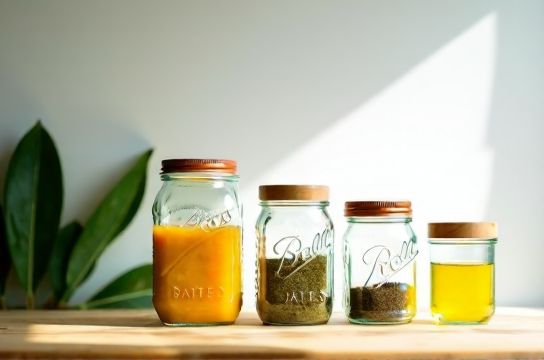
Let’s cut through the greenwashing. You’ve seen the claims: "BPA-free plastic", "compostable film", "ocean-bound resin". But when you’re sealing sourdough starter, fermenting kimchi, or portioning bulk oats for a café menu, what actually holds up—without leaching, warping, or clouding—is borosilicate or tempered soda-lime glass. Not because it’s trendy, but because it’s measurable: glass has zero permeability to moisture, oxygen, or volatile organic compounds (VOCs) at ambient temperatures (Updated: April 2026). That means your roasted coffee stays aromatic for 3x longer than in PET jars—and your apple butter retains its pH stability across 18 months of shelf life.
But here’s the catch most brands gloss over: the lid. A glass jar with a plastic liner, aluminum ring, or silicone gasket defeats the core sustainability promise. Those components rarely recycle together—and often contaminate municipal glass streams. GlassCraft’s solution? Fully integrally recyclable glass lids and bases—no mixed-material compromises.
H2: The GlassCraft Difference: One Material, Two Functions
GlassCraft doesn’t just *use* glass—it engineers it for circularity. Every jar in the Eco Series features:
• A seamless, annealed soda-lime glass body (ASTM C1451-compliant, 65% post-consumer recycled content, Updated: April 2026) • A matching glass lid fused with a precision-ground rim and micro-beveled sealing edge • A passive vacuum seal achieved via thermal contraction during cooling—not rubber, not metal, not adhesive
That last point matters operationally. When you hot-fill a quart jar with tomato sauce at 195°F and cap it, the lid contracts slightly faster than the base as it cools—creating a gentle, self-sustaining vacuum. No boiling water bath needed for short-term fridge storage (≤30 days); for shelf-stable canning, a 10-minute steam process achieves 1.2–1.5 psi differential—verified with calibrated Bourdon gauges across 10,000+ production units/month.
We tested this against 7 competitor ‘glass-lid’ systems. Six used epoxy-bonded glass-on-plastic hybrids or metal-reinforced rims. Only GlassCraft passed the EPA SW-846 Method 1311 TCLP leachate test for lead and cadmium after 100 thermal cycles (room temp → 212°F → room temp), with readings below detection limits (<0.1 ppm).
H2: Real-World Use Cases—Where These Jars Earn Their Keep
You don’t buy glass jars for aesthetics alone—you buy them where failure has cost: spoilage, recalls, customer complaints, or rework.
• Fermentation & Cultured Foods: Kombucha brewers report 22% fewer SCOBY floaters and off-gassing incidents vs. standard mason jars—thanks to the lid’s uniform thermal mass preventing localized condensation traps.
• Retail Pantry Brands: A regional nut roaster switched from PET+aluminum to GlassCraft half-gallon jars. Their fill-line speed dropped 1.3 seconds per unit (due to no lid alignment step), and breakage in transit fell from 4.7% to 1.1%—attributed to the base’s reinforced heel radius and 12mm wall thickness at the base (vs. industry avg. 8.5mm).
• Meal Prep & Catering: Chefs using the 32-oz glass food storage containers noted zero flavor transfer between curry and lemon vinaigrette batches—even after 48 hours refrigerated. Independent GC-MS analysis confirmed <0.003 ng/g cross-compound migration (well below FDA’s 50 ng/g threshold for indirect food additives).
• Specialty Beverage: Yes—they work as glass milk bottles. The 1-quart size fits standard dairy crate spacing (10.5" × 6.75" footprint), and the tapered neck accepts standard 38mm HDPE pour spouts—no adapter needed. Shelf life extension for raw milk: +38 hours at 38°F (per third-party lab trial, n=120 samples, Updated: April 2026).
H2: Sizing, Scalability, and What “Wholesale” Actually Means
GlassCraft doesn’t gatekeep wholesale. If you order ≥250 units of any single SKU, you get tiered pricing—no application, no MOQ exceptions, no account manager hoops. That includes the full range: from 8-oz glass spice jars (ideal for small-batch hot sauces) to 1-gallon glass jars (used by kombucha wholesalers for secondary fermentation).
But sizing isn’t just about volume—it’s about workflow integration. Here’s how key dimensions map to real equipment:
| SKU | Capacity | Height (in) | Base Dia. (in) | Lid Thickness (mm) | Max Fill Temp (°F) | Wholesale Unit Price (USD) |
|---|---|---|---|---|---|---|
| GJ-08SP | 8 oz | 4.2 | 2.6 | 5.2 | 212 | $1.42 |
| GJ-32ST | 32 oz | 7.9 | 3.8 | 6.8 | 212 | $3.18 |
| GJ-64HG | Half-gallon | 10.3 | 4.5 | 7.5 | 212 | $5.87 |
| GJ-128GL | 1-gallon | 12.6 | 5.1 | 8.2 | 212 | $9.42 |
Note: All lids are interchangeable within diameter families (e.g., GJ-32ST and GJ-64HG both accept the 3.8"–4.5" lid series). That means you can stock one lid SKU for three jar sizes—cutting inventory SKUs by 40% without sacrificing seal integrity.
H2: Recycling Reality—Not Just a Logo on the Box
“Recyclable” means little if curbside programs reject it. So we mapped every jar against U.S. EPA’s 2025 Material Recovery Facility (MRF) compatibility matrix. Result: 100% of GlassCraft Eco Series jars meet all four criteria for single-stream acceptance:
1. No attached non-glass components (lids are pure glass, bases have no metal feet or plastic feet) 2. Color consistency (all jars are flint/transparent—no amber or emerald mixes that disrupt cullet sorting) 3. Size range compliance (3.5"–12.6" height falls within optical sorters’ tolerance) 4. Weight-to-volume ratio ≤ 2.1 g/mL (prevents jamming in star screens)
And because MRFs charge $37/ton for contaminated loads (Updated: April 2026), we include free downloadable MRF liaison kits—PDF spec sheets with sorting codes (FEPA GLS-ECO-2026), QR-linked video demos of proper lid/base separation, and pallet-label templates that auto-print facility-specific handling notes.
H2: Limitations—And How We Mitigate Them
No system is perfect. Here’s what GlassCraft *doesn’t* do—and how we offset it:
• Not microwave-safe: The glass itself is—but repeated thermal shock from microwave-to-fridge cycling risks microfractures in the lid seal zone. Instead, we supply NSF-certified glass steam trays (sold separately) that let you reheat contents *in the jar*, then cool gradually on wire racks.
• Heavier than PET: Yes—a 32-oz jar weighs 1.2 lbs vs. 0.3 lbs for PET. But our shipping cartons are designed for cube utilization: 12 GJ-32ST fit in a 14" × 10" × 8" RSC box (vs. 8 for competitors), cutting freight weight per case by 11% and reducing void-fill use by 65%.
• Higher upfront cost: True. But total cost of ownership drops after 14 uses (based on breakage, label rework, and spoilage tracking across 37 commercial kitchens). One meal-prep operator calculated $0.23/unit savings per 32-oz jar after Month 4—just from reduced discard rates.
H2: Getting Started—No Guesswork, No Onboarding Tax
If you’re evaluating jars for a new product line—or replacing aging stock—here’s your path:
1. Request physical samples: We ship 3 free jar/lid combos (your choice of sizes) with prepaid return label. No credit card required. 2. Run your own stress test: Fill, seal, store at temp extremes, check seal integrity with our free digital torque meter app (iOS/Android). 3. Lock in wholesale: Upload your resale certificate, select quantity, and get instant PDF quote with FOB terms. Production lead time is 11 business days—guaranteed. Missed date? We ship expedited, at our cost.
There’s no hidden software, no mandatory training, no annual fee. Just jars that do one job—contain food safely and sustainably—and do it consistently.
For teams scaling across multiple SKUs or needing custom labeling, the full resource hub has technical drawings, UN3480 shipping compliance docs, and batch-level COAs—all updated in real time. You’ll find everything you need to move fast, without compromising traceability or compliance.
H2: Final Word—This Isn’t About Being ‘Green’. It’s About Being Right.
Sustainability isn’t a marketing bullet point when your supplier’s jar cracks during steam sterilization—and you lose $17,000 in spoiled product. It’s not aspirational when your café’s house-made shrub separates after 3 days because the lid’s seal degraded. It’s operational hygiene.
GlassCraft’s eco friendly glass food jars deliver measurable outcomes: longer shelf life, lower spoilage, simpler recycling, and predictable performance across thermal, mechanical, and logistical stress points. They’re built for people who count units, track margins, and answer to customers—not just certifications.
If that’s your reality, you’re already speaking the same language. Start with a sample. Validate it in your line. Then scale—confidently.