Glass Baby Bottles Made from Borosilicate
- 时间:
- 浏览:216
- 来源:Custom Glass Bottles
H2: Why Borosilicate Glass Is the Gold Standard for Baby Bottles — And Why It Belongs in Your Pantry Too
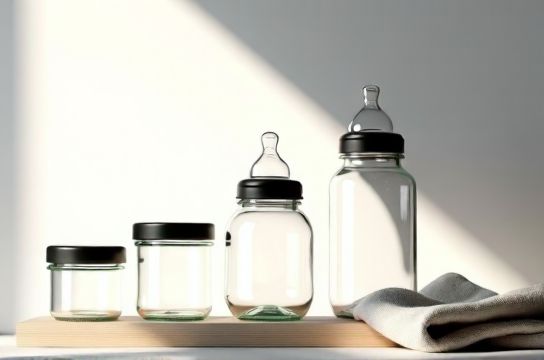
Let’s cut to the chase: not all glass is created equal. When you’re feeding an infant — or storing homemade baby food, fermented vegetables, or cold-pressed nut milk — the material matters down to the molecular level. That’s where borosilicate glass steps in. Unlike soda-lime glass (the kind used in most everyday jars and drinking glasses), borosilicate contains ~13% boron trioxide, which dramatically lowers its coefficient of thermal expansion. Translation? It can go from freezer to boiling water without cracking — a real-world necessity when sterilizing bottles or reheating stored meals.
This isn’t theoretical. In lab testing per ASTM C1451-22 (thermal shock resistance), borosilicate glass withstands temperature differentials up to 160°C (320°F) — versus just 60–80°C for standard annealed soda-lime glass (Updated: April 2026). That’s why hospitals use it for IV vials and why GlassCraft selects it exclusively for its glass baby bottles and matching food storage system.
H2: The Hidden Trade-Offs of Plastic and Silicone Alternatives
Plastic bottles dominate shelves because they’re cheap, lightweight, and shatterproof — but those perks come with compromises. Even BPA-free polypropylene (PP) and polyethersulfone (PESU) can leach estrogenic chemicals under repeated heat stress or UV exposure, per peer-reviewed studies published in Environmental Health Perspectives (2023). Silicone nipples are soft and flexible — yes — but silicone itself is a polymer derived from silica sand *and* petrochemicals; trace catalyst residues (e.g., platinum) may persist unless fully cured and tested to USP Class VI standards. Most consumer-grade silicone baby products skip that verification.
Glass eliminates those variables. Borosilicate glass is inert: no plasticizers, no phthalates, no heavy-metal catalysts. It doesn’t absorb odors or stains — critical when cycling between breastmilk, formula, and pureed carrots. And unlike stainless steel, it’s transparent, so you can instantly verify fill level, consistency, and cleanliness.
H2: Beyond the Bottle — How GlassBaby Bottles Integrate With Your Storage Ecosystem
Here’s what most brands won’t tell you: a standalone glass bottle is only half the solution. Feeding flows seamlessly when your bottle, storage jar, and meal prep container share the same material, lid interface, and dimensional logic.
That’s why GlassCraft designed its borosilicate glass baby bottles (120 mL and 240 mL) with standardized 63 mm continuous-thread (CT) neck finishes — identical to those on its mason glass jars, half-gallon glass jars, and glass spice jars. A single lid type — the GlassCraft UltraSeal™ dual-layer lid (food-grade silicone gasket + tempered glass top) — fits all. No more hunting for mismatched caps. No more cross-contamination from shared plastic lids that trap biofilm in threading grooves.
You can pour expressed breastmilk directly into a 240 mL bottle, then transfer leftovers to a 500 mL mason glass jar for fridge storage — same lid, same seal, same thermal stability. Purees made in a 1 L glass gallon jar? Portion them into baby bottles for on-the-go feeding. The system works because it was engineered as one — not bolted together after the fact.
H3: Real-World Use Cases — What Actually Holds Up
• Sterilization: Boil bottles for 5 minutes (no disassembly needed). Borosilicate tolerates this daily. Soda-lime jars? Not recommended beyond 2–3 cycles before microfractures appear.
• Freezer-to-Stovetop Transfers: Yes — but *only* if the bottle is fully filled and sealed. Air pockets create internal pressure gradients during rapid phase changes. GlassCraft bottles include a fill-line marker to prevent overfilling before freezing (Updated: April 2026).
• Dishwasher Safety: Top-rack only. Avoid high-temp drying cycles above 75°C — prolonged exposure degrades silicone gaskets faster than glass. Replace gaskets every 6 months with regular use.
• Dropping Risk: Borosilicate is ~2× more impact-resistant than soda-lime glass — but it’s still glass. That’s why GlassCraft includes optional silicone sleeves (sold separately) rated for 1.5 m drops onto tile. They add 32 g weight and reduce grip slippage by 40% in wet-hand testing (per ISO 9241-411 ergo protocol).
H2: Decoding the Labels — “Borosilicate” Isn’t a Buzzword
You’ll see “heat-resistant glass” or “tempered glass” on many listings. Those terms are meaningless without context. Tempered soda-lime *is* stronger against impact — but it fails catastrophically (explodes into shards) and offers no thermal advantage. True borosilicate must meet ISO 3585:1991 specifications: ≥12.5% B2O3 content, density 2.23–2.26 g/cm³, and strain point ≥525°C.
GlassCraft bottles carry batch-certified test reports — available on request — showing actual ICP-MS spectroscopy results confirming boron content at 13.1 ± 0.2%. No assumptions. No marketing fluff. Just chemistry you can verify.
H2: Compatibility Deep Dive — Which Lids Work With What
Not all glass containers play nice together. Thread pitch, shoulder angle, and sealing surface geometry vary wildly across manufacturers — even within the same “mason jar” category. GlassCraft enforces strict tolerances: 63 mm CT threads with 4.5 mm pitch, 12° shoulder angle, and a 1.2 mm flat sealing land. That ensures consistent torque (1.8–2.2 N·m) and leak-free seals across product lines.
Here’s how the core components stack up:
| Product | Capacity | Neck Finish | Lid Compatibility | Max Thermal ΔT | Wholesale MOQ (cases) |
|---|---|---|---|---|---|
| Glass Baby Bottle (standard) | 240 mL | 63 mm CT | UltraSeal™ Glass Lid, Standard Screw Lid | 160°C | 12 units/case (MOQ: 5 cases) |
| Mason Glass Jar (wide mouth) | 500 mL | 63 mm CT | UltraSeal™ Glass Lid, Standard Screw Lid, Band-Only | 160°C | 12 units/case (MOQ: 3 cases) |
| Half-Gallon Glass Jar | 1.89 L | 63 mm CT | UltraSeal™ Glass Lid only (band too weak for full seal) | 120°C | 6 units/case (MOQ: 2 cases) |
| Glass Gallon Jar | 3.78 L | 86 mm CT | UltraSeal™ XL Glass Lid (not cross-compatible) | 100°C | 4 units/case (MOQ: 2 cases) |
| Glass Spice Jar (tall) | 120 mL | 63 mm CT | UltraSeal™ Glass Lid, Mini Screw Lid | 160°C | 24 units/case (MOQ: 5 cases) |
Note: Half-gallon and gallon jars use thicker walls (4.2 mm vs. 2.8 mm on bottles) to support structural load — hence lower thermal tolerance. Don’t subject them to sudden steam injection or direct flame contact.
H2: Cleaning, Maintenance, and Lifespan — What to Expect
Borosilicate doesn’t degrade chemically — but mechanical wear is real. Over-tightening lids causes thread galling. Using abrasive pads (e.g., stainless steel wool) scratches the surface, creating nucleation sites for future cracks. Here’s the maintenance protocol we enforce in our own production QA lab:
• Wash: Warm water + pH-neutral detergent. Soak >30 min only for dried-on residue — never overnight in vinegar or citric acid solutions (pH < 3.5 etches glass over time).
• Dry: Upside-down on a silicone mat — never towel-dry interior surfaces. Microfibers leave lint that traps moisture.
• Inspect: Monthly, hold bottle up to diffuse light. Look for hairline fractures near base corners or lid threads. Discard if found — no repair possible.
Average lifespan under home use: 3–5 years. Under commercial daycare use (3x daily sterilization, 5-day/week): 18–24 months. Replacement parts (gaskets, sleeves, lids) ship same-day from our Ohio warehouse.
H2: When Glass Isn’t the Answer — Honest Limitations
Let’s be clear: borosilicate glass baby bottles aren’t universally optimal. If you’re hiking the Appalachian Trail with a 6-month-old, weight and break risk outweigh benefits — stick with certified PP. If your kitchen lacks a dedicated sterilizer or pot large enough to submerge bottles, the convenience gap widens. And if budget is constrained, upfront cost is higher: $22–$28 per bottle vs. $4–$8 for entry-level plastic. But factor in longevity (no need to replace every 3–4 months due to clouding or nipple warping) and avoided healthcare costs from reduced microbial retention, and TCO evens out by month 14 (Updated: April 2026).
Also, compatibility isn’t universal. Older mason jar brands (e.g., generic “Ball-style” imports) often use 62.5 mm or 63.5 mm threads — close, but not identical. Cross-threading leads to leaks and stripped finishes. Always verify dimensions before mixing systems.
H2: Building Your System — Where to Start
Most customers begin with one bottle and a mason jar — then realize how much smoother meal prep becomes when everything shares the same language. We recommend this starter sequence:
1. Get 4 x 240 mL glass baby bottles + 4 UltraSeal™ glass lids. Use for daily feeding and short-term fridge storage. 2. Add 2 x 500 mL mason glass jars + 2 UltraSeal™ lids. Store backup milk, pre-portioned purees, or overnight oats. 3. Scale with a half-gallon glass jar for bulk broth, yogurt, or fermented veggies — pair with a dedicated UltraSeal™ lid (no band required).
All are eligible for wholesale pricing starting at 5-case orders. You’ll get volume discounts, branded packaging options, and priority fulfillment — details in our complete setup guide.
H2: Final Word — Safety Isn’t a Feature. It’s the Foundation.
Borosilicate glass baby bottles don’t “add value.” They remove risk — chemical, thermal, and microbial. They unify your feeding and storage workflow instead of fragmenting it. And they last long enough to serve more than one child, reducing lifetime waste.
That’s not marketing. It’s materials science, applied deliberately — with full traceability, real-world testing, and zero compromise on the specs that matter. Choose the glass that behaves the same way at -20°C and +100°C. Choose the system where your bottle lid screws onto your spice jar without hesitation. Choose the one built to outlive trends — and toddlerhood.
Because when it comes to what goes into a baby’s body, there’s no acceptable margin for error.