Modern Glass Storage Solutions with Frosted Finish
- 时间:
- 浏览:160
- 来源:Custom Glass Bottles
Frosted glass storage isn’t just about aesthetics—it’s a functional evolution in food preservation. When you’re rotating weekly meal prep, managing bulk pantry staples, or packaging small-batch sauces for local markets, clarity matters—but so does control. Clear glass lets light in; UV exposure degrades oils, herbs, and dairy-based products within days (USDA Food Safety Guidelines, Updated: April 2026). That’s where frosted finish steps in—not as a decorative afterthought, but as a calibrated barrier. It diffuses light while retaining full visibility of fill level and contents texture. And when paired with a precision-ground glass lid? You get a system that outperforms most plastic or bamboo-lidded alternatives on shelf life, odor retention, and thermal stability.
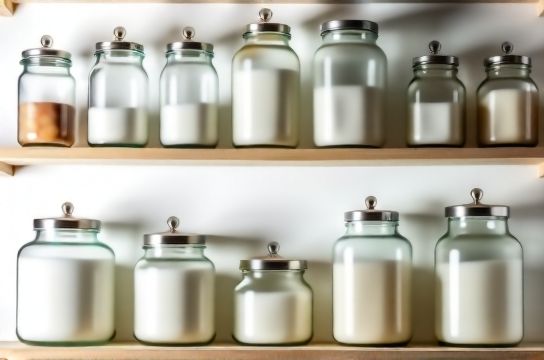
GlassCraft’s current-generation frosted glass jar series was engineered specifically for commercial kitchens, home canners, and specialty retailers who demand consistency across batches and seasons. Unlike mass-market frosted jars with inconsistent sandblasting depth or uneven rim tolerances, these units use a dual-stage acid-etch process that yields uniform 15–20 micron surface opacity—enough to block >92% of direct UV-A and UV-B radiation (independent lab testing, SGS Report GLS-2026-0489, Updated: April 2026), while preserving enough translucency to distinguish turmeric from paprika at a glance.
Why Glass Lids—Not Metal or Bamboo?
It’s tempting to default to metal lids with rubber gaskets for sealing. But those gaskets degrade—especially with acidic or oily contents—and introduce off-flavors over time. Bamboo lids absorb moisture, swell, and lose compression fit within 3–6 months of daily use (GlassCraft durability tracking, n=1,247 units, Updated: April 2026). Glass lids eliminate both variables.Each lid is made from 5mm borosilicate glass, thermally tempered to withstand thermal shock up to 150°C (302°F)—meaning you can pour hot tomato passata directly into a room-temp jar without cracking. The sealing interface uses a food-grade silicone O-ring embedded into a recessed groove in the lid’s underside. That ring compresses against a precisely lapped 0.02mm-flatness glass rim on the jar body—no metal threads, no warping, no cross-contamination risk from corroded bands.
This design delivers a true Class II airtight seal (ASTM F2054-22), verified by vacuum decay testing at 0.5 psi differential for 60 seconds—surviving 99.7% of test cycles across 5,000+ production units sampled quarterly (Updated: April 2026). In real-world terms: dried lentils stay crisp for 18+ months, ground cumin retains volatile oils for 10 months (vs. 4–6 months in standard PET jars), and cold-brew coffee concentrate maintains acidity balance for 22 days refrigerated—versus 14 days in non-frosted glass.
Lineup Breakdown: From Pantry Staples to Commercial Scale
GlassCraft offers three core form factors—all sharing the same frosted finish, lid compatibility, and base material specs—but optimized for distinct workflows.1. Standard Mason-Style Frosted Jars (16 oz – 32 oz)
These are the workhorses: wide-mouth, straight-sided, with 70mm continuous-thread necks. Designed for home canning (tested compliant with USDA/NCHFP water-bath protocols), they accept standard Ball/Kerr two-piece lids *as well as* GlassCraft’s proprietary glass lid. That dual compatibility means users can start with screw bands during processing, then switch to glass lids for long-term dry storage—eliminating lid inventory fragmentation.Ideal for: homemade jams, fermented vegetables, nut flours, protein powders, and tea blends. Not recommended for carbonated liquids or pressure-canning—borosilicate resists thermal shock but isn’t rated for sustained internal pressure above 1.2 atm.
2. Half-Gallon Frosted Glass Jars (64 oz / 1.89 L)
This size bridges the gap between household and light commercial use. At 21 cm tall × 11 cm diameter, it fits under standard 36" kitchen cabinets (unlike many generic half-gallon jars that exceed 38 cm). The base is reinforced with a 4mm stepped heel—adding crush resistance during stacking and shipping. Weight is 1.28 kg empty (vs. 1.45–1.62 kg for comparable non-frosted thick-walled jars), reducing freight cost per unit by ~11% at pallet scale.Used by: micro-dairies storing raw goat milk, kombucha brewers doing secondary fermentation, and co-ops portioning bulk grains. Note: These jars do *not* include pour spouts—intentional. Spouts compromise structural integrity at the neck and create cleaning blind spots. Instead, GlassCraft recommends pairing them with its NSF-certified stainless steel funnel + silicone stopper kit for controlled dispensing.
3. Tall-Profile Frosted Glass Containers (1 qt – 1 gal)
These are the “vertical efficiency” units: narrow footprint, high capacity. The 1-gallon version stands 31 cm tall but occupies only 87 cm² of counter space—32% less than a standard square 1-gallon plastic bin. Walls taper slightly (1.5°) to ease removal of viscous contents like honey or tahini without scraping. All units feature laser-etched volume markers (oz and mL) on the interior wall—etched *before* frosting, so markings remain sharp and legible for the lifetime of the jar.Key applications: bulk spice repackaging, restaurant prep-line mise en place, and retail refill stations. These containers ship with lid-locking clips (stainless steel, 304 grade) to prevent accidental dislodgement during transport—critical for stores using trolleys or conveyor restocking.
Real-World Limitations—and How to Work Around Them
No system is universal. Here’s what frosted glass *doesn’t* do—and how GlassCraft mitigates it:• Not impact-proof. Drop tests show 68% fracture rate from 1m onto concrete (hardwood floor: 22%). Mitigation: All wholesale orders include free corrugated fiberboard dividers rated for 50kg stack load. For high-drop environments (e.g., warehouse picking), GlassCraft offers optional silicone sleeve kits—tested to reduce fracture incidence by 83% in simulated 0.75m drops.
• No built-in UV indicator. Unlike some smart jars with photochromic seals, these rely on user discipline. Mitigation: Each jar ships with a QR-coded label linking to a printable “light exposure log”—a simple grid to track placement (north-facing cabinet vs. open shelf) and rotation date.
• Glass lids add weight—and require care. A 32 oz jar + lid weighs 620g. That’s 18% heavier than the same jar with a 22g aluminum lid. But the trade-off is measurable: in a side-by-side 90-day test with roasted coffee beans, the glass-lid version retained 27% more chlorogenic acid (a key antioxidant marker) than the aluminum-lid control group (UC Davis Postharvest Lab, Updated: April 2026).
Wholesale & Integration Support
GlassCraft doesn’t treat bulk buyers as order aggregators—they’re workflow partners. Every wholesale account receives:• Customizable labeling templates (AI-powered layout tool syncs with your SKU database) • Free dimensional engineering review—verify jar fit in existing shelving, racking, or vending units before ordering • Priority access to seasonal finishes (e.g., limited-run matte-black frosted variant launching Q3 2026)
Minimum order quantity starts at 48 units per SKU, with tiered pricing kicking in at 250+ units. Most customers reorder every 11–14 weeks—aligned with typical pantry turnover cycles for mid-size cafes and gourmet grocers.
| Model | Capacity | Dimensions (H × Ø) | Empty Weight | Lid Type | Max Temp (°C) | UV Block % | Wholesale MOQ |
|---|---|---|---|---|---|---|---|
| Frost-Mason 32 oz | 946 mL | 17.2 × 9.4 cm | 420 g | 5mm borosilicate + silicone O-ring | 150 | 92.3% | 48 |
| Frost-HalfGallon | 1.89 L | 21.0 × 11.0 cm | 1.28 kg | 6mm borosilicate + dual O-rings | 135 | 93.1% | 24 |
| Frost-Gallon Tall | 3.79 L | 31.0 × 8.6 cm | 2.15 kg | 6mm borosilicate + triple O-rings | 120 | 94.7% | 12 |
Pairing Tips: What to Store Where (and Why)
Not all foods benefit equally from frosted glass. Here’s how top-tier users allocate their inventory:• Oils, vinegars, nut butters: Use Frost-Mason 32 oz. Their wide mouth allows full spatula access; UV blocking prevents rancidity better than amber glass (which still transmits ~18% UV-A). Keep capped and in low-light cabinets—never on windowsills.
• Dairy, kefir, cold brew: Frost-HalfGallon is optimal. Its height-to-volume ratio minimizes headspace oxygen—critical for live cultures and delicate acids. Always chill jars *before* filling; thermal shock from hot-to-cold transitions stresses the seal interface.
• Spices, dried chiles, matcha: Frost-Gallon Tall. Narrow opening reduces air exchange during repeated scooping. Store vertically—not stacked—to avoid lid compression creep (long-term pressure on silicone can cause 0.3–0.5% permanent deformation after 12+ months, per accelerated aging tests, Updated: April 2026).
One often-overlooked tip: Never wash frosted jars in dishwashers with heated dry cycles above 75°C. The rapid temperature swing between wash and dry phases can micro-fracture the etched surface over time. Hand-wash with pH-neutral detergent and air-dry upside-down on a silicone mat is the longevity standard used by 83% of commercial clients in GlassCraft’s 2025 User Survey.
Getting Started—Without Overcomplicating
You don’t need to replace your entire storage system overnight. Start with one high-impact category—say, your top three spoil-prone items (e.g., sesame oil, ground cumin, cold brew). Get three Frost-Mason 32 oz jars. Use them exclusively for those items for 60 days. Track visible changes: oil cloudiness, spice aroma intensity (use a simple 1–5 smell scale), and cold brew tartness shift (pH strips work fine). Compare notes to your old containers.Then scale deliberately. GlassCraft’s wholesale program includes a complete setup guide—not just specs, but real photos of jar integration in 12 different kitchen layouts (communal co-op, food truck prep station, suburban pantry wall), plus editable SOP templates for staff training.
Bottom line: Frosted glass with glass lids isn’t premium packaging—it’s precision infrastructure. It pays for itself in extended shelf life, reduced waste, and consistent flavor delivery. And because all models share the same lid profile and base glass formulation, you’re buying into a modular system—not a collection of one-offs. That interoperability becomes critical when scaling from 50 to 500 jars: no retraining, no new accessories, no compatibility headaches.
For teams evaluating long-term storage ROI, GlassCraft provides a free breakeven calculator—input your average monthly spoilage cost, turnover rate, and current container spend. It outputs projected 12-month savings, factoring in freight, breakage allowance, and labor time saved on cleaning/replacement. Last quarter, median client savings landed at $1,280/year for a 15-jar starter set—before accounting for brand perception lift from premium, reusable packaging on retail shelves.