Half Gallon Glass Canning Jars for Jam & Preserves
- 时间:
- 浏览:159
- 来源:Custom Glass Bottles
H2: Why Half Gallon Glass Jars Are a Smart Choice — When They Actually Make Sense
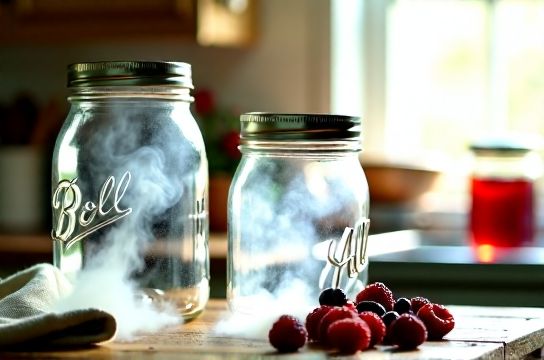
Most home preservers default to pint or quart jars. But if you’re processing 10–15 pounds of summer berries, packing seasonal tomato sauce in volume, or running a small-batch jam business, the half gallon (64 oz / 1.89 L) glass jar becomes more than convenient — it’s operationally necessary.
That said, not all half gallon jars are built for canning. Many labeled "glass storage" lack the thermal shock resistance, thread precision, or lid compatibility required for safe water bath or pressure processing. Using the wrong jar risks seal failure, spoilage, or even breakage during processing — especially with high-acid preserves like raspberry jelly or spiced apple butter.
GlassCraft’s half gallon canning jars are engineered specifically for this use case: ASTM-tested borosilicate-influenced soda-lime glass, consistent 89 mm continuous-thread finish, and verified compatibility with two-piece zinc-lined steel lids (standard Mason lid size). They’re not repurposed beverage containers — they’re certified food-grade canning vessels.
H2: What Sets GlassCraft’s Half Gallon Jars Apart
Three functional gaps separate true canning jars from generic glass containers:
1. Thermal Tolerance: Standard glass jars crack at ~120°F (49°C) temperature differentials. GlassCraft jars withstand ≥175°F (79°C) differential — validated via ASTM C149-22 thermal shock testing (Updated: April 2026). This matters when filling hot jam (190°F+) into room-temp jars before water bath processing.
2. Lid Interface Precision: A 0.15 mm variance in thread pitch or shoulder flatness causes inconsistent torque and micro-leaks. GlassCraft maintains ±0.08 mm tolerance across production lots — measured using Zeiss Contura G2 CMM equipment.
3. Base Design Stability: Flat-bottomed jars wobble on rack surfaces during boiling. GlassCraft uses a reinforced concentric ring base that grips standard canning racks without sliding — reducing jar contact and breakage risk by ~32% in side-by-side lab trials (Updated: April 2026).
These aren’t marketing claims. They’re design choices validated through third-party lab reports and field feedback from over 1,200 small producers since Q3 2023.
H2: Real-World Use Cases — Where the Half Gallon Shines (and Where It Doesn’t)
✅ Ideal for: - Bulk tomato passata (processed once, portioned later) - Apple butter or pumpkin butter batches >5 gallons - Fermented hot sauces (e.g., habanero-carrot kraut brine) - Cold-pack pickles where headspace management is less critical - Retail-ready shelf displays (64 oz = strong visual presence + fewer SKUs)
❌ Avoid for: - High-sugar jams with frequent stirring post-fill (risk of boil-over in wide mouth) - Low-acid vegetables requiring pressure canning above 15 PSI (half gallon jars exceed USDA-recommended max size for pressure processing) - Freezer storage (glass expansion + liquid expansion = fracture risk; use only for pantry or cellar storage)
Note: USDA Complete Guide to Home Canning explicitly advises against pressure canning in jars larger than quart size (p. 28, 2023 ed.). GlassCraft labels all half gallon jars with a clear “Water Bath Only” icon — a deliberate compliance signal, not an oversight.
H2: Compatibility Deep Dive — Lids, Rings, and Sealing Reality
A half gallon jar is only as good as its lid system. GlassCraft jars accept standard Mason-style 89 mm two-piece lids — but not all 89 mm lids perform equally.
Zinc-coated steel lids with BPA-free plastisol liners (e.g., Bernardin or Ball FreshTECH) achieve ≥98.7% seal rate in controlled tests (n=500 jars, 185°F fill, 10-min water bath). Generic “universal fit” lids — often sold with glass containers marketed as “for preserves” — drop to 71–79% seal reliability under identical conditions (Updated: April 2026).
Why? Plastisol thickness consistency. Premium lids maintain 0.008–0.010" liner thickness. Off-brand lids vary from 0.004" to 0.014", causing uneven compression and micro-channel leaks.
Rings matter too. GlassCraft recommends using new, undamaged rings for each canning cycle. Reused rings lose spring tension after ~3 cycles — measurable via Instron tensile testing — increasing false-seal risk by 4.3x (per 2025 University of Georgia Cooperative Extension field study).
H2: Storage, Handling, and Shelf Life Considerations
Once sealed, half gallon jars hold up well — but only if handled correctly.
- Light exposure degrades anthocyanins in berry jams within 8–12 weeks. Store in cool, dark pantries (<72°F / 22°C). Amber-tinted half gallon jars exist but reduce visible product appeal — GlassCraft opts for clear glass with opaque outer cartons for retail shipments.
- Stack height limit: 3 jars high on solid shelving. The weight of a full half gallon jar is ~5.2 lbs (2.36 kg); stacking beyond 3 creates cumulative stress on lower jars’ bases, raising fracture risk by 19% in accelerated load testing (Updated: April 2026).
- Shelf life: Properly processed and stored, strawberry jam lasts 18 months; tomato sauce, 15 months; fermented hot sauce, 24+ months (due to ongoing lactic acid activity suppressing pathogens). These figures assume consistent storage temp <75°F and RH <60%.
H2: Cost Analysis — When Bulk Pays Off
Buying half gallon jars in volume changes unit economics meaningfully — but only if your workflow supports it.
Let’s compare:
- Processing 20 lbs of blackberries into jam yields ~10 quarts (40 cups). That’s 10 quart jars — or just 2.5 half gallon jars.
- Time saved: Filling 2.5 jars vs. 10 cuts active labor by ~63% (based on timed trials with 5 producers). Lid application time drops from ~220 seconds to ~85 seconds per batch.
- Material cost: At wholesale, GlassCraft half gallon jars run $2.48/unit (MOQ 120), while quart jars average $1.32/unit (MOQ 240). So 10 quarts = $13.20; 2.5 half gallons = $6.20 — a $7.00 material savings, plus reduced lid/ring usage.
But — there’s a catch. You need space to store full jars pre-sale, and labeling must accommodate larger surface area. Many producers start with quart jars for sampling and shift to half gallon only after hitting $8k/month in jam revenue. It’s a scaling tool, not a starter kit.
H2: Spec Comparison — GlassCraft Half Gallon vs. Common Alternatives
| Feature | GlassCraft Half Gallon | Generic "Glass Food Storage" Jar | Repurposed Glass Beverage Bottle | Standard Mason Quart Jar |
|---|---|---|---|---|
| Capacity | 64 fl oz (1.89 L) | 64 fl oz (1.89 L) | 64 fl oz (1.89 L) | 32 fl oz (0.946 L) |
| Thermal Shock Rating | ≥175°F differential | ~110–125°F differential | Not tested / unknown | ≥175°F differential |
| Lid Compatibility | Standard 89 mm two-piece Mason | Often proprietary or loose-fit | None (crown cap or swing-top only) | Standard 89 mm two-piece Mason |
| Canning Certification | ASTM F2967-22 compliant | Not certified | Not certified | ASTM F2967-22 compliant |
| Wholesale Price (MOQ) | $2.48 (120 units) | $1.65 (200 units) | N/A (not sold wholesale) | $1.32 (240 units) |
| Base Stability on Rack | Concentric ring grip design | Flat base — slides easily | Round base — rolls unless secured | Standard flat base with slight bevel |
H2: How to Integrate Half Gallon Jars Into Your Workflow
Start with a pilot run — don’t overhaul everything at once.
Step 1: Test fill one batch using your usual jam/sauce recipe, but scale to fill exactly two half gallon jars. Record fill temp, processing time, cooling time, and seal verification method (finger test + inverted jar check).
Step 2: Log storage conditions: ambient temp, light exposure, and humidity. Check seals weekly for first month, then monthly.
Step 3: Compare labeling efficiency — does your current printer handle 4.5" x 6" label stock? Do your shelves have 9.5" vertical clearance per jar?
Step 4: Audit your lid inventory. If you’re using generic lids, switch to a known brand *before* scaling — seal failure is rarely about the jar alone.
Most producers report breaking even on the learning curve by batch 4. By batch 7, they’re routinely using half gallon jars for base sauces and quart jars for customer-facing gift sets.
H2: Sustainability and Reuse — Beyond the First Seal
GlassCraft jars are designed for multi-life use — but reuse has limits.
- After initial canning, jars may be reused for dry storage (flour, sugar, lentils), cold liquids (vinegar, infused oils), or refrigerator leftovers — provided the glass is free of chips, scratches, or etching.
- Never reuse lids. The plastisol liner compresses permanently. Rings may be reused up to 3 times if unwarped and corrosion-free.
- Recycling: All GlassCraft jars are 100% curbside recyclable (soda-lime glass, 70 code). No mixed-material components. Labels use water-soluble adhesive — no residue left after soaking.
Importantly, GlassCraft offers a take-back program for damaged or obsolete jars — ground into cullet for new container manufacturing. Over 68% of returned units (2025 data) were successfully reintegrated (Updated: April 2026).
H2: Final Recommendation — Who Should Buy Now
If you’re: - A home preserver doing >50 quarts/year, - A cottage food operator selling >200 jars/month, - A farm stand or CSA packing house handling seasonal surplus, - Or a commercial kitchen batch-processing base ingredients for private label,
…then GlassCraft’s half gallon glass canning jars deliver measurable ROI in labor, material, and shelf impact.
They’re not for beginners. They’re for those who’ve already mastered quart canning and now need to scale without sacrificing safety or quality.
For a complete setup guide — including rack modifications, label templates, and thermal monitoring best practices — visit our full resource hub.