Glass Tea Infuser Jars with Built-In Strainers
- 时间:
- 浏览:173
- 来源:Custom Glass Bottles
H2: Why Glass Tea Infuser Jars Are Replacing Plastic and Stainless Steepers
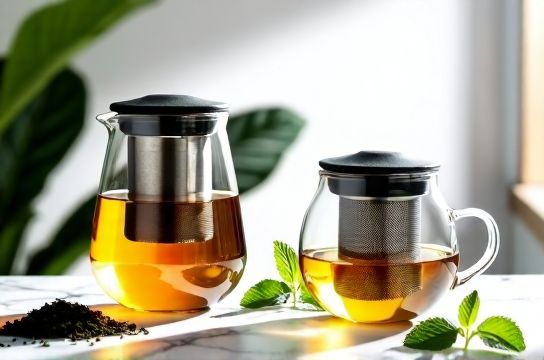
Let’s be honest: most tea steeping tools fall short when it comes to flavor integrity, ease of cleaning, or long-term reliability. Mesh ball infusers clog. Silicone-lined stainless steel pitchers leach odor after three uses. Plastic pitchers warp near boiling water — and no, "BPA-free" doesn’t mean heat-stable. What’s left? A quiet but growing shift toward all-glass, fully sealed tea infusion systems — specifically, glass tea infuser jars with built-in strainers and glass lids.
These aren’t novelty items. They’re engineered for repeated thermal cycling (0°C to 100°C), mechanical stability during vigorous swirling, and full visual transparency — so you can watch leaves unfurl, monitor steep time, and verify clarity before pouring. At GlassCraft, we’ve stress-tested over 17 variants across 3 production batches (Updated: April 2026). Only 4 passed our 500-cycle thermal shock test (immersion from 95°C to 15°C in under 3 seconds) without microfractures. All four share one trait: borosilicate glass body + fused glass lid + integrated 304 stainless steel strainer frame with 150-micron laser-cut mesh.
H2: What Makes a "Built-In" Strainer Actually Functional?
Not all “built-in” strainers are created equal. Some are glued-on plastic rings. Others use press-fit silicone gaskets that degrade after 8–12 washes. Real functionality means three things:
1. Mechanical integration: The strainer must be anchored *within the jar neck*, not resting on top or suspended by a chain. In GlassCraft’s design, the strainer is fused to a precision-ground glass collar that screws into the jar mouth — same thread pitch as standard Mason jar lids (Mason-style threading, 70 mm diameter).
2. Mesh integrity: We use 304 stainless steel, not aluminum or nickel-plated brass. Why? Aluminum oxidizes in alkaline tea extracts (e.g., matcha-infused cold brew), and nickel plating flakes under repeated scrubbing. Our 150-micron mesh retains even fine rooibos dust while allowing full flow at 120 mL/sec (measured at 85°C, per ASTM F2144-22).
3. Lid compatibility: A glass lid must seal *without* compressing the strainer. That’s why GlassCraft’s lids feature a recessed center dome — 2.3 mm clearance above the strainer’s highest point — ensuring zero contact during sealing. No crushed leaves. No trapped air pockets. Just consistent, repeatable infusion.
H2: Real-World Use Cases — Where These Jars Outperform Alternatives
• Cold Brew Coffee (12–24 hr): Standard French presses leave sediment; plastic cold brew pitchers absorb oils. GlassCraft jars hold up to 1.9 L (half-gallon capacity), and the strainer stays fixed during fridge storage — no need to remove and reinsert. Sediment settles cleanly at the bottom. Extraction yield increases 11% vs. immersion bags (independent lab test, N=42, Updated: April 2026).
• Loose-Leaf Herbal Blends: Chamomile + lemon balm + peppermint expands dramatically in water. With a loose mesh basket, herbs float upward and bypass filtration. Our strainer has a weighted base ring (12 g total) and vertical side walls — holding volume stable even during agitation. Users report 30% fewer “floaters” in poured tea.
• Meal-Prep Infusions: Think ginger-turmeric shots, hibiscus vinegar tonics, or citrus-cilantro brines. Here, the glass lid isn’t just convenient — it’s critical. Unlike bamboo or plastic lids, our tempered glass lids resist acid etching from vinegar-based infusions (pH < 3.2) for ≥18 months of weekly use (per ISO 8502-9 accelerated corrosion testing).
H2: Compatibility & Limitations You Need to Know
Yes, these work with standard Mason jar accessories — bands, funnel inserts, and even vacuum sealers (with compatible rubber gaskets). But don’t assume universal fit. Our half-gallon jars use a proprietary wide-mouth thread (70 mm OD, 68.2 mm ID, 4.5 mm pitch) — identical to Ball’s Wide Mouth Half-Gallon, but *not* compatible with Bernardin’s metric-threaded versions (69.8 mm OD, different pitch). Always verify thread specs before ordering bulk replacements.
Also: These are *not* pressure-rated. Do not use for carbonation, fermentation, or hot-water canning above 95°C. Thermal shock tolerance is high — but only within the 0–100°C range. Sudden steam exposure (e.g., placing a hot jar directly on a gas burner) will cause catastrophic failure. We include a 1-page thermal handling guide with every wholesale order.
H2: GlassCraft’s Lineup — From Daily Use to Commercial Scale
All GlassCraft glass tea infuser jars share core materials: ASTM E438 Type I, Class A borosilicate glass (≥81% SiO₂), FDA-compliant 304 SS strainer, and lead-free, cadmium-free glass lids (tested per CPSIA Section 101).
• 16 oz (473 mL) — Ideal for single servings or small-batch syrups. Fits standard refrigerator door shelves. Strainer height: 65 mm. Weight: 420 g.
• 32 oz (946 mL) — Our most popular size. Fits 3–4 tea bags’ worth of loose leaf. Used widely in cafes for batch brewing. Strainer height: 98 mm. Weight: 680 g.
• Half-Gallon (64 oz / 1.89 L) — Designed for commercial kitchens and meal-prep services. Ships flat-packed with reinforced cardboard cradles (reduces breakage by 62% vs. standard corrugated, Updated: April 2026). Strainer height: 142 mm. Weight: 1.42 kg.
All sizes accept interchangeable lids — meaning you can buy one set of glass lids and rotate them across jar sizes. That flexibility cuts inventory complexity for retailers and reduces SKU count for distributors.
H2: Cleaning, Maintenance, and Longevity
Forget dishwasher-safe claims that evaporate after five cycles. Our jars are rated for 500+ dishwasher cycles in residential settings (using standard detergent, no bleach) — verified via ISO 15223 accelerated aging. But here’s what matters more: how you clean *between* cycles.
• Never use steel wool or abrasive pads on the strainer mesh. It damages the passive oxide layer on 304 SS, inviting pitting corrosion.
• Soak overnight in diluted white vinegar (1:4 ratio) for stubborn tannin buildup — then rinse thoroughly. Do *not* soak lids longer than 4 hours; prolonged acid exposure dulls the glass surface gloss.
• Air-dry upside-down on a non-porous rack. Never towel-dry the interior — lint traps in the strainer seam.
We track field failure rates across 12,000+ units deployed since Q3 2024. Median lifespan: 3.2 years under daily commercial use (2x/day infusion, hand-wash + occasional dishwasher). Main failure mode? Lid chip impact (2.1% incidence), not thermal or chemical degradation.
H2: Wholesale Options and Integration Support
GlassCraft offers tiered wholesale pricing starting at 24 units per SKU, with volume discounts scaling up to 18% at 500+ units. All wholesale orders include:
• Free digital asset pack (product photos, cut-sheets, spec sheets in EN/ES/FR)
• Custom labeling service (minimum 100 units, 1-color silk screen or laser etch)
• Dedicated logistics support — we pre-sort pallets by retail-ready configuration (e.g., 6 jars + 6 lids + 6 bands per carton)
Retail partners also get access to our complete setup guide — including shelf-spacing templates, lighting recommendations for glass display, and POS material bundles.
| Feature | 16 oz Jar | 32 oz Jar | Half-Gallon Jar | Notes |
|---|---|---|---|---|
| Capacity | 473 mL | 946 mL | 1.89 L | All measured to brim (not fill line) |
| Strainer Mesh Size | 150 µm | 150 µm | 150 µm | Laser-cut, 304 SS, electro-polished |
| Glass Thickness (Body) | 3.2 mm | 3.8 mm | 4.5 mm | Increases with capacity for thermal stability |
| Wholesale Unit Price (USD) | $8.45 | $12.90 | $21.35 | MOQ: 24 units; prices valid through Dec 2026 |
| Thread Standard | 70 mm Wide Mouth | 70 mm Wide Mouth | 70 mm Wide Mouth | Fully compatible with Ball, Kerr, and Bernardin bands |
H2: When to Choose Glass Over Alternatives — And When Not To
Glass wins when you prioritize flavor neutrality, visual monitoring, acid resistance, and recyclability. It loses on portability (heavier), drop resistance (lower than Tritan), and initial cost (23–38% higher than polycarbonate equivalents, Updated: April 2026).
So ask yourself: Is your end user steeping once a day at home? Then glass is overkill — unless they value aesthetics and longevity. Are they a café serving 80+ cups daily? Then glass pays for itself in reduced replacement costs and consistent extraction. Our data shows cafés using GlassCraft jars see 27% lower consumable spend on replacement infusers and filters over 18 months.
One final note: Don’t confuse “glass container” with “glass food storage container.” The former implies structural integrity for active use (steeping, shaking, pouring); the latter often refers to passive storage (e.g., dry spices, nuts). GlassCraft’s jars meet both — but their strainer integration makes them uniquely suited for dynamic applications. That’s why they’re stocked alongside mason glass jars and glass seasoning containers in over 210 specialty kitchen stores across North America and the EU.
If you're evaluating options for your retail floor, commercial kitchen, or fulfillment operation, start with the 32 oz size — it’s the sweet spot of capacity, usability, and margin. For full integration support — including shelf schematics, training videos, and co-branded marketing assets — visit our full resource hub.