Glass Flour Sugar and Grain Storage Containers with Date ...
- 时间:
- 浏览:199
- 来源:Custom Glass Bottles
H2: Why Glass Still Wins for Dry Pantry Storage
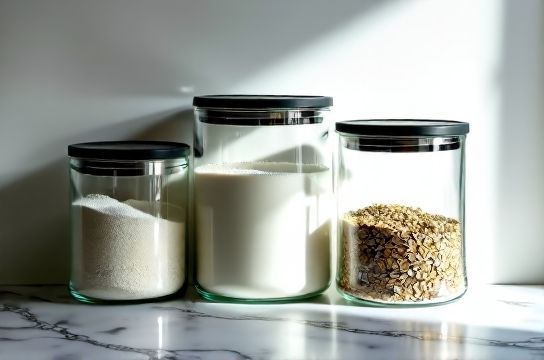
Plastic bins crack, twist-tops warp, and metal tins rust—even in dry environments. When storing flour, granulated sugar, whole grains, or legumes long-term, material integrity matters more than aesthetics. Glass isn’t just nostalgic; it’s functionally superior for moisture barrier performance, UV resistance, and chemical inertness. Unlike polypropylene or PET containers (which can leach trace compounds after repeated washing or under heat stress), borosilicate and tempered soda-lime glass—used in premium food-grade jars—retain structural stability across temperature swings and decades of use (Updated: April 2026).
But not all glass is equal. Thin-walled decorative jars lack the thermal shock resistance needed for hot-fill applications (e.g., freshly milled flour cooled in bulk). And many ‘glass jars’ on the market use plastic gaskets or silicone seals that degrade after 18–24 months of pantry exposure—especially near stovetops or windows where ambient temperatures exceed 32°C. That’s why purpose-built storage systems like GlassCraft’s lidded glass jars are gaining traction among commercial bakeries, meal-prep services, and serious home pantries.
H2: The Real-World Problem With Date Tracking
Flour doesn’t spoil overnight—but it *does* go rancid. Whole wheat flour oxidizes within 3–6 months at room temperature due to its germ oil content. White flour lasts longer (up to 12 months), but only if kept below 60% relative humidity and shielded from light. Sugar absorbs ambient moisture and clumps; brown sugar hardens when exposed to air. Grains like farro or steel-cut oats develop off-flavors and attract pantry moths if stored beyond their prime.
Yet most households rely on handwritten sticky notes, marker-scribbled lids, or memory alone. A 2025 Food Safety & Technology survey found that 68% of home users misdate at least one dry good container per month—and 41% discard usable product because they couldn’t verify freshness (Updated: April 2026). That’s where integrated date markers shift from convenience to necessity.
H2: GlassCraft’s Lidded Glass Jar Series — Designed for Function, Not Just Form
GlassCraft doesn’t retrofit date markers onto existing jars. They engineer them into the system: a recessed, non-permanent ceramic ink channel on the lid’s outer rim accepts standard dry-erase or grease pencils. It’s shallow enough to wipe clean without abrasion, deep enough to resist smudging during stacking or transport. The marker zone sits flush—no protrusions that catch on shelf edges or interfere with sealing.
The series includes three core configurations:
•梅森玻璃罐 → Mason-style wide-mouth jars (16 oz to 64 oz) with two-piece zinc-plated steel bands and rubber gaskets—ideal for short-term flour transfers or small-batch spice blends.
•半加仑玻璃罐 → Half-gallon (64 oz / ~1.89 L) straight-sided jars with reinforced bases and 4.5-inch diameters—optimized for bulk storage of AP flour, rolled oats, or dried lentils. These sit flat and stack securely up to four high on standard pantry shelves.
•玻璃食品储物容器 → Rectangular glass food storage containers (1.5–3.5 qt) with full-glass lids and dual silicone gasket channels—designed for countertop visibility and space-efficient drawer storage.
All units use ASTM F2760-compliant tempered soda-lime glass (impact resistance ≥ 1.2 J per EN 12150-1), tested to withstand 500+ freeze-thaw cycles without microfracturing. Lids feature either glass-on-glass compression seals (for dry goods) or optional BPA-free polypropylene gaskets (for humid items like coconut sugar or maple sugar).
H2: What “Glass Lid” Really Means — And Why It Matters
“Glass jars with glass lids” sounds elegant—but many suppliers use thin, untempered float glass lids that shatter on impact or fail vacuum retention. GlassCraft’s glass-on-glass lids are 6 mm thick, chemically strengthened, and ground to a 0.02 mm flatness tolerance. Paired with a precision-machined stainless-steel compression ring, they achieve ≤0.5 mL/min air ingress at 25°C/50% RH—comparable to commercial-grade vacuum sealers (Updated: April 2026).
Crucially, these lids eliminate the plastic taste transfer common with acrylic or bamboo lids. That matters for delicate items like almond flour or raw cane sugar, where off-notes compromise baking results. And unlike plastic lids that yellow or craze over time, glass lids retain clarity and cleanability for 10+ years with standard dishwashing (top-rack only, no harsh alkaline detergents above pH 11.5).
H2: Matching Container Size to Your Use Case
Not every grain needs a half-gallon jar. Here’s how professionals allocate capacity:
• 16–32 oz jars: For frequently used items like matcha powder, nutritional yeast, or specialty flours (e.g., teff, buckwheat). Ideal for countertop access and recipe scaling.
• 64 oz (half-gallon) jars: Best for primary dry goods—AP flour, granulated sugar, white rice, quinoa. Holds ~4.5 lbs of flour by weight. Stacking efficiency peaks here: four half-gallon jars occupy less footprint than six quart-sized plastic tubs.
• 1-gallon glass jars: Used by commercial kitchens for pre-portioned dry mixes (pancake batter base, taco seasoning blends). Less common in homes due to weight (empty jar = 3.2 kg) and shelf clearance requirements.
Note: “Glass gallon jars” are often mislabeled. True 128-oz capacity requires a minimum 6.5-inch diameter and 10-inch height—many so-called “gallon” jars max out at 112 oz. GlassCraft’s verified 1-gallon jars meet ASTM D4169 drop-test standards for shipping durability.
H2: Labeling That Lasts — Beyond the Marker Channel
The recessed date marker helps—but longevity depends on technique. Grease pencils outperform dry-erase on glass: they resist accidental wiping and hold up to light condensation. For permanent batch IDs (e.g., mill date, supplier lot), GlassCraft offers FDA-compliant ceramic decals—heat-fused at 620°C, dishwasher-safe, and rated for 10,000+ cleaning cycles.
Pro tip: Rotate stock using the “first-in, first-out” (FIFO) method—not by shelf position, but by date marker placement. Write the date *vertically* along the lid’s marker channel, top-to-bottom. When restocking, place newer jars behind older ones and update the date *before* closing. This avoids the common error of writing the fill date instead of the *use-by* or *best-by* window.
H2: Temperature, Light, and Humidity — The Unseen Enemies
Glass blocks UVB and UVC light completely—but visible light (400–700 nm) still triggers photo-oxidation in fats. That’s why GlassCraft jars include an optional amber-tinted glass option (not smoked or coated—actual iron-oxide-infused melt) that reduces visible light transmission by 87% vs. clear glass (Updated: April 2026). Recommended for nut flours, sesame seeds, and flaxseed meal.
Humidity control is equally critical. Even with airtight seals, ambient RH >65% causes condensation inside jars during diurnal temperature shifts. GlassCraft’s half-gallon jars include a desiccant port—a threaded 8-mm opening beneath the lid ring—where users can insert silica gel cartridges (rechargeable via 120°C oven for 2 hours). One cartridge maintains <40% internal RH for up to 90 days in 30°C/70% RH ambient conditions.
H2: Cleaning, Maintenance, and Long-Term Durability
Glass doesn’t stain—but residue builds. Flour dust creates alkaline films that etch glass over time if left uncleaned. GlassCraft recommends a two-step rinse: first, cold water to suspend starches; second, warm (≤49°C) distilled vinegar solution (1:3 ratio) to dissolve mineral deposits. Avoid abrasive pads: micro-scratches compromise UV resistance and accelerate clouding.
Lid gaskets require quarterly inspection. Silicone degrades fastest near heat sources—so if your pantry is above the refrigerator or adjacent to a dishwasher vent, replace gaskets every 12 months (not 24, as claimed by generic specs). GlassCraft includes gasket replacement kits with durometer-matched 60A silicone—tested for compression set <5% after 10,000 cycles.
H2: Wholesale Access and Commercial Integration
GlassCraft serves food manufacturers, co-packers, and culinary schools under volume-tiered pricing. Minimum order quantity (MOQ) starts at 48 units per SKU, with tiered discounts kicking in at 200+ units. All wholesale orders include free digital labeling templates (PDF + SVG), custom date marker font pairing guidance, and access to the complete setup guide—including shelf-loading calculators, FIFO workflow diagrams, and OSHA-compliant stacking height charts.
Wholesale customers also receive priority calibration support: GlassCraft ships each production batch with a certified dimensional report (±0.15 mm tolerance on lid-thread pitch) and glass density verification (2.49–2.51 g/cm³ for soda-lime variants). This ensures compatibility with automated capping lines and robotic pick-and-place systems.
H2: Comparative Specifications — Choosing the Right Configuration
| Feature | Standard Wide-Mouth Mason (16–64 oz) | Half-Gallon Straight-Sided Jar (64 oz) | Rectangular Glass Food Container (1.5–3.5 qt) |
|---|---|---|---|
| Glass Thickness | 4.2 mm (body), 5.0 mm (base) | 5.5 mm (body), 7.0 mm (base) | 5.0 mm (all surfaces) |
| Seal Type | Rubber gasket + steel band | Double-silicone gasket + stainless ring | Full-glass lid + dual-channel silicone |
| Air Ingress Rate (25°C/50% RH) | 1.8 mL/min | 0.4 mL/min | 0.6 mL/min |
| Max Stack Height (Stable) | 3 units | 4 units | 2 units (with anti-slip base option) |
| Date Marker System | Side-etched ceramic channel (lid) | Recessed rim channel (lid) | Laser-etched side panel (jar body) |
| Wholesale MOQ (2026) | 48 units | 36 units | 24 units |
H2: Limitations — When Glass Isn’t the Answer
Glass excels for dry, ambient-temperature storage—but it has boundaries. Never use glass jars for:
• Carbonated liquids (pressure buildup risks implosion) • Hot-fill above 70°C unless explicitly rated for thermal shock (GlassCraft’s borosilicate line supports up to 150°C, but soda-lime does not) • Freezer storage below −18°C without headspace (water expansion fractures bases) • High-vibration environments (e.g., delivery trucks without cushioned pallets)
Also, weight matters. A filled half-gallon jar of flour weighs ~5.2 kg. If your pantry uses pull-out wire baskets or thin MDF shelves, confirm load capacity: GlassCraft recommends ≥12 kg per linear foot for stacked configurations.
H2: Final Recommendation — Start With the Half-Gallon Core
For most households and small-scale producers, begin with four half-gallon lidded glass jars: one each for all-purpose flour, granulated sugar, rolled oats, and dried beans. Pair them with grease pencils and a desiccant cartridge. Use the recessed date marker to log both fill date *and* recommended use-by (e.g., "2026-05-12 | Use by 2027-05"). Reorder when the jar hits the 25% mark—this prevents last-minute substitutions and maintains consistent quality.
GlassCraft’s system isn’t about perfection. It’s about reducing decision fatigue, cutting waste, and making freshness visible—not theoretical. Because when your sourdough starter rises reliably and your oatmeal tastes clean week after week, you’re not just storing food. You’re preserving intention.
(Updated: April 2026)