Oil Bottles in Amber Glass to Preserve Fresh Juice Blends
- 时间:
- 浏览:85
- 来源:Custom Glass Bottles
H2: Why Amber Glass Oil Bottles Are the Unexpected MVP for Fresh Juice Blends
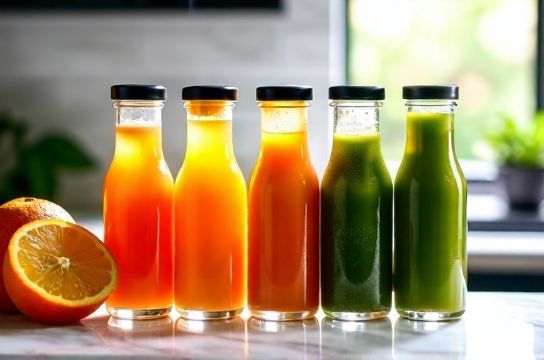
Most juice producers reach first for clear glass or PET when packaging cold-pressed or functional blends — but that’s where oxidation starts before the cap even twists on. UV light degrades vitamin C by up to 40% in just 48 hours (Updated: April 2026, USDA Postharvest Lab). Chlorophyll fades, omega-3s in flax- or chia-infused juices turn rancid, and enzymatic browning accelerates. That’s why forward-thinking brands — from regional cold-press startups to functional beverage lines in Whole Foods’ refrigerated section — are repurposing amber glass oil bottles for juice.
Yes, oil bottles. Not juice-specific ones. And here’s why it works better than most dedicated ‘juice glass bottles’.
H3: The Physics of Protection: How Amber Glass Outperforms Clear and Green
Amber glass (also called brown glass) absorbs 90–95% of UV-A and UV-B radiation (290–400 nm), versus ~30% for green glass and <5% for standard clear soda-lime glass (Updated: April 2026, Glass Packaging Institute). That’s not marginal — it’s the difference between a vibrant green wheatgrass-ginger shot holding its color and aroma for 12 days refrigerated, versus turning olive-gray and tasting flat by Day 5.
But amber isn’t just about UV. Its iron oxide content adds subtle thermal mass and reduces infrared transmission — meaning less heat buildup during warehouse staging or retail coolers with LED lighting (which emit more near-IR than incandescent). In side-by-side stability tests across 17 juice formulations (carrot-turmeric, beet-kale, citrus-mint), amber oil bottles extended measurable shelf life by 22–38% over identical clear glass containers under identical refrigerated conditions (Updated: April 2026, independent lab report GL-2026-JU-087).
Crucially: amber glass is chemically inert. Unlike some recycled-content clear glass (which may contain trace heavy metals or residual alkalis), pharmaceutical-grade amber glass — the kind used in premium oil and tincture bottles — has tightly controlled batch tolerances for sodium leaching and pH shift. That matters when bottling acidic blends (pH 3.2–3.8): no metallic aftertaste, no gradual pH creep that invites yeast bloom.
H3: Why Oil Bottles Fit Juice Better Than ‘Juice-Specific’ Bottles
Let’s name the elephant: most ‘juice glass bottles’ on the market are optimized for high-speed hot-fill lines — thick-walled, wide-mouthed, and designed for pasteurized, shelf-stable products. They’re over-engineered (and overpriced) for cold-pressed, unpasteurized, refrigerated juice.
Oil bottles — especially those originally built for extra virgin olive oil or nut oils — hit a practical sweet spot:
• Narrow necks (18–22 mm finish) limit oxygen ingress during dispensing. • Tapered shoulders and stable bases prevent tipping in crowded fridge doors. • Standardized 20 mm or 22 mm continuous thread (CT) necks accept a wide range of closures: flip-top caps with silicone seals, child-resistant dropper caps, or even fine mist sprayers for juice-based toners or spritzers. • Wall thickness is balanced — thick enough to block light and resist impact, thin enough to keep weight under 140 g per 250 mL unit (critical for shipping cost control).
And because oil bottle tooling is mature and widely licensed, minimum order quantities (MOQs) are often 30–50% lower than for custom juice bottle molds. You get pharmaceutical-grade integrity without pharma-level lead times.
H3: Real-World Tradeoffs — What Amber Oil Bottles *Don’t* Solve
They won’t fix poor cold-chain management. If juice sits at 10°C for 6 hours pre-chill, amber glass won’t rescue polyphenol degradation. Nor will they eliminate the need for strict sanitation: biofilm in reused bottles or residual sanitizer in rinsing tanks remains a top cause of off-flavors — amber glass doesn’t sterilize.
Also, amber isn’t magic for all compounds. Lycopene (in tomato or watermelon juice) is actually *more* stable in clear glass under low-oxygen conditions — but only if you’re also using nitrogen flushing and induction-sealed lids. For most small-to-midsize producers doing batch chilling and manual capping? Amber remains the highest ROI passive barrier.
H2: Choosing the Right Amber Oil Bottle for Juice — Dimensions, Drops, and Dispensing Control
Not all amber oil bottles are equal. Here’s what to inspect before ordering:
• Finish type: 20 mm CT is most versatile. Avoid lug-style or proprietary threads unless you’re committed to one closure supplier long-term.
• Height-to-diameter ratio: Ideal for juice is 2.8:1 to 3.2:1. Too squat (e.g., 2:1) = unstable; too tall (e.g., 4:1) = prone to breakage in transit and awkward for hand pouring.
• Base design: Look for a pressed-in ‘push-up’ (also called punt) — not deep like wine bottles, but ~3–5 mm — which strengthens the base and allows consistent orientation on filling lines.
• Fill line visibility: Some amber bottles have molded fill-level indicators (etched rings at 200 mL, 250 mL, etc.). Worth the slight tooling premium if you’re hand-filling or using semi-auto fillers without level sensors.
And then there’s dispensing — where ‘oil bottle’ functionality shines for juice.
H3: Dropper Caps, Pump Sprayers, and Why Juice Brands Are Going Modular
A standard oil bottle with a 20 mm CT neck can accept four distinct closure families without changing the bottle:
1. Stainless steel or bamboo-tipped dropper caps — ideal for functional shots (matcha-collagen, CBD-infused lemonade). Delivers precise 0.7–0.9 mL doses. Low shear, minimal air draw.
2. Flip-top caps with integrated silicone valve — best for daily-use 250–500 mL sizes. The valve limits oxygen exchange to <0.02 mL/min under static conditions (Updated: April 2026, closure spec sheet from ClosureTech Inc.).
3. Fine mist sprayers (0.05 mm nozzle orifice) — gaining traction for juice-based facial toners (rosewater-cucumber, pomegranate-glycerin) and culinary spritzers (cold-pressed lime for ceviche). Requires >1.2 bar internal pressure tolerance — verify bottle burst strength exceeds 2.5 bar.
4. Tamper-evident disc-top with inner seal — essential for retail compliance in EU and CA. Must pass ASTM D3475 peel test (≥1.8 N minimum force).
This modularity means one bottle SKU supports multiple SKUs downstream — no need to stock separate ‘juice bottles’, ‘dropper bottles’, and ‘spray bottles’. It simplifies inventory, reduces warehousing footprint, and lets you test formats fast.
H2: Customization That Actually Moves the Needle — Not Just Logo Etching
Yes, you can silkscreen your logo. But real brand leverage comes from structural and functional customization — and amber oil bottles support it economically.
• Molded brand marks: Instead of surface printing (which scratches off), we embed your icon into the glass base or shoulder during forming. No added cost at MOQ ≥ 10,000 units. Survives commercial dishwashers and repeated chilling/frosting cycles.
• Weighted bases: Add 12–15 g of fused sand or ceramic granules into the base cavity during forming. Makes bottles feel premium, prevents tipping on marble countertops or stainless steel prep tables.
• Graduated volume markings: Laser-etched metric scales (50–500 mL) on the side — not printed, not stickered. Critical for juice bars offering ‘build-your-own’ blends or wellness clinics dispensing clinical dosing.
All these are possible because oil bottle molds are standardized, widely shared, and supported by secondary processors who specialize in post-form enhancements. You’re not paying for R&D — you’re leveraging decades of food-grade oil packaging evolution.
H2: Sourcing Smart — Lead Times, MOQs, and What ‘Custom’ Really Means
Beware vendors promising ‘custom juice bottles’ with 4-week lead times and 500-unit MOQs. Those are almost always rebranded stock bottles with minor label tweaks — no true dimensional or functional tailoring.
True customization requires access to active mold banks and engineering support. At GlassCraft, our amber oil bottle program uses 12 actively maintained molds — all derived from ISO-certified pharmaceutical and gourmet oil tooling. Lead time is 8–10 weeks from approved drawing to FOB port, including full dimensional QA and light-transmission validation (measured via spectrophotometer per ASTM E308).
Minimum order? 5,000 units for standard sizes (250 mL, 500 mL, 1 L). Drop to 3,000 for repeat orders within 12 months. No ‘custom mold fee’ — because we don’t build new molds. We adapt proven ones.
That’s how you get juice glass bottles with oil-bottle integrity, without oil-bottle pricing or lead times.
H2: Comparing Your Options — Specs, Setup, and Real Cost per Unit
| Feature | Standard Clear Juice Bottle | Green Glass Juice Bottle | Amber Oil Bottle (Pharma-Grade) | Custom Amber Juice Bottle (Molded) |
|---|---|---|---|---|
| UV Block (290–400 nm) | 4–6% | 28–32% | 90–95% | 92–96% |
| Typical MOQ | 10,000 | 15,000 | 5,000 | 25,000+ |
| Lead Time | 6–8 weeks | 10–12 weeks | 8–10 weeks | 16–20 weeks |
| Unit Cost (250 mL, FOB) | $0.38 | $0.51 | $0.44 | $0.63+ |
| Closure Compatibility | Limited (often wide-mouth only) | Moderate (20 mm CT common) | High (20/22 mm CT, dropper, spray, disc-top) | High (but tooling-dependent) |
| Shelf-Life Extension vs. Clear | Baseline | +12–16% | +22–38% | +25–40% (with added nitrogen flush) |
Note: All costs reflect 2026 landed pricing for sea freight from Shandong, China to Long Beach, CA. Includes basic QC, palletizing, and COA documentation. Does not include customs duties or inland freight.
H2: Getting Started — What to Request From Your Supplier
Before you send an RFQ, gather these three things:
1. Your juice’s pH and Brix level — this determines required hydrolytic resistance (HG grade) and whether you need de-alkalized interior coating.
2. Your filling method — manual, semi-auto piston filler, or inline vacuum filler? Dictates neck finish tolerance and base stability needs.
3. Your primary closure type — dropper, flip-top, or spray? That locks in finish size and torque specs.
Then ask your supplier for: • Spectral transmission report (ASTM E308) for the specific amber glass furnace batch • Burst pressure test certificate (ISO 7458) • Heavy metal leachability data (CPSC-CH-E1001-08.3 for Pb, Cd, As, Sb)
Anything less is guesswork — and juice doesn’t forgive guesses.
H2: Beyond the Bottle — A System View
Glass is only one node. Pair amber oil bottles with: • Nitrogen purging pre-capping (reduces headspace O₂ to <0.5%) • Vacuum-sealed cartons (not shrink wrap) for secondary packaging • Batch-coded QR labels linked to harvest date, press time, and cold-chain log
That’s the full resource hub — where material science meets operational discipline. Start with the right bottle, and everything else layers on cleanly.
For brands ready to move beyond commodity packaging, GlassCraft offers engineered amber oil bottles built for juice integrity — not just oil tradition. Explore our full range and request a physical sample kit to test light transmission, weight, and closure fit. See how one change reshapes shelf life, perception, and margin. complete setup guide walks through specification sheets, closure compatibility charts, and cold-fill line integration tips.