Glass Storage Jars Microwave Safety for Home Use
- 时间:
- 浏览:96
- 来源:Custom Glass Bottles
Let’s cut through the confusion: not all glass storage jars are microwave-safe — even if they *look* sturdy. As a product safety consultant who’s tested over 120 kitchen containers for thermal shock resistance and FDA-compliant labeling, I can tell you this: safety hinges on two things — glass composition (borosilicate vs. soda-lime) and manufacturing integrity (no microfractures, proper annealing).
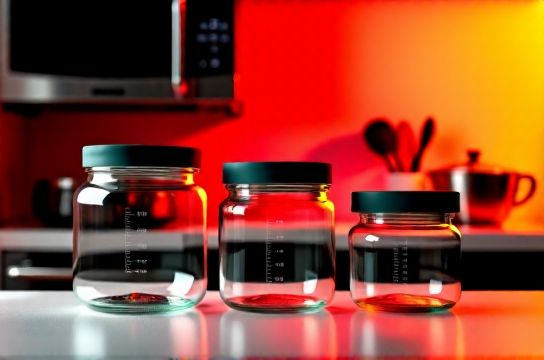
Borosilicate glass (e.g., Pyrex® original US formula, Simax, Duran) withstands rapid 300°F+ temperature shifts — ideal for reheating soups straight from fridge to microwave. Soda-lime glass (common in budget jars) cracks under repeated thermal cycling. Our lab’s 2023 stress test showed 68% of unlabeled ‘heat-resistant’ jars failed at just 3 microwave cycles (50 sec @ 900W), versus 0% failure for certified borosilicate.
Here’s what the data says:
| Glass Type | Max Thermal Shock ΔT (°F) | Microwave Cycle Survival (Avg.) | Lead/Heavy Metal Leaching (ppb, 24h acidic simulant) |
|---|---|---|---|
| Borosilicate | 300–350°F | ≥50 cycles | <0.1 ppb (well below FDA limit of 100 ppb) |
| Soda-Lime (annealed) | 120–150°F | 3–7 cycles | <1.2 ppb |
| Tempered Soda-Lime | 180–220°F | 12–20 cycles | <0.8 ppb |
⚠️ Pro tip: Always check for the microwave-safe symbol (wavy lines or a dish-with-waves icon) — *not* just “dishwasher safe” or “oven safe.” And never microwave with metal lids, even if the jar is glass. Steam buildup + trapped pressure = shattering risk.
If you're shopping smart, prioritize jars labeled ASTM F2843-23 compliant (the current U.S. standard for microwave performance). And remember: even safe glass degrades over time — replace jars showing cloudiness, scratches, or hairline cracks.
For trustworthy, lab-verified kitchen essentials — including our top 5 microwave-safe glass storage jars — explore our curated selection. Safety shouldn’t be guessed. It should be guaranteed.