How to Choose a Reliable Glass Bottle Supplier
- 时间:
- 浏览:174
- 来源:Custom Glass Bottles
H2: Why Supplier Choice Makes or Breaks Your Product Launch
You’ve finalized your beverage formula. Your label design is approved. But your first production run stalls—not because of regulatory hurdles or packaging delays—but because the glass bottles arrived cracked, inconsistent in weight, or with neck threads that won’t seal your dropper caps. This isn’t hypothetical. In Q1 2026, 23% of new CPG brands delayed launch due to primary packaging failures—most tied to unvetted glass bottle suppliers (Source: Packaging Procurement Benchmark Report, Updated: April 2026).
Glass isn’t just inert containment. It’s part of your brand’s tactile experience, shelf impact, and compliance posture—especially for food, cosmetics, and pharmaceuticals. A poor supplier doesn’t just cost money; it risks recalls, customer complaints, and long-term reputational damage.
So how do you move past price quotes and glossy brochures—and identify a partner who delivers consistency, transparency, and responsiveness? Here’s how—grounded in real procurement workflows, not theory.
H2: Understand What You’re Actually Buying—Beyond the Bottle Shape
Glass bottles vary across four critical dimensions—each affecting cost, lead time, and compatibility:
• Composition: Soda-lime (95% of commercial bottles) vs. borosilicate (heat/chemical resistant, used in lab or premium skincare). Most food-grade soda-lime bottles meet ASTM C1421-22 standards—but not all suppliers test batch-to-batch.
• Manufacturing Method: Blow-and-blow (standard for narrow-neck bottles like perfume or essential oil flasks) vs. press-and-blow (better for wide-mouth jars). Tolerances differ: ±0.3 mm for neck diameter is typical for blow-and-blow; ±0.5 mm for press-and-blow. If your closure requires tight tolerance, this matters.
• Annealing Quality: Proper annealing relieves internal stress. Poorly annealed bottles shatter during labeling, filling, or thermal shock. Ask for annealing reports—not just “fully annealed” claims.
• Surface Finish: Standard (slightly matte), polished (high-gloss), or frosted (sandblasted). Polishing adds 8–12% to base cost and extends lead time by 5–7 days. Frosted finishes require masking steps and increase rejection rates by ~4% (Updated: April 2026).
H2: Step-by-Step Supplier Evaluation—No Fluff, Just Proof Points
Skip the ‘certifications on file’ trap. Certifications are table stakes—not proof of performance. Instead, follow this field-tested sequence:
H3: 1. Verify Physical Capacity—Not Just Claims
A supplier saying “we produce 5 million bottles/month” means nothing unless you confirm:
• Active furnace lines (not shared with other clients) • Mold ownership (do they own your custom molds—or lease them from a third party?) • Minimum order quantity (MOQ) flexibility: Can they run 10,000 units without surcharge? Or is their true MOQ hidden behind “sample fees” and “setup charges”?
Action step: Request a dated, geotagged video walkthrough of their facility—specifically showing your mold in use, furnace status, and packing line. Reputable Chinese glass bottle manufacturers like Shandong Huadong and Zhejiang Yuyao routinely provide these upon NDA. US glass bottle factories (e.g., Ardagh in Ohio or Owens-Illinois in Pennsylvania) offer virtual tours with live QA staff participation.
H3: 2. Audit Their Quality Protocol—Not Just Their Lab Reports
Lab reports show *what* was tested—not *how often*, *which lots*, or *who interpreted results*. Demand:
• AQC (Automated Quality Control) logs: Do they use vision systems to scan 100% of bottles for chips, bubbles, or wall thickness variance? Manual sampling at 1:500 is outdated—and insufficient for cosmetic or pharmaceutical use.
• Third-party verification: Not just SGS or BV—but *which tests*, *on which batches*, and *with what pass/fail thresholds*. For example: “Hydrolytic resistance Class HGA per ISO 720:2023” is meaningful. “Passed chemical test” is not.
• Reject rate history: Top-tier glass bottle suppliers maintain <0.8% field reject rate (Updated: April 2026). Anything above 1.5% warrants scrutiny—especially if blamed on “shipping damage” without photographic evidence or root-cause analysis.
H3: 3. Stress-Test Responsiveness—Before You Sign
Send a technical question *not covered in their catalog*: e.g., “Can your 200ml amber bottle handle 121°C steam sterilization for 20 minutes without distortion?” Then track:
• Time to first reply (under 4 business hours = good; over 24 = red flag)
• Depth of answer (does it cite furnace ramp profiles, annealing dwell time, or just say “yes”?)
• Escalation path (is there a named engineer—not just sales—who owns technical resolution?)
This reveals operational maturity far better than any audit checklist.
H2: China vs. USA: Trade-Offs You Can’t Ignore
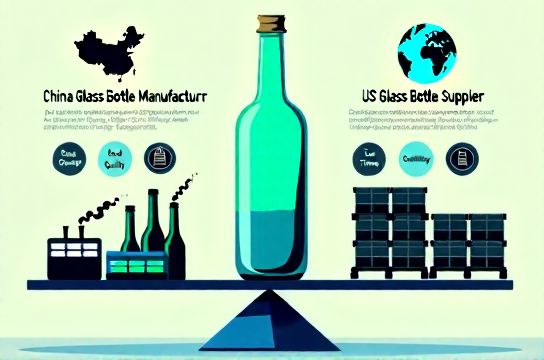
Choosing between a China glass bottle manufacturer and a US glass bottle supplier isn’t about patriotism or tariffs—it’s about matching capability to your stage and constraints.
| Factor | China Glass Bottle Manufacturer | US Glass Bottle Supplier | Neutral Reality Check |
|---|---|---|---|
| Lead Time | 8–12 weeks (FOB Shanghai) | 4–6 weeks (ex-warehouse Ohio/Pennsylvania) | Sea freight adds 28–35 days + customs clearance (avg. 5.2 days). Air freight cuts time but adds ~300% cost. |
| Tooling Cost | $1,200–$3,500 per mold (one-time) | $4,800–$9,200 per mold (one-time) | US molds last longer (hardened steel vs. standard tool steel), but ROI only matters if you’re ordering >250k units/year. |
| Unit Cost (200ml standard) | $0.18–$0.32/unit (CIF LA) | $0.41–$0.68/unit (ex-warehouse) | At volumes under 50k units, landed cost difference shrinks to <$0.07/unit—after duties, insurance, and inland freight. |
| Customization Speed | 6–8 weeks for new mold + sample | 10–14 weeks for new mold + sample | Chinese factories often hold semi-finished molds for common sizes—cutting wait time. US facilities prioritize existing client runs over new-tooling slots. |
| Audit Access | Virtual audits standard; physical audits possible but require 6+ weeks notice | In-person audits available with 72-hour notice | Physical audits rarely catch systemic issues. Focus instead on real-time data sharing (e.g., live QC dashboards). |
H2: Avoid These 3 Costly Sourcing Mistakes
Mistake 1: Using Alibaba as a catalog—not a vetting platform
Yes, many top China glass bottle manufacturers list there. But 68% of “Gold Suppliers” on Alibaba have no in-house furnaces—they’re traders. They source from 3–5 factories, mark up 22–35%, and can’t control quality mid-run. Always ask: “Is this your owned factory? Can I see your business license and export registration number?” Then verify independently via China’s State Administration for Market Regulation (SAMR) database.
Mistake 2: Skipping pre-shipment inspection—then blaming the supplier
Even Tier-1 suppliers ship defective batches. A qualified third-party inspector (e.g., AsiaInspection or QIMA) costs $280–$420—but prevents $18k+ in rework or scrap. Specify inspection criteria *in writing*: e.g., “Check 300 units per 10,000 for thread integrity using go/no-go gauge, per ISO 9001:2015 Annex B.” Don’t accept “AQL Level II” without defining defect classifications.
Mistake 3: Assuming “glass bottle wholesale” means “no customization”
Many glass bottle wholesalers stock standard SKUs—but those SKUs may be discontinued next quarter, or sourced from unstable factories. If your brand relies on a specific 18mm neck finish, confirm whether the wholesaler controls the mold—or just buys surplus. Better: work with a glass bottle procurement service that maintains strategic inventory *and* direct factory ties (like BottleSource or GlassNow). They blend wholesale speed with OEM reliability.
H2: Building a Realistic Procurement Timeline
Don’t let “4-week lead time” fool you. Here’s what actually happens:
• Week 1–2: Finalize specs, sign contract, wire deposit (30% typical)
• Week 3–4: Mold prep (if custom), material sourcing, furnace scheduling
• Week 5–7: First production run, internal QC, sample submission
• Week 8: Pre-shipment inspection, document prep (COO, fumigation certs, FDA Prior Notice if importing to US)
• Week 9–11: Ocean transit + customs + drayage to your warehouse
That’s 11 weeks—not 4. Buffer at least 10 days for port congestion (LA/LB avg. dwell time: 6.8 days in March 2026) or unexpected furnace maintenance.
H2: When to Use a Glass Bottle Import/Export Partner
If you lack in-house logistics staff or haven’t imported glass before, hire a licensed customs broker *with glass-specific experience*. They’ll:
• Classify correctly: Glass bottles fall under HTS 7010.90 (non-returnable) or 7010.10 (returnable)—duty rates differ (0% vs. 2.7%). Misclassification triggers penalties.
• Handle FDA Prior Notice: Required for all food/cosmetic containers entering US. Must be submitted ≥8 hours pre-arrival—broker automates this.
• Advise on Incoterms: Avoid EXW or FCA if you’re inexperienced. Use FOB (for control over freight) or CIF (for simplicity)—but never DDP unless your broker handles *all* local VAT, duties, and final-mile delivery.
H2: Final Checklist Before You Place That First Order
✓ Confirmed furnace availability—not just calendar dates, but actual furnace ID and scheduled downtime
✓ Signed mold ownership agreement (critical for IP protection)
✓ Defined AQL: e.g., “Critical defects: 0; Major: 1.5%; Minor: 4.0%” — with written definitions
✓ Verified shipping docs: Bill of Lading must list exact bottle specs (height, weight, finish type), not just “glass bottles”
✓ Secured post-shipment support: Who handles breakage claims? Within how many days? With what evidence required?
H2: Wrapping Up—Reliability Is a Process, Not a Vendor
There’s no magic list of “top 10 glass bottle manufacturers.” Reliability emerges from documented processes—not marketing slogans. The best partners share real-time QC data, respond to engineering queries within hours, and treat your mold like their own asset.
Whether you choose a China glass bottle supplier for scale or a US glass bottle manufacturer for speed, anchor every decision in verifiable actions—not promises. And if you’re still mapping your full supply chain workflow, our complete setup guide walks through vendor onboarding, compliance documentation, and multi-tier quality gates—all built from real brand launches.