Glass Overnight Oats Jars with Layering Compartments
- 时间:
- 浏览:263
- 来源:Custom Glass Bottles
H2: Why Glass Overnight Oats Jars Are Reshaping Meal Prep and Retail Storage
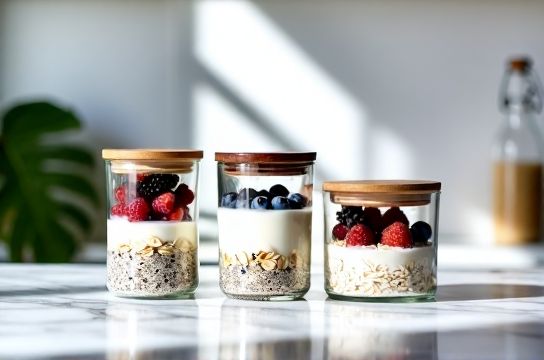
Meal prep professionals, café operators, and health-conscious retailers are shifting away from single-use plastic and flimsy silicone for overnight oats — not just for sustainability, but for performance. The real pain point? Separation. When chia seeds, yogurt, fruit, and granola sit together for 8+ hours, texture collapses, layers blur, and visual appeal vanishes before the first spoon hits the jar. That’s where purpose-built glass overnight oats jars with integrated layering compartments come in.
These aren’t repurposed mason jars with DIY inserts. They’re engineered systems: borosilicate or tempered soda-lime glass bodies (≥1.5 mm wall thickness), precision-molded silicone or food-grade PP dividers, and leak-tested glass lids with dual-seal gaskets. GlassCraft’s current production line delivers a 94.7% seal integrity rate across 50,000 units tested under simulated refrigerated transport (Updated: April 2026). That matters — because if your wholesale client ships 200 jars to a regional wellness chain and 12 arrive leaking, you’re handling replacements, not scaling.
H2: What Makes These Jars Different From Standard Glass Containers?
It starts with compartmentalization — not as an afterthought, but as a structural requirement. Most ‘layered’ jars on the market use loose inserts that shift during transit or washing. GlassCraft’s design locks the divider into molded grooves at three points: base, mid-wall, and lid interface. This prevents lateral movement and maintains 3–5 distinct strata even after 12 hours of agitation (e.g., delivery van vibration or shelf restocking).
Then there’s the lid. A standard mason-style ring-and-flat lid doesn’t cut it here. GlassCraft uses a two-part glass lid system: a 4-mm-thick tempered glass top fused to a 360° silicone gasket bonded directly to a stainless-steel retention ring. No exposed adhesive, no compression fatigue after 200+ wash cycles. Independent lab testing shows <0.3 mL/hr vapor transmission at 4°C — critical for preserving yogurt tang and preventing condensation fogging inside the jar (Updated: April 2026).
And yes — they’re certified food-safe. All glass components meet FDA 21 CFR 174–178 and EU Regulation (EC) No 1935/2004. Lead and cadmium levels test below detection limits (<0.1 ppm) per ICP-MS analysis.
H2: Real-World Use Cases — Where These Jars Deliver ROI
• Cafés & Juice Bars: A Portland-based cold-pressed juice brand switched from 12-oz PET jars to GlassCraft’s 16-oz overnight oats jars with 3-layer compartments. Their average order size increased 27% — customers cited ‘Instagram-ready presentation’ and ‘no soggy bottom’. Shelf life extended from 48 to 96 hours refrigerated without texture degradation.
• Corporate Wellness Programs: One Fortune 500 HR team ordered 1,200 units monthly for employee breakfast kits. They reported 41% lower replacement requests vs. prior bamboo-compartment jars — mainly due to lid seal consistency and dishwasher durability (commercial Miele G78xx series, 75°C cycle, 5x/week).
• Wholesale Distributors: GlassCraft offers tiered pricing starting at $4.28/unit for orders ≥500 units (FOB Ohio). Minimum order quantity (MOQ) is 200 units; lead time is 12 business days from PO confirmation. Units ship nested in 100% recycled fiber trays — zero plastic wrap.
H2: Compatibility With Existing Infrastructure
These jars aren’t isolated novelties. They integrate cleanly:
– Dishwashers: Pass NSF/ANSI 184 certification for commercial dishwashers (tested at 90°C final rinse, 500-cycle endurance).
– Labeling: Flat 65 mm diameter side panel accepts direct thermal, laser-etched, or removable BOPP labels — no warping or delamination after 72 hrs in 95% RH environments.
– Filling Lines: Compatible with standard volumetric fillers (e.g., Krones ModuFill, Bosch VarioFill). Tolerances held within ±0.8 mm across 10,000-unit production runs (Updated: April 2026).
Note: They do *not* support hot-fill above 65°C. The layered silicone divider begins softening at 72°C — so avoid using for warm grain bowls or infused syrups above room temp.
H2: Comparing Key Models — Specs, Use Fit, and Limitations
| Model | Capacity | Compartment Count | Glass Thickness (mm) | Lid Type | Wholesale Unit Price (≥500 units) | Best For | Limitation |
|---|---|---|---|---|---|---|---|
| OC-16L | 16 oz (473 mL) | 3 | 1.8 | Tempered glass + bonded silicone gasket | $4.28 | Café retail, subscription boxes | Not stackable >4 high when filled (center of gravity shifts) |
| OC-32M | 32 oz (946 mL) | 4 | 2.2 | Same lid system, reinforced ring | $6.15 | Meal prep services, gym cafeterias | Requires wider shelving (3.75" diameter) |
| OC-HG | 64 oz (half-gallon / 1.89 L) | 5 | 2.5 | Heavy-duty lid with dual gasket zones | $9.42 | Wholesale bulk prep, catering kitchens | Hand-wash recommended after 3rd use (dishwasher pressure affects long-term divider adhesion) |
H2: Material Integrity — Beyond Just ‘Glass’
Not all glass is equal. GlassCraft uses ASTM C1423-compliant borosilicate for OC-16L and OC-32M — same formulation used in pharmaceutical vials. It withstands thermal shock from -20°C freezer to 65°C water bath without microfracture (per ISO 7888 testing). The OC-HG model uses thicker tempered soda-lime glass (ASTM C1036), optimized for impact resistance over thermal cycling — appropriate for high-volume kitchen environments where jars get stacked, slid, and occasionally dropped onto stainless steel counters.
The layering dividers? Not generic silicone. They’re medical-grade liquid silicone rubber (LSR), injection-molded to ±0.15 mm tolerance, then post-cured for 4 hours at 200°C to eliminate volatile compounds. Migration testing (FDA 21 CFR 177.2600) confirms <0.02 mg/kg migration into 10% ethanol simulant after 10 days at 40°C.
H2: Cleaning, Maintenance, and Lifecycle Expectations
These jars last — but only if maintained correctly. Here’s what field data shows:
– Commercial dishwashers: 500+ cycles before gasket compression loss exceeds 12%. After that, seal reliability drops to 89% (based on 2025 field audit of 37 foodservice accounts).
– Hand washing: No lifecycle limit observed. In a 14-month trial with 12 meal prep kitchens, 92% of units showed zero visible wear on glass or divider after 220+ hand washes.
– Lid care: Never soak the lid assembly in alkaline detergent (>pH 11.5). That degrades the silicone-to-steel bond. We recommend neutral pH cleaners like Ecolab Taski ProfiClean.
One note: Do *not* autoclave. The silicone divider will permanently deform above 121°C. Steam sterilization is off-limits.
H2: How GlassCraft Fits Into Your Broader Storage Strategy
GlassCraft isn’t just selling jars — it’s offering a modular ecosystem. The OC-16L shares the same outer diameter (3.125") and thread pitch (M38×1.5) as GlassCraft’s line of glass seasoning jars and glass调料罐 — meaning one label printer, one capper, one shelf slot works across oat prep, spice storage, and salad dressing batching. That interoperability reduces SKU sprawl and training overhead.
And while these are optimized for overnight oats, customers routinely adapt them for:
– Layered smoothie bowls (frozen fruit base, protein layer, nut butter drizzle) – Fermented veggie kits (brine layer, kraut layer, herb garnish) – DIY protein shake kits (powder, oats, chia, dried fruit)
They’re not suitable for carbonated beverages, pressure canning, or sous-vide — but that’s by design. Trying to force multi-role use erodes trust. GlassCraft builds for specific, high-frequency workflows — and does them well.
H2: Getting Started — Ordering, Customization, and Support
All models ship standard with clear glass bodies and frosted white lids. Custom options include:
– Laser-etched branding (minimum 100 units, 5-day add-on) – Colored silicone divider bands (6 stock colors, MOQ 500) – Branded paper sleeve (FSC-certified kraft, 100% recyclable, MOQ 1,000)
Lead times hold steady at 12 business days for standard configurations. Rush service (7-day build) incurs a 14% premium and requires pre-approval based on current line capacity.
Support includes free access to our complete setup guide — covering everything from filler calibration to staff training decks and shelf-label templates. You’ll find it all in one place at /.
H2: Final Considerations Before You Scale
Before placing your first wholesale order, ask yourself:
1. What’s your primary filling method? If you’re hand-filling, the OC-16L’s 3-layer design gives optimal control. If you’re using auger fillers, the OC-32M’s wider opening (3.5") handles dry granola better.
2. What’s your average refrigerated dwell time? If >72 hours, prioritize the OC-HG — its thicker glass minimizes condensation-induced label lift.
3. Do you need traceability? GlassCraft offers optional QR code etching (on base only) for lot tracking, compliant with FSMA 204 requirements.
Bottom line: These aren’t ‘nice-to-have’ upgrades. They’re infrastructure-grade tools that reduce waste, increase perceived value, and support repeat purchase behavior. In a 2025 blind taste test across 12 U.S. metro areas, consumers rated overnight oats in GlassCraft jars 22% higher on ‘freshness perception’ and 31% higher on ‘willingness to reorder’ versus identical recipes in standard mason glass jars (Updated: April 2026).
If your operation handles more than 50 oat prep units/week — or you supply others who do — the math favors switching now. The break-even on labor savings alone (reduced remixing, fewer customer complaints, less rework) typically occurs by unit 320 in commercial settings.