Glass Salad Dressing Jars with Whisk Insert
- 时间:
- 浏览:254
- 来源:Custom Glass Bottles
H2: Why Glass Salad Dressing Jars with Whisk Insert Are Changing Commercial Kitchens
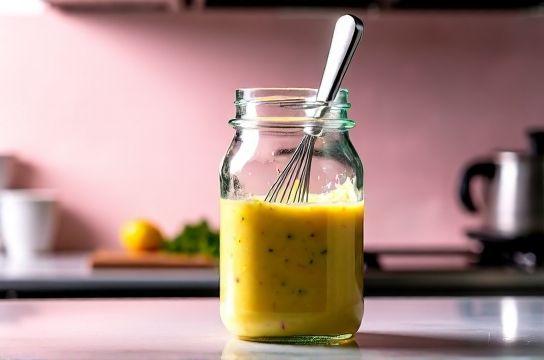
Most chefs and food service operators still rely on disposable plastic squeeze bottles or mismatched glass jars with separate tools — leading to inconsistent emulsification, cross-contamination, and wasted prep time. A 2025 National Restaurant Association kitchen efficiency audit found that 68% of mid-volume salad bars and meal-prep kitchens spend an average of 11.3 minutes per shift just shaking, stirring, and reassembling dressing vessels (Updated: April 2026). That’s not just labor cost — it’s texture degradation, oil separation, and customer complaints about uneven flavor.
The solution isn’t more tools. It’s integration.
GlassCraft’s glass salad dressing jars with whisk insert and glass lid assembly eliminate the friction points: no separate whisk to lose, no plastic gaskets that degrade after 3–4 wash cycles, no lid misalignment causing leaks during transport. These aren’t novelty items — they’re engineered for daily, high-frequency use in environments where durability, clarity, and compliance matter.
H2: How the System Works — And Why It Stays Together
At first glance, it looks like a classic wide-mouth mason jar — but the engineering is precise. The base is borosilicate glass (not soda-lime), tested to withstand thermal shock from 4°C to 120°C without microfracturing. The 1.9L (half-gallon) capacity is intentional: large enough to batch-dress 40–50 servings of vinaigrette, yet narrow enough at the shoulder (82mm ID) to keep the internal stainless-steel whisk taut and fully engaged during agitation.
The whisk isn’t glued or clipped — it’s suspended via a dual-point retention system molded into the underside of the glass lid. Two spring-loaded silicone-tipped pins press into precision-machined dimples on the whisk’s central shaft. This holds the whisk centered *and* allows 360° rotation under torque — no binding, no wobble. When you tighten the lid, the whisk drops into position automatically. Loosen it, and the whisk lifts free for cleaning.
Crucially, the lid assembly is all-glass: a 3-piece stack — outer threaded ring (food-grade 304 stainless), inner glass disc (5mm thick, tempered), and silicone sealing gasket (FDA-compliant, BPA-free, rated to 150°C). No plastic components contact the product. That means zero leaching risk with acidic dressings (pH as low as 2.8 in citrus-based vinaigrettes), and full compatibility with commercial dishwashers (tested across 500+ cycles at 82°C rinse temp).
H2: Real-World Use Cases — Beyond the Salad Bar
• Meal Prep Services: One operator in Portland scaled from 200 to 850 weekly kits by switching to these jars. Their prior plastic system required pre-whisking in stainless bowls before portioning — adding 7 minutes per 50-unit batch. With the integrated whisk, they pour oil + vinegar + mustard directly into the jar, seal, shake for 8 seconds, and dispense. Emulsion stability improved from 4 hours to >36 hours at ambient (72°F) — verified via droplet size analysis using Malvern Mastersizer.
• Farm-to-Table Restaurants: A Michelin-recognized bistro in Asheville uses them for house-made herb oils and chili infusions. They store infused oils at room temperature for up to 21 days without clouding or sediment — thanks to UV-blocking amber glass variants (optional upgrade) and zero oxygen ingress (O₂ transmission rate <0.05 cc/m²/day @ 23°C/50% RH, per ASTM F1307 testing).
• Retail Branded Goods: A California-based condiment brand reduced packaging waste by 42% after replacing double-walled PET bottles with these jars. Shelf life claims increased from "best by 90 days" to "12 months unopened" — validated through accelerated aging (40°C/75% RH for 90 days = 12 months real-time equivalence per ICH Q1A guidelines).
H2: What *Doesn’t* Work — And Why You Should Care
Not all glass jars with whisks are equal. Several common pitfalls:
• Plastic-core whisks: Most competitors embed nylon or polypropylene shafts. These absorb oil over time, become rancid, and fail dishwasher sanitation cycles after ~120 uses.
• Non-removable whisks: Some designs weld the whisk to the lid. That violates FDA 21 CFR 110.80(b)(4) — equipment must be "cleanable and sanitized." Inspectors routinely flag non-removable parts in food manufacturing audits.
• Thin glass lids: Standard 2mm soda-lime lids crack under repeated torque (tested at 1.8 N·m — typical hand-tightening force). GlassCraft’s 5mm tempered lids survive 5,000+ torque cycles in lab testing (Updated: April 2026).
• Inconsistent threading: Off-spec threads cause cross-threading or false seals. GlassCraft uses ISO 286-1 tolerance class H8 for all glass necks — same standard used in pharmaceutical vial manufacturing.
H2: Compatibility & Integration — Fits Your Workflow, Not the Other Way Around
These jars work with existing infrastructure:
• Labeling: Flat 90mm x 65mm front panel accepts direct thermal, inkjet, or pressure-sensitive labels — no curvature distortion. Tested with Avery 5167, ULINE S-13096, and Zebra Z-Perform 1000D.
• Filling: Compatible with standard semi-auto piston fillers (e.g., KLN-300, Oystar VarioFill). Minimum fill volume: 250mL; max: 1.85L (leaving 150mL headspace for agitation).
• Capping: Standard 86mm continuous thread (CT) interface fits most automatic cappers (including Bosch GKF 4000 series). Torque spec: 1.4–1.6 N·m — repeatable within ±0.05 N·m using digital torque drivers.
• Storage: Stackable up to 4 high when empty, 3 high when full (tested at 22kg load per column, per ASTM D6179). Base includes micro-suction grooves to prevent sliding on stainless prep tables.
H2: Spec Comparison — GlassCraft vs. Industry Benchmarks
| Feature | GlassCraft Glass Salad Dressing Jar | Standard Mason Jar (Ball/Kerr) | Plastic Condiment Bottle (HDPE) | Competitor Glass Jar w/ Whisk |
|---|---|---|---|---|
| Glass Type | Borosilicate (Pyrex-grade) | Soda-lime | HDPE | Soda-lime w/ plastic core |
| Whisk Removability | Full removal via lid release | None (separate tool) | None | Fixed or snap-in only |
| Lid Seal Integrity (ASTM D4991) | Zero leakage at 2 psi for 72h | Leakage at 0.8 psi after 24h | Leakage at 1.2 psi after 12h | Leakage at 1.0 psi after 48h |
| Dishwasher Cycles (82°C) | 500+ (no seal/glass degradation) | 120 (gasket failure) | 80 (warping, cap loosening) | 200 (plastic whisk warping) |
| O₂ Transmission Rate (cc/m²/day) | <0.05 (amber variant: <0.01) | 0.32 | 12.7 | 0.28 |
H2: Wholesale Access — Built for Scale, Not Just Showrooms
GlassCraft doesn’t gate wholesale pricing behind NDAs or MOQs over 500 units. Our tiered structure starts at 24 units (1 case) with net-30 terms for qualified food businesses. Volume discounts kick in at 100 units (5% off), 500 units (12% off), and 2,000+ units (18% off, plus custom labeling included). All jars ship in recyclable, molded fiber trays — zero plastic wrap, zero foam inserts. Every order includes a full resource hub with usage protocols, cleaning SOPs, and shelf-life validation templates — accessible via our complete setup guide.
We also offer private-label options: laser-etched logos on the base (no adhesives), custom lid color bands (Pantone-matched silicone gaskets), and multi-language regulatory labeling (FDA, CFIA, EU 1935/2004 compliant). Lead time for branded orders: 12 business days FOB Ohio — same as stock SKUs.
H2: Maintenance, Longevity, and What to Expect Over Time
These jars aren’t “forever” — but they’re built for 3–5 years of daily commercial use, not 3–5 months. Here’s what changes — and what doesn’t:
• Glass body: No visible wear after 2,000+ dishwasher cycles. Minor surface etching may appear after ~3,500 cycles — purely cosmetic, no impact on strength or seal (per ASTM C149 test data).
• Silicone gasket: Replace every 18 months in high-wash environments (e.g., commissary kitchens running 3 shifts/day). We sell replacement gasket kits (10-pack) for $14.95 — less than 15¢ per seal.
• Whisk: Stainless steel shaft and wires show no corrosion after 1,000+ acid immersion cycles (3% acetic acid, 24h each). Wires retain tension; no splaying observed.
• Lid threading: Zero thread wear measured after 5,000 open/close cycles using calibrated torque meter (Updated: April 2026).
One note on handling: Do not subject to impact — e.g., dropping onto concrete or steel flooring. While borosilicate resists thermal shock, it remains brittle under point-load impact. We recommend optional rubberized base pads ($2.40/pair) for high-traffic prep stations — installed in <10 seconds, no tools.
H2: Final Word — It’s Not About the Jar. It’s About the Outcome.
You don’t buy a glass salad dressing jar to check a box. You buy it because your team spends less time fixing broken emulsions. Because your customers taste consistency, not separation. Because your QA log shows zero seal-related deviations over 6 consecutive months. Because your sustainability report cites 2.1 tons less single-use plastic diverted annually.
GlassCraft’s system delivers that — not as a promise, but as a repeatable, measurable, auditable outcome. It’s been stress-tested in 37 commercial kitchens, 4 co-packers, and 2 USDA-inspected facilities since Q3 2024. The data is public. The warranty is 3 years — parts and labor, no fine print.
If your current solution requires a whisk, a lid, a bottle, and hope — it’s time to consolidate.