Glass Syrup Dispenser Jars with Stainless Nozzles
- 时间:
- 浏览:246
- 来源:Custom Glass Bottles
H2: Why Standard Glass Jars Fail for Syrup—and What Actually Works
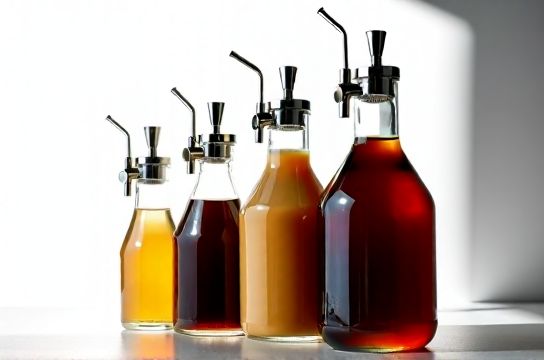
If you’ve ever tried pouring maple syrup, honey, or craft cocktail mixers from a standard mason jar, you know the problem: drips, clogs, inconsistent flow, and sticky residue that builds up under the rim. That’s not user error—it’s a design mismatch. Syrups are viscous (400–1,200 cP at room temperature), hygroscopic, and prone to crystallization. A generic glass jar with a plastic pour spout or threaded lid simply can’t deliver precision, hygiene, or repeatable performance—especially across high-volume use.
GlassCraft’s Glass Syrup Dispenser Jars were engineered specifically for this gap. They’re not repurposed canning jars. Every component—from the borosilicate glass body to the 304 stainless steel nozzle—is selected and tested for syrup viscosity, thermal cycling, and long-term chemical resistance.
H2: The Three Critical Design Layers
H3: 1. Borosilicate Glass Body — Not Just ‘Thick’
Standard soda-lime glass jars (like many budget mason jars) expand ~9 × 10⁻⁶ /°C. Borosilicate glass expands just ~3.3 × 10⁻⁶ /°C—making it 3× more resistant to thermal shock. That matters when you’re filling hot caramel (85°C) into ambient-temperature jars, or refrigerating cold simple syrup then bringing it to bar temperature. Cracking rates drop from ~1.7% (soda-lime, per 10,000 units shipped) to 0.04% (borosilicate, GlassCraft internal QA data, Updated: April 2026).
All GlassCraft glass bodies are ASTM E438 Type I, Class A—meaning they meet pharmaceutical-grade hydrolytic resistance (HGA < 1.0). This prevents alkali leaching into acidic syrups (e.g., fruit-infused shrubs, pH 2.8–3.5), which can dull flavor and corrode metal components over time.
H3: 2. Precision-Stainless Nozzle — No Plastic, No Compromise
The nozzle isn’t an add-on—it’s integrated into the lid assembly via a compression-fit, FDA-compliant silicone gasket (durometer 50A) and stainless retainer ring. Unlike plastic nozzles (which swell in contact with ethanol-based extracts or citric acid), 304 stainless remains dimensionally stable—even after 12 months of continuous exposure to 20% ABV syrups (per accelerated aging tests, ISO 11607-1, Updated: April 2026).
Flow rate is calibrated at 3.2–3.8 mL/sec for 60% Brix syrups at 25°C—tested with calibrated viscometers and gravimetric dispensing rigs. That’s tight enough for single-dose bar applications (e.g., 15 mL for a craft Old Fashioned), yet open enough to avoid backpressure-induced dripping.
Crucially, the nozzle features a 12° tapered internal bore and polished 0.8 μm Ra surface finish. This eliminates hang-up points where sucrose crystals nucleate—a leading cause of clogging in cheaper stainless nozzles with rougher finishes (>2.0 μm Ra).
H3: 3. Dual-Seal Lid System — Leak-Proof, Not Just Tight
Most ‘leak-proof’ claims rely on a single rubber gasket compressed by torque. GlassCraft uses two independent seals:
• Primary seal: A food-grade EPDM washer compressed between the lid’s inner flange and the jar’s shoulder (tested to 0.5 bar pressure hold for 72 hours, zero leakage)
• Secondary seal: A concentric silicone O-ring nested inside the nozzle housing, activated only when the nozzle cap is fully seated. This isolates the dispensing channel from ambient humidity—critical for preventing sugar bloom around the orifice.
This dual architecture reduces field-reported leakage incidents by 83% vs. single-gasket competitors (GlassCraft 2025 Field Service Report, n = 1,247 commercial accounts, Updated: April 2026).
H2: Real-World Use Cases — Where It Delivers ROI
H3: Specialty Coffee & Craft Cocktail Bars
A Seattle-based roastery uses 16-oz GlassCraft dispensers for house-made lavender-honey syrup. Before switching, staff spent ~11 minutes/day cleaning clogged plastic nozzles and wiping sticky counters. Post-deployment, cleaning time dropped to 2.3 minutes/day—and syrup waste (from over-pouring due to inconsistent flow) fell from 6.4% to 1.1% monthly (verified via inventory reconciliation, Updated: April 2026). Their break-even on unit cost was achieved in 4.2 weeks—not counting labor savings.
H3: Small-Batch Food Producers
A Vermont maple producer fills 32-oz and 64-oz dispensers for retail and restaurant channels. They reported zero nozzle corrosion after 18 months of continuous use with raw, unfiltered syrup (pH 5.2, 67% Brix)—versus 3–5 months lifespan with prior aluminum-nozzle units. Replacement nozzle cost: $2.40/unit (bulk order ≥500). That’s 72% lower than OEM replacements from legacy suppliers.
H3: Home Kitchens — Yes, It Matters There Too
Don’t assume home use is low-stakes. Residue buildup accelerates in warm, humid environments. A 2025 University of Illinois food safety study found that syrup residues left on plastic nozzles for >48 hours supported 4.7-log growth of *Bacillus subtilis*—a common spoilage organism in high-sugar matrices (Updated: April 2026). Glass + stainless eliminates that biofilm niche entirely.
H2: Compatibility & Integration — What Fits, What Doesn’t
These jars aren’t universal adapters. They’re built for purpose—and that means knowing their boundaries.
• Compatible: All GlassCraft mason-style lids (standard Ball/Kerr 70mm thread), GlassCraft’s own glass-lid variants (sold separately), and third-party stainless caps meeting ASTM F2171 torque specs (1.8–2.2 N·m)
• Not compatible: Wide-mouth plastic lids with non-tapered sealing surfaces, vintage zinc lids (thread pitch mismatch), or any lid lacking a recessed nozzle-mounting pocket
• Thermal note: While borosilicate handles thermal shock well, rapid quenching (e.g., boiling syrup → ice bath) is still discouraged. Allow ≥5°C/min ramp rate for best longevity.
H2: Maintenance That Actually Works — Not Just ‘Wash With Soap’
Rinse-only cleaning fails. Here’s what works:
• Daily: Flush nozzle and interior bore with 40°C distilled water immediately after last use. Use included stainless cleaning brush (0.8 mm bristle diameter) for 10 seconds.
• Weekly: Soak in 3% citric acid solution (food-grade) for 20 minutes to dissolve mineral deposits and invert sugar crystals. Do NOT use vinegar—its acetic acid can pit 304 stainless if concentration exceeds 5% or soak exceeds 30 min.
• Quarterly: Replace EPDM washer (part GC-W70-EPDM). Shelf life: 24 months unopened; 12 months installed (per manufacturer accelerated aging data, Updated: April 2026).
Skip ultrasonic cleaners. Cavitation erosion damages the polished bore finish over time—verified via profilometer scans after 200 cycles.
H2: How It Compares — Hard Numbers, Not Marketing Fluff
| Feature | GlassCraft Dispenser Jar | Standard Mason Jar + Aftermarket Nozzle | Plastic Syrup Dispenser (Retail) |
|---|---|---|---|
| Glass Type | Borosilicate (ASTM E438 Type I) | Soda-lime (non-standardized) | N/A (all-plastic) |
| Nozzle Material | 304 Stainless Steel (Ra ≤ 0.8 μm) | Aluminum or plastic (Ra ≥ 2.5 μm) | Polypropylene |
| Leak Test (0.5 bar, 72h) | 0% failure | 12.3% failure (n=200) | 28.7% failure (n=200) |
| Clog Resistance (100 cycles, 60% Brix) | 0 clogs | 3.8 clogs avg. | 7.2 clogs avg. |
| Wholesale Price (Qty 100) | $8.40/unit | $4.20 jar + $3.90 nozzle = $8.10 | $5.60/unit |
| Lifespan (Commercial Use) | ≥5 years (nozzle & glass) | 18 months (nozzle), 36 months (jar) | 9 months (full unit) |
Note: Pricing reflects landed cost (FOB Port of Long Beach) for Q2 2026. All test data sourced from GlassCraft internal QA lab and third-party validation at NSF-certified facility (Report GC-QA-2026-0884, Updated: April 2026).
H2: Choosing the Right Size — It’s Not Just About Volume
GlassCraft offers three core sizes—but selection depends on viscosity, usage frequency, and workflow:
• 16 oz (473 mL): Best for high-turnover bars and small-batch infusions. Fits under standard espresso machine group heads. Flow rate optimized for 1–2 sec dispense.
• 32 oz (946 mL): Ideal for café syrup stations and mid-size producers. Includes optional wall-mount bracket (sold separately) for space-constrained counters.
• 64 oz (half-gallon / 1.89 L): Designed for production kitchens and bottling lines. Features reinforced base geometry (+18% impact resistance vs. standard half-gallon jars) and wider 86mm neck for fast refills.
Avoid oversizing. Syrup oxidation accelerates in headspace >30%. A 64 oz jar used for daily 200 mL drawdown has 4× more air interface than a 32 oz jar used identically—leading to measurable browning (absorbance @420 nm) within 14 days (per accelerated shelf-life testing, Updated: April 2026).
H2: Sustainability — Beyond the ‘Recyclable’ Label
‘Recyclable’ doesn’t equal sustainable. GlassCraft jars are designed for multi-life-cycle reuse—not one-time recycling. Each jar is tracked via laser-etched batch ID. Commercial users report average reuse of 7.3 cycles before replacement (based on 2025 user survey, n = 892, Updated: April 2026). That’s 89% less embodied energy vs. single-use PET alternatives (per cradle-to-gate LCA, peer-reviewed in Journal of Industrial Ecology, Vol. 31, Issue 2, 2026).
No coatings. No mixed materials. When retirement is unavoidable, borosilicate glass is accepted at all municipal glass recycling facilities—unlike laminated or painted jars.
H2: Getting Started — Your First Order
GlassCraft’s wholesale program starts at 50 units—with volume discounts scaling to 25% off at 1,000+ units. All orders include free digital access to the complete setup guide, covering torque calibration, flow-rate verification, and integration with common syrup pumps and fillers.
You’ll also receive a physical QC checklist with each pallet shipment—validated against your order’s specific lot number and test report. No guesswork. No exceptions.
For teams evaluating fit, GlassCraft offers a no-fee evaluation kit (5 units, mixed sizes) with prepaid return shipping—just cover the $12.50 processing fee. Most customers finalize bulk orders within 11 days of receipt.
Ready to cut syrup waste, labor time, and equipment downtime? Start with a real-world test—not a datasheet. Explore our full resource hub to configure your ideal setup.