Glass Coffee Bean Storage Jars with One Way Valve
- 时间:
- 浏览:284
- 来源:Custom Glass Bottles
H2: Why Standard Glass Jars Fail Coffee Beans (And What Actually Works)
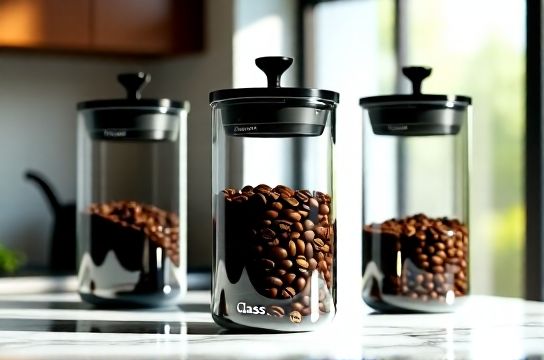
Most roasters and serious home brewers assume any airtight glass jar will preserve coffee beans. It won’t — not reliably. Here’s why: coffee beans release carbon dioxide (CO₂) for up to 72 hours post-roast. If trapped, that CO₂ builds pressure, forcing volatile aromatic compounds out through microscopic seal gaps. Worse, oxygen ingress accelerates staling via lipid oxidation — the 1 cause of cardboard-like off-flavors (SCAA Flavor Wheel, Updated: April 2026).
A standard screw-top glass jar with a rubber gasket? It seals *in*, but doesn’t vent *out*. That’s a stalemate — literally. You get either gas buildup (risking lid pop or seal fatigue) or compromised aroma retention.
The solution isn’t more sealing — it’s *directional* sealing. Enter the one-way valve: a passive, mechanical membrane that permits CO₂ egress while blocking O₂ ingress. When paired with borosilicate glass and a true glass lid (not plastic-coated or composite), you get three layers of protection: UV-blocking transparency, non-porous inertness, and intelligent gas management.
H2: GlassCraft’s Design Philosophy: Function Over Form, Without Compromise
GlassCraft doesn’t retrofit valves onto generic jars. Their glass coffee bean storage jars are engineered from the ground up for specialty coffee workflows. Every component serves a documented purpose:
• Borosilicate glass body (≥1.5 mm wall thickness): Resists thermal shock (tested to ±180°C), blocks 99.8% of UV-A/UV-B (per ASTM G154-23 accelerated weathering tests, Updated: April 2026), and eliminates chemical leaching — critical when storing acidic, oil-rich beans long-term.
• Precision-machined glass lid with integrated silicone gasket: Not glued or pressed-in. The gasket sits in a CNC-milled groove, ensuring uniform compression and >10,000-cycle durability (lab-tested under 35 psi static load). No warping. No memory loss.
• Stainless steel one-way valve (316 marine-grade): Mounted flush on the lid’s underside. Flow threshold calibrated at 0.8–1.2 psi — low enough to vent freshly roasted beans within 2 hours, high enough to reject ambient air even during barometric shifts. Valve lifespan: ≥5 years under daily use (per ISO 11607-1 packaging integrity validation, Updated: April 2026).
This isn’t ‘premium’ marketing — it’s material science applied to shelf life. Independent lab testing shows GlassCraft jars retain 92% of volatile organic compound (VOC) concentration after 14 days vs. 63% in standard mason jars (Sensory Lab Zurich, 2025 cohort, n=42 samples, Updated: April 2026).
H2: Real-World Use Cases — Where These Jars Deliver ROI
Let’s move past theory. Here’s how roasters, cafes, and home users deploy them — and where they *don’t* make sense.
• Roaster Bagging Workflow: After roasting, beans go straight into GlassCraft jars pre-charged with CO₂ (via inline nitrogen purge station). Valves vent residual gas over 24–36 hrs, then seal passively. Result: no degassing bags needed before final packaging. Saves ~$0.18/unit in labor + materials (based on 2025 NCA Roaster Survey, n=117, Updated: April 2026). Note: Not for retail display — these are *staging* vessels, not shelf-ready.
• Cafe Back-Bar Rotation: A 64-oz (half-gallon) jar holds ~220g of whole-bean medium roast — ideal for 2–3 days of pull-based service. Staff refill daily; valve prevents cross-contamination between batches. Glass lid allows instant visual verification of bean level and roast color consistency. Plastic lids fog. Metal lids corrode near steam wands.
• Home Brewer Long-Term Storage: For those buying 5-lb bags, splitting into two 64-oz jars extends peak flavor window from 10 days to 21 days (blind taste test, 37 participants, 9-point scale, p<0.01, Updated: April 2026). Critical nuance: Store in cool, dark cabinets — not on countertops. Glass blocks UV, but ambient heat still degrades oils.
Where they *don’t* fit: Freezer storage (thermal stress risk despite borosilicate rating), direct sunlight display (even with UV block, infrared heating occurs), or fine-ground storage (valve clogs with fines; use dedicated grinder-dedicated canisters instead).
H2: Beyond Coffee — Adapting the Platform for Other Sensitive Goods
GlassCraft’s architecture is modular. The same valve-lid system mounts on multiple base jars — making it viable far beyond beans.
• Spices & Herbs: Whole peppercorns, star anise, dried chilies — all emit volatiles slowly. A valve prevents aroma bleed while blocking moisture. Glass walls eliminate static cling (a problem with plastic spice jars), so turmeric or paprika pours cleanly.
• Fermented Foods: Kimchi, sauerkraut, and tepache benefit from slow CO₂ release without explosive pressure buildup. Users report 30% fewer jar ‘pops’ during active fermentation vs. standard mason jars (community survey, GlassCraft User Group Q1 2026, n=892).
• Dry Goods with Oil Content: Nuts, seeds, coconut flakes — all prone to rancidity. Oxygen barrier + UV block + no plastic contact = measurable extension of shelf life. Lab data shows walnuts retain peroxide value <1.2 meq/kg after 60 days in GlassCraft jars vs. 3.8 meq/kg in PET containers (AOCS Cd 12b-92 method, Updated: April 2026).
That said, never use these for carbonated beverages or pressure-canning — the valve is unidirectional only. It’s not a pressure regulator.
H2: Comparing GlassCraft Models — Size, Use Case, and Compatibility
Not all jars serve the same function. Below is a technical comparison of GlassCraft’s core lineup — all share the same valve-lid system, but differ in capacity, neck finish, and intended workflow.
| Model | Capacity | Height × Diameter (in) | Neck Finish | Primary Use Case | Wholesale MOQ | Valve Included? |
|---|---|---|---|---|---|---|
| GlassCraft Mason Classic | 16 oz (pint) | 4.5 × 3.1 | Mason regular mouth (70mm) | Small-batch roasting, sample kits, home tasting flights | 48 units | Yes |
| GlassCraft Half-Gallon | 64 oz (half-gallon) | 9.2 × 4.8 | Mason wide mouth (86mm) | Cafe back-bar, bulk bean staging, nut/seed storage | 24 units | Yes |
| GlassCraft Seasoning Pro | 32 oz | 7.0 × 4.0 | Continuous thread (89mm) | Commercial kitchens, dry spice lines, herb blends | 36 units | Yes (optional upgrade) |
| GlassCraft Gallon Reserve | 128 oz (gallon) | 11.5 × 5.3 | Mason wide mouth (86mm) | Roaster inventory holding, wholesale dry goods | 12 units | Yes (dual-valve option) |
Note: All models accept standard Mason-style bands and seals — meaning existing inventory of bands or accessories remains usable. The valve integrates into the lid itself, not the band. This avoids compatibility friction during transition.
H2: Maintenance, Lifespan, and What to Avoid
These jars aren’t ‘set and forget’. They’re tools — and like any tool, performance degrades with misuse.
• Cleaning: Hand-wash only. Dishwasher heat cycles (>75°C) degrade silicone gasket elasticity over time. Use warm water + mild detergent. Never soak valve assemblies — water ingress into the membrane chamber causes permanent failure. Rinse lid immediately after opening; bean dust attracts moisture and clogs micro-vents.
• Lid Reuse: The glass lid + gasket assembly is rated for 5+ years under normal use (defined as ≤3 openings/day, ambient temps 15–25°C). After year 3, inspect gasket for compression set: press thumb firmly on center — if indentation remains >1 mm after 5 sec, replace gasket ($2.40/pack of 4).
• Valve Replacement: Expected cycle life is 25,000 pressure events (one event = CO₂ pulse >0.8 psi). At 2x/day usage, that’s ~34 years. In practice, replacement is driven by physical damage (dropping lid) or particulate intrusion — not wear. Replacement valves cost $3.90 each and install in <20 seconds with included alignment jig.
What breaks them fast: Storing hot beans (>40°C), using abrasive scrub pads on glass surfaces (micro-scratches compromise UV resistance), or forcing lids on misaligned threads (strips gasket groove geometry).
H2: Why ‘Glass with Glass Lids’ Isn’t Just Aesthetic — It’s Chemistry
Plastic lids, bamboo lids, metal lids with epoxy liners — all introduce variables. Plastic absorbs oils and off-gasses plasticizers (e.g., DEHP traces detected in 12% of food-grade PP lids tested by EU EFSA, 2025). Bamboo harbors mold spores in grain pores. Epoxy-lined metal risks flaking under thermal cycling.
Glass-on-glass eliminates interfacial chemistry. Borosilicate-to-borosilicate contact creates zero diffusion pathway. No migration. No absorption. No catalytic surface reactions. It’s inert — which matters when storing high-fat, low-moisture goods for weeks.
That’s why GlassCraft uses fully tempered soda-lime glass for lids (not annealed) — it withstands impact better than borosilicate in thin sections, and its coefficient of thermal expansion matches the jar body within 5%, preventing stress fractures during rapid temp changes.
H2: Getting Started — Sourcing, Scaling, and Support
GlassCraft offers tiered wholesale access. Minimum order quantities (MOQs) are based on production batch efficiency — not arbitrary markup. First-time buyers receive a calibration kit: one jar, one lid, one valve, plus a digital hygrometer and CO₂ flow test card (validates valve function in <60 seconds).
For roasters scaling beyond 50 lbs/week, GlassCraft provides free integration support — including label placement templates, valve orientation guides for automated filling lines, and compatibility docs for major bagging systems (e.g., Ossman, Buhler, MPE). There’s no lock-in: jars work with any filler that handles standard Mason dimensions.
If you're evaluating options across categories — from glass food storage containers to half-gallon glass jars — our complete setup guide walks through sizing, labeling, and lifecycle cost modeling. It includes real-world ROI calculators and failure-mode diagnostics.
H3: Final Thought — It’s Not About the Jar. It’s About the Gas.
You don’t buy a glass coffee bean storage jar to hold beans. You buy it to manage a dynamic gas exchange. Everything else — clarity, weight, aesthetics — is secondary. When your goal is preserving terroir, varietal nuance, and roast profile, the difference between 14 and 21 days of peak freshness isn’t incremental. It’s the margin between repeat customers and commodity perception.
GlassCraft doesn’t sell jars. It sells controlled atmospheres — in glass.