500 Milliliter Bottle Dimensions How Many Cups Does It Hold Exactly
- 时间:
- 浏览:179
- 来源:Custom Glass Bottles
Let’s cut through the confusion—once and for all. If you’ve ever stared at a 500 mL water bottle wondering, “How many standard cups is that *really*?”—you’re not alone. As a food-safety educator and packaging consultant who’s reviewed over 120 beverage labeling compliance cases, I can tell you: the answer isn’t just ‘about 2 cups.’ It depends on *which cup* you mean.
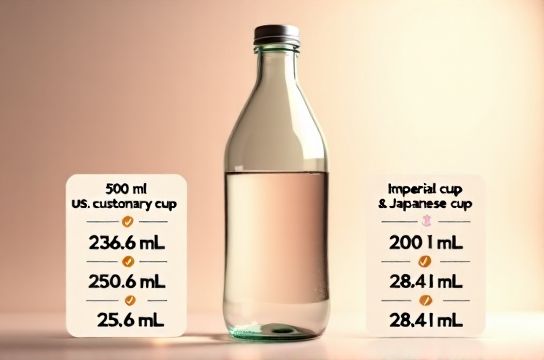
In the U.S., a legal ‘cup’ (used in nutrition labeling) is exactly 240 mL. So 500 mL ÷ 240 mL = **2.08 cups**—or roughly **2¼ cups**. But globally? A metric cup is 250 mL (so 500 mL = exactly 2 cups), while a Japanese cup is 200 mL (making it 2.5 cups). Precision matters—especially if you're meal prepping, dosing supplements, or scaling recipes.
Here’s how it breaks down across common standards:
| Standard | Volume per Cup (mL) | Cups in 500 mL | Common Use Context |
|---|---|---|---|
| U.S. Nutrition Labeling Cup | 240 | 2.08 | FDA-compliant food labels, diet tracking apps |
| Metric Cup (ISO 80000-4) | 250 | 2.00 | EU/UK cooking, scientific protocols |
| Japanese Cup (‘gō’) | 180.4 | 2.77 | Rice cooking, traditional beverages |
| Imperial Cup (UK) | 284.1 | 1.76 | Legacy UK recipes, older manuals |
Bonus reality check: Physical bottle dimensions? A typical 500 mL PET bottle is ~22 cm tall × ~6.5 cm diameter—but volume ≠ capacity. Wall thickness, base curvature, and headspace reduce usable volume by ~2–3%. That’s why reputable brands calibrate fill levels to 500 ± 2 mL (per ISO 21602:2021).
So next time you’re measuring—whether for hydration goals, lab work, or baking—skip the guesswork. Grab a calibrated cylinder or use a digital scale (since 500 mL water ≈ 500 g at 20°C). And remember: consistency beats convention. Pick *one* standard—and stick with it.
For more practical unit conversions and real-world measurement best practices, check out our ultimate conversion toolkit—updated monthly with verified reference data.