Glass Bottle Wholesale Pricing Models Explained
- 时间:
- 浏览:119
- 来源:Custom Glass Bottles
H2: Why Glass Bottle Wholesale Pricing Isn’t One-Size-Fits-All
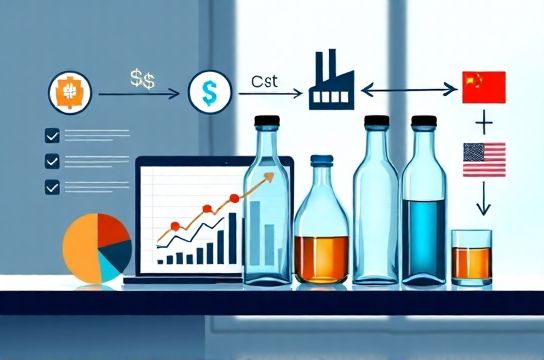
You’re sourcing 50,000 amber wine bottles for a new organic brand. Your first quote from a Chinese glass bottle manufacturer is $0.38/unit FOB Ningbo. A US glass bottle manufacturer quotes $0.82/unit FOB California. A third supplier—listed as a ‘glass bottle wholesaler’ on Alibaba—offers $0.29/unit but requires full prepayment and provides no mold certification.
None of these prices are ‘wrong’. They reflect different cost structures, risk allocations, service levels, and production models. Glass bottle wholesale pricing isn’t linear—it’s layered. And misreading the layers leads to late shipments, rejected batches, or hidden compliance penalties.
This guide cuts through the noise. It maps how real glass bottle manufacturers build their quotes, what each line item means operationally, and how smart buyers compare—not just prices—but total landed cost and execution risk.
H2: The Four Core Pricing Models (and When to Use Each)
Glass bottle wholesale pricing falls into four dominant models. Your choice depends on volume, timeline, customization needs, and control preferences.
H3: 1. Per-Unit Fixed Price (Most Common for Mid-to-High Volume)
Used by established glass bottle manufacturers—especially those with dedicated furnace lines—and preferred by brands ordering ≥100,000 units annually. Price includes mold amortization (if new), raw material (sand, soda ash, cullet), energy (furnace fuel), labor, QC, and basic packaging (palletized cartons).
Key nuance: ‘Fixed’ doesn’t mean static. Most contracts include a ±5% adjustment clause tied to regional soda ash or natural gas index changes (e.g., U.S. EIA Natural Gas Price Index). This protects both parties when input costs swing sharply—common since 2022. Buyers who skip indexing clauses absorb 100% of volatility (Updated: May 2026).
H3: 2. Mold + Unit Cost (Best for Custom Shapes or First-Time Launches)
When you need a unique shoulder profile or embossed logo, you pay separately for mold development ($2,500–$7,500 depending on complexity) plus per-unit cost. Reputable glass bottle factories in China or the U.S. treat molds as your property—documentation, CAD files, and physical ownership transfer upon full payment.
Caution: Some ‘glass bottle suppliers’ list low per-unit prices but bury mold fees under vague ‘tooling charges’ or retain mold ownership. Always verify title transfer language in the contract. No reputable glass bottle manufacturer retains mold rights without written consent and compensation.
H3: 3. Toll Manufacturing (For Brands With Existing Molds or High Control Needs)
You supply the mold (or lease it), raw materials (cullet, colorants), and sometimes even furnace schedule oversight. The glass bottle factory charges only for labor, energy, and equipment use—typically $0.12–$0.21/unit (Updated: May 2026). This model is rare outside North America and Western Europe due to logistics friction, but growing among U.S.-based beverage startups with sustainability mandates (e.g., using post-consumer recycled glass).
Downside: You assume full responsibility for material quality, consistency, and customs clearance if importing cullet. Not recommended unless you have in-house technical glass expertise.
H3: 4. Spot Batch Pricing (For Urgent, Low-Volume, or Seasonal Needs)
A ‘glass bottle wholesaler’ may offer spot pricing—e.g., $0.44/unit for 5,000 units of stock 375ml flint liquor bottles, ready in 10 days. These are usually overruns, discontinued SKUs, or inventory liquidations. Pros: Speed, no MOQ, no tooling. Cons: Zero customization, limited QC traceability, and no lot continuity (batches may vary slightly in weight or finish).
Spot batches make sense for pop-up retailers or sampling—but never for regulated products like pharmaceuticals or infant formula where batch traceability is mandatory.
H2: What Actually Drives Price Differences Between Suppliers?
Two suppliers quote $0.36/unit for identical 250ml cobalt blue cosmetic bottles. One is a China glass bottle manufacturer; the other, a U.S. glass bottle supplier. Why the same number? Let’s break down the real drivers:
• Cullet Sourcing: Chinese factories average 25–35% recycled content (domestic cullet is cheap and abundant); U.S. factories often use 50–70% (driven by state mandates and customer demand), raising sorting and washing costs.
• Energy Mix: Coal-fired furnaces (still common in parts of China) cost ~$18/MBtu vs. natural gas (~$24/MBtu in U.S. Midwest, Updated: May 2026). But U.S. plants invest more in regenerative heat recovery—net energy/unit differs by <3% at scale.
• Labor & QC Rigor: A certified ISO 9001 glass bottle factory in Shandong spends ~$0.018/unit on 3-stage visual inspection (pre-form, annealing lehr, final pack). A non-certified supplier may skip the lehr scan—saving $0.007/unit but increasing breakage risk by 1.8–2.3% (per 2025 Glass Packaging Institute audit data).
• Minimum Order Quantity (MOQ): Chinese glass bottle manufacturers typically require 20,000–50,000 units per SKU; U.S. glass bottle manufacturers often set MOQs at 5,000–10,000. Lower MOQ = higher per-unit cost to cover setup overhead.
• Port & Logistics Markup: A ‘glass bottle supplier’ quoting DDP Los Angeles includes ocean freight, import duties (HTS 7010.90.50: 0% duty for most glass containers), ISF filing, and drayage. That adds $0.04–$0.09/unit depending on container utilization. Always confirm Incoterms—FOB, EXW, or DDP—before comparing.
H2: How to Audit a Quote (Without Being an Engineer)
A quote isn’t just a number. It’s a contract blueprint. Here’s what to validate—quickly and concretely:
• Mold Reference: Does it list mold ID, revision date, and cavity count? If not, ask.
• Tolerance Specs: Look for ±0.3mm on neck finish (critical for cap fit), ±1.5g on weight (affects filling line speed). Anything looser than ±0.5mm on diameter suggests process instability.
• Annealing Schedule: Should specify lehr temperature curve (e.g., “peak 540°C, 45-min soak, controlled cool to 50°C”). No schedule = high thermal stress risk.
• Packaging Details: “Shrink-wrapped trays, 24/bundle, 40 bundles/pallet” is precise. “Standard export packaging” is not.
• Compliance Docs: FDA 21 CFR 174–178 (for food contact), Prop 65 (CA), REACH (EU). Confirm which certs are included—and whether test reports are batch-specific or factory-wide.
H2: China vs. U.S.: Real Trade-Offs, Not Just Geography
Choosing between a China glass bottle manufacturer and a U.S. glass bottle manufacturer isn’t about ‘cheap vs. premium’. It’s about matching capability to your operational reality.
| Factor | China Glass Bottle Manufacturer | U.S. Glass Bottle Manufacturer | Practical Impact |
|---|---|---|---|
| Lead Time | 8–12 weeks (incl. sea freight) | 3–6 weeks (domestic ground) | U.S. enables faster reorders; China requires 12-week forward planning |
| Mold Flexibility | High (200+ active molds typical) | Moderate (often <50 custom molds) | China better for niche shapes; U.S. stronger on standard sizes with fast turnaround |
| Quality Consistency | Variable (certified factories: excellent; uncertified: high reject risk) | Consistently tight (tighter labor standards, lower turnover) | Audit reports matter more than country label—always request AQL Level II sampling records |
| Landed Cost (250ml bottle, 50k units) | $0.41–$0.47/unit (FOB + freight + duty + port) | $0.72–$0.85/unit (FOB + ground) | China saves ~35–40% net, but only if order volume justifies container load (≥18,000 units/pallet) |
H2: Red Flags That Signal a ‘Glass Bottle Wholesaler’ Isn’t Who They Claim To Be
Many entities call themselves ‘glass bottle suppliers’ or ‘glass bottle wholesalers’—but operate as middlemen with zero manufacturing control. Spot them early:
• No factory address or tour option: Legitimate glass bottle factories welcome verified buyers. If they refuse video walkthroughs of melting tanks or annealing lehrs, walk away.
• Vague certifications: “ISO certified” without certificate number or issuing body is meaningless. Demand PDFs from accredited bodies (e.g., SGS, BV, TÜV).
• Payment terms requiring 100% upfront: Reputable glass bottle manufacturers accept 30% deposit, 70% against BL copy. Full prepayment signals cash flow distress—or no actual production capacity.
• Stock photos only: No real-time production shots, no batch labels, no mold ID stamps visible in images.
• No technical support: If they can’t explain annealing lehr dwell time or why your cobalt blue batch needs extra cobalt oxide dosing, they’re reselling—not engineering.
H2: Your Action Plan: From Quote to First Shipment
1. Define your non-negotiables: Is lead time priority 1? Then prioritize U.S. glass bottle suppliers—even at higher cost. Is unit cost king and you forecast steady volume? Then qualify 2–3 certified China glass bottle manufacturers with audited capacity.
2. Request sample batches *before* signing: Pay for 500 units, shipped to your lab. Test for weight variation, thermal shock resistance (5°C to 65°C, 3 cycles), and cap torque consistency. Don’t rely on factory QC alone.
3. Lock in Incoterms and payment milestones: Use LC at sight for first orders with new China partners. Switch to TT after 2 clean shipments. For U.S. partners, net-30 is standard after credit approval.
4. Assign a single point of contact *with authority*: Not a sales rep, but a production planner or QA manager. Their responsiveness during sample review predicts operational reliability.
5. Build buffer into your launch timeline: Add 10 days to quoted lead time. Furnace outages, typhoon port delays, or customs inspections happen—especially with first-time glass bottle imports.
H2: Final Note: Wholesale Isn’t About Buying Cheap—It’s About Buying Right
‘Wholesale’ implies scale, but scale without control breeds risk. The lowest glass bottle wholesale price wins only if every downstream variable—breakage rate, fill-line uptime, customer returns—is optimized. A $0.03/unit saving that causes 4% capping failure isn’t savings. It’s rework, delay, and brand damage.
Treat your glass bottle manufacturer as a tier-1 engineering partner—not a commodity vendor. Audit their processes, not just their price sheet. Align incentives (e.g., bonus for <0.5% defect rate), share forecasts, co-invest in mold upgrades.
That’s how brands turn glass bottle procurement from a cost center into a competitive advantage. For deeper implementation frameworks—including vetting checklists, sample RFQ templates, and a full resource hub, visit our complete setup guide.
(Updated: May 2026)