Certified Glass Bottle Factories in China with OEM Capabi...
- 时间:
- 浏览:111
- 来源:Custom Glass Bottles
H2: Why Certification + OEM Capability Matter — Not Just a Checkbox
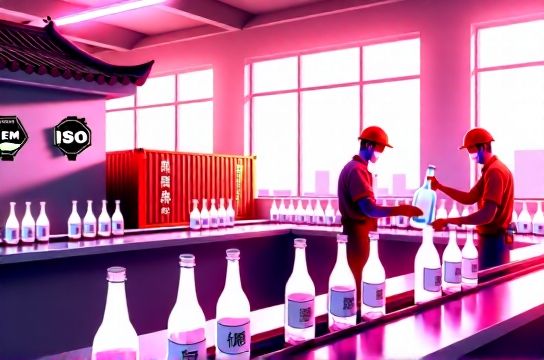
When you’re procuring glass bottles for cosmetics, beverages, pharmaceuticals, or premium food products, two supplier attributes separate reliable partners from risky ones: third-party certification *and* proven OEM capability. Certification (e.g., ISO 9001, BRCGS, FDA registration, SGS audit reports) confirms consistent process control and traceability. OEM capability means the factory can execute your exact design — custom mold tooling, unique neck finishes, proprietary embossing, color matching (cobalt blue, amber, flint), and labeling compatibility — not just fill your logo onto a stock shape.
Here’s what happens when either is missing: A ‘certified’ factory without OEM muscle may quote fast but subcontract molding or decoration — introducing delays, dimensional drift, and untraceable batch records. Conversely, an OEM-savvy factory with no formal certification may deliver perfect prototypes but fail a brand’s internal audit or U.S. FDA inspection due to undocumented raw material sourcing or inconsistent annealing cycles.
Real-world example: A U.S.-based organic toner brand ordered 120,000 amber 100 mL bottles from a Shandong factory listed as “ISO-certified” on Alibaba. The first shipment passed visual inspection — but failed thermal shock testing (5°C to 65°C in <30 sec) at the importer’s lab. Root cause? The factory used uncertified cullet (recycled glass) exceeding 15% — allowed under Chinese GB/T 24694-2009 but prohibited by the brand’s quality agreement. No documented incoming material checks. No corrective action log. They’d passed ISO 9001 *on paper*, but hadn’t implemented it in glass melting or lehr calibration.
H2: How Glass Bottle Manufacturing Actually Works — And Where Quality Breaks Down
Glass bottle production isn’t linear — it’s a tightly coupled system of six interdependent stages. Skipping verification at any point risks cascading failure:
1. **Raw Material Sourcing & Batch Formulation**: Sand (SiO₂), soda ash (Na₂CO₃), limestone (CaCO₃), and cullet (pre-processed recycled glass). Cullet content impacts melt temperature, clarity, and CO₂ emissions. Certified factories maintain batch logs showing cullet source, % composition, and heavy metal screening (Pb, As, Cd per GB 4806.5-2016). (Updated: May 2026)
2. **Melting & Refining (1550–1600°C)**: Done in continuous tank furnaces. Critical parameters: furnace atmosphere (oxidizing vs. reducing), residence time (>24 hrs for homogeneity), and redox control. Off-spec redox causes amber tint in flint bottles or bubbles in thin walls.
3. **Forming (Individual Section Machine – IS Machine)**: Molten glass flows into molds. Two main methods: Blow-and-Blow (for narrow-neck containers like perfume) and Press-and-Blow (for wide-mouth jars). Tolerances matter: neck finish ±0.15 mm, wall thickness ±0.2 mm, weight ±2 g. Top-tier OEM factories calibrate IS machines weekly using laser micrometers.
4. **Annealing (Lehr Oven)**: Controlled cooling over 30–90 minutes. Under-annealed bottles shatter during capping; over-annealed ones lose strength. Certified lehrs log temperature profiles every 15 minutes with NIST-traceable thermocouples.
5. **Inspection & Sorting**: Automated vision systems (e.g., G+D, Sidel IQS) detect micro-cracks, stones, cords, and dimensional outliers. Manual 100% inspection is rare and unsustainable beyond 5,000 units/day. Reputable OEM factories combine both: auto-sort >95% of defects, then manual spot-check 5% of each pallet.
6. **Packaging & Traceability**: Bottles packed in corrugated sleeves or reusable plastic crates. Each carton must carry a lot code linking to melt batch, IS machine section, lehr zone, and inspection report. Without this, recalls become guesswork.
H2: How to Vet a China-Based Glass Bottle Factory — Beyond the Brochure
Don’t trust certificates alone. Verify execution. Here’s your field-tested checklist:
• **Ask for the latest full audit report** — not just the certificate PDF. Request the SGS/BV/FDA audit summary (not just pass/fail), including non-conformities and CAPA status. A genuine ISO 9001:2015 report will list clause-specific findings (e.g., “Clause 8.5.2 — No documented procedure for mold maintenance”).
• **Request live video of their IS machine room** — specifically ask to see mold changeover. OEM-capable factories do this in <12 minutes with calibrated torque wrenches and infrared surface temp checks. If they hesitate or show only static photos, walk away.
• **Test their technical responsiveness**: Send a simple engineering query — e.g., “Can you hold ±0.1 mm on 24mm neck thread pitch with 120g weight?” A qualified OEM partner replies within 24 hours with a feasibility assessment, mold cost estimate, and lead time impact. Generic “Yes, we can do all bottles” = red flag.
• **Verify raw material certs**: Ask for CoA (Certificate of Analysis) for last three sand and cullet shipments. Cross-check supplier names against Chinese Ministry of Ecology and Environment’s hazardous waste disposal registry — illegal cullet dumping remains common in Hebei and Henan provinces.
• **Audit their packaging integrity**: Request drop-test video (1.2m height, 5 drops per orientation on concrete) of *your* bottle in *their* final shipping configuration. Many factories test empty bottles — but filled bottles with liquid shift center-of-gravity and stress different seams.
H2: Cost Drivers — What Actually Moves the Needle (And What Doesn’t)
Glass bottle landed cost isn’t just “$0.18/unit.” It’s a function of four levers — and only one is negotiable without sacrificing quality:
• **Mold Investment**: One-time cost. $2,800–$7,500 per cavity depending on complexity (e.g., dual-tone base + shoulder embossing adds 40%). Non-refundable. But amortized over 250,000 units, it’s <$0.03/bottle. Don’t skip this — stock molds limit differentiation and invite copycats.
• **Cullet Ratio**: Using 30% certified post-industrial cullet (vs. 0%) cuts energy use by ~18% and lowers CO₂ footprint. Most certified factories offer 25–40% cullet as standard — no upcharge. Avoid suppliers charging extra for “eco-glass.”
• **Minimum Order Quantity (MOQ)**: Standard MOQ for custom OEM is 50,000–100,000 units. Below that, setup labor dominates cost. Don’t expect $0.12/unit at 5,000 pcs — it’ll be $0.31–$0.44. Use the table below to benchmark realistic pricing tiers.
• **Logistics & Compliance**: Sea freight from Ningbo to LA is $1,850–$2,200/20’ container (FOB terms) (Updated: May 2026). Add 5.5% U.S. HTS duty (7010.90.50), FDA Prior Notice ($25–$40/batch), and ISPM-15 crate fumigation ($120). These are fixed — negotiate them upfront.
| Order Volume | Base Price (FOB Ningbo) | Mold Amortization | Landed Cost (LA Port) | Lead Time (Weeks) | Key Risk |
|---|---|---|---|---|---|
| 50,000 units | $0.22–$0.29 | $0.05–$0.07 | $0.38–$0.49 | 10–12 | Mold wear affects consistency after 30k units |
| 150,000 units | $0.17–$0.22 | $0.02–$0.03 | $0.32–$0.39 | 12–14 | Raw material price volatility (sand up 12% YoY) |
| 500,000 units | $0.14–$0.18 | $0.005–$0.01 | $0.29–$0.35 | 14–16 | Inventory obsolescence if formula changes |
H2: Importing from China — Your Compliance & Logistics Checklist
U.S. importers face three hard requirements — no exceptions:
1. **FDA Registration**: Your China factory *must* be registered with FDA as a foreign supplier (not just your U.S. agent). Verify registration status at fda.gov/food/fda-registration-food-facilities. Unregistered factories trigger automatic detention at port.
2. **Prior Notice**: Submit FDA Prior Notice (PN) via FDA’s Prior Notice System Interface (PNSI) *before* vessel departure. Include lot codes, net weight, and HTS number. Late filing = $250 fee + 3-day delay.
3. **ISPM-15 Compliant Packaging**: Wooden crates/pallets must bear the IPPC mark with country code (CN), producer code, and HT (heat-treated) stamp. Bamboo or plastic crates avoid this — but add $0.015–$0.022/unit.
Also critical: Ensure your supplier issues a commercial invoice listing *glass composition* (e.g., “Soda-lime glass, 28% cullet, Pb <0.1 ppm”) — required for CBP entry and state-level toxics reporting (e.g., California Prop 65).
H2: When to Consider U.S. Glass Bottle Manufacturers — And When Not To
U.S. glass bottle manufacturers (e.g., Ardagh, Owens-Illinois plants in Ohio and Pennsylvania) offer zero ocean freight, faster response, and full FDA alignment. But their reality check:
• Minimum order: 250,000 units for custom OEM. Below that, they won’t open a mold.
• Lead time: 16–20 weeks for new tooling (vs. 8–10 weeks in China).
• Cost: $0.42–$0.68/unit FOB U.S. for same spec — driven by labor ($28/hr avg. vs. $3.20/hr in China), energy ($0.12/kWh vs. $0.08), and lower automation penetration in secondary operations (labeling, packing).
Use U.S. manufacturers only if: You need <4-week replenishment, require domestic-only supply chain for defense contracts, or ship <50 miles to bottling line (e.g., craft beverage co-packer in Portland). Otherwise, China remains the only scalable OEM option for mid-volume brands.
H2: Building a Long-Term Partnership — Not Just a Transaction
Treat your glass bottle factory like a Tier-1 engineering partner — not a commodity vendor. Start with a pilot run of 10,000 units using your full spec sheet and packaging plan. Require:
• Pre-shipment inspection report with 10-point dimensional checklist (neck OD, thread depth, base flatness, etc.)
• Sample retention: 3 bottles per lot, stored 12 months for retest
• Shared digital dashboard: Real-time access to production schedule, mold maintenance logs, and lehr temp charts
One client — a Seattle-based kombucha brand — reduced defect rate from 3.2% to 0.4% in 6 months by co-developing a mold cleaning SOP with their Jiangsu factory and installing remote vibration sensors on IS machine spindles. Their next step? Joint IP filing on a patented ergonomic shoulder curve — now exclusive to them.
That level of collaboration doesn’t happen with RFQs sent to 12 factories. It starts with selecting one certified, technically fluent OEM partner — then investing in shared tools, data, and accountability.
For deeper operational templates — including mold spec sheets, audit questionnaires, and FDA compliance checklists — see our complete setup guide. (Updated: May 2026)