Glass Bottle Procurement Service Experts for Global Impor...
- 时间:
- 浏览:166
- 来源:Custom Glass Bottles
H2: Why Glass Bottle Procurement Is Harder Than It Looks
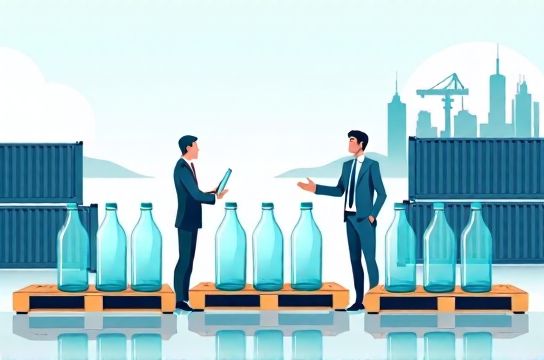
Sourcing glass bottles isn’t just about finding the lowest unit price. A mid-sized beverage brand in Toronto recently ordered 200,000 amber 330ml swing-top bottles from a quoted ‘ISO-certified’ factory in Shandong. They paid 30% deposit, got sample approval via photos only, and waited 11 weeks for shipment. Upon arrival, 18% of bottles had micro-fractures visible under UV light — undetectable in photos, but catastrophic for carbonated drinks. The supplier refused liability, citing ‘normal tolerance’ in their T&Cs. No third-party inspection. No mold traceability. No recourse.
That’s not an outlier. It’s the default risk when procurement skips process discipline.
H2: How Glass Bottles Are Actually Made (And Why It Matters to Buyers)
Understanding the manufacturing workflow helps you ask better questions — and spot red flags early.
Glass bottle production starts with raw material batching (sand, soda ash, limestone, cullet), then melts at ~1500°C in continuous tank furnaces. From there, molten glass flows into blank molds, gets partially formed, then transferred to blow molds where compressed air shapes the final bottle. Annealing (controlled cooling) is non-negotiable — skip it or rush it, and you get stress fractures. Then comes inspection: automated optical sorting (AOS) catches dimensional flaws, but only trained human eyes catch subtle surface defects like seeds (unmelted particles) or cords (density variations).
Key takeaway: You can’t inspect your way out of poor annealing or inconsistent furnace temperature control. Quality starts at the furnace — not the QC desk.
H3: What to Verify in a Glass Bottle Factory Audit
Don’t rely on self-reported certifications. Ask for:
– Furnace logbooks (temperature variance over last 30 days, max deviation ≤ ±5°C) – Annealing lehr calibration records (verified weekly by certified metrologist) – Mold maintenance logs (e.g., chrome plating recoating every 400,000 cycles) – Batch traceability: each production lot must map to raw material batch IDs, furnace zone, shift, and operator
Factories that push back on sharing this — or say “we don’t keep logs” — are optimizing for speed, not stability. That’s fine for low-risk decorative jars. Not for food-grade, pressure-rated, or pharmaceutical packaging.
H2: China vs. US Glass Bottle Manufacturers: Trade-Offs, Not Winners
There’s no universal ‘better’. There’s only fit-for-purpose.
China remains the dominant source for custom-shaped, low-to-mid volume glass bottles — especially for craft brewers, premium skincare, and organic tonics. As of April 2026, average landed cost for a standard 250ml flint wine bottle (plain, no decoration) is $0.18–$0.27/unit FOB Ningbo, depending on MOQ and mold reuse terms. Minimum order quantities typically start at 50,000 units per SKU. Lead time: 9–14 weeks from PO to port departure — longer if custom molds are needed (add 4–6 weeks).
US-based glass bottle manufacturers (e.g., Ardagh Group’s Lancaster, PA plant; Owens-Illinois facilities in Ohio and California) excel in high-volume, standardized SKUs — think 12oz soda bottles or 750ml liquor containers. Their strength isn’t flexibility; it’s repeatability, regulatory alignment (FDA 21 CFR Part 117, FSMA), and zero ocean freight or tariff risk. Landed cost for the same 250ml bottle: $0.39–$0.52/unit, with lead times of 4–7 weeks and MOQs often ≥200,000 units.
Neither option is ‘cheap’. China trades cost for control; the US trades cost for compliance and speed.
H2: 5 Supplier Evaluation Criteria That Actually Predict Performance
1. Mold ownership & reuse policy: Who owns the mold? Can you take it if you switch suppliers? Does the factory charge ‘mold storage fees’ after 12 months of inactivity? (Red flag: yes.)
2. Cullet usage rate: Reclaimed glass (cullet) reduces energy use and CO2. Top-tier factories use ≥30% post-consumer cullet (Updated: April 2026). Below 15% suggests outdated furnace tech or lax environmental controls.
3. Breakage rate history: Ask for 3-month rolling data on in-house breakage — not just ‘final yield’, but pre-annealing, post-annealing, and packing-line losses. Consistent <0.8% total loss signals mature process control.
4. Packaging methodology: Are bottles packed in reusable wood crates (standard in EU/US) or single-use cardboard dividers (common in China)? Crate systems reduce transit damage by 65%+ but require deposit logistics. If your importer lacks crate return infrastructure, insist on ISO-certified shock-absorbing cartons with ISTA 3A validation reports.
5. Regulatory documentation readiness: For FDA-regulated products (food, cosmetics, supplements), confirm they provide full extractables & leachables test reports (per USP <661.1>), heavy metals screening (Pb, Cd, As, Sb), and migration testing — not just ‘complies with FDA standards’.
H2: Realistic Cost Breakdown: What Moves the Needle
Unit cost is only 45–60% of total landed cost. Hidden line items dominate the rest:
– Tooling: Custom mold = $3,500–$12,000 (one-time, amortized) – Sampling: $350–$900 per round (including courier, lab tests, engineer time) – Third-party inspection: $320–$580 per man-day (required for first 3 shipments) – Ocean freight (40ft HC): $2,800–$5,100 (Asia–US West Coast, April 2026) – Duty: 0–5% for most glass bottles (HTS 7010.90, depends on end-use and country of origin) – Bonded warehouse handling: $0.018–$0.032/unit (for customs clearance + palletizing) – Insurance: 0.25–0.4% of CIF value
Below is a realistic comparison of procurement pathways for a 100,000-unit order of 300ml cobalt blue cosmetic bottles (custom shape, silk-screened logo):
| Factor | China Manufacturer (FOB) | US Manufacturer (EXW) | Hybrid (China mold + US finishing) |
|---|---|---|---|
| Unit price | $0.41 | $0.68 | $0.49 |
| Mold cost | $6,200 | $9,800 | $6,200 (reused) |
| Ocean freight + duty | $3,950 | $0 | $3,950 |
| Lead time (weeks) | 12 | 5 | 9 |
| Quality failure risk (first run) | Medium-High (requires 100% AQL 1.0 inspection) | Low (process-validated) | Medium (depends on finishing partner) |
| Total landed cost (100k units) | $47,150 | $77,800 | $55,150 |
Note: Hybrid models use Chinese factories for base bottle production (shape, annealing, basic finish), then ship to US-based co-packers for labeling, screen printing, or quality rework. This balances cost and control — but adds coordination overhead. Only viable if your US partner has glass-specific expertise (not just general contract packaging).
H2: Your Procurement Checklist — Before, During, and After Order
Before PO: – Confirm mold design sign-off includes dimensional GD&T drawings (not just renderings) – Require pre-production samples tested for thermal shock (120°C → 20°C immersion, 3 cycles, zero cracks) – Lock in Incoterm: FOB is standard, but if supplier insists on EXW, verify they’ll handle export docs — many Chinese factories outsource this to agents who cut corners
During production: – Hire a third-party inspector *before* final packing. Not after. Not ‘on loading day’. At 30% and 80% completion. – Require real-time furnace temp logs (shared via secure portal), not retrospective PDFs – Track first-article inspection reports (FAIR) for every critical dimension — not just ‘approved’ stamps
After delivery: – Hold 5% payment for 30 days post-arrival. Use it to cover rework or replacement if defects exceed AQL 1.0 – Store original batch certificates and test reports digitally — FDA and EU authorities may request them 2+ years later during audits
H2: When to Walk Away — 4 Non-Negotiable Red Flags
1. ‘We don’t do third-party inspections.’ Legitimate factories welcome them. They know their process is auditable.
2. Samples shipped loose in cardboard boxes (no molded trays or dividers). That’s not cost-saving — it’s a preview of how they’ll pack your bulk order.
3. No English-speaking technical contact with engineering authority. If the person quoting you can’t explain annealing cycle profiles or refractory wear rates, they’re a sales agent — not a manufacturer.
4. Refusal to share furnace ID or melt batch numbers on COAs. Traceability isn’t optional for regulated goods.
H2: Building Long-Term Supplier Resilience
One-off transactions breed risk. Strategic partnerships reduce it.
Start small: order 2–3 SKUs at 50% of target volume. Use that run to pressure-test communication, documentation rigor, and problem resolution speed — not just defect rate.
Then co-develop a Supplier Development Plan: jointly agree on 3–6 month goals (e.g., reduce breakage from 1.2% to <0.7%, implement digital batch tracking, achieve ISO 14001 certification). Tie 10–15% of annual payment to verified progress.
This shifts the relationship from vendor to partner — and gives you leverage beyond price.
H2: Final Thought — Procurement Is Process Engineering, Not Shopping
Buying glass bottles isn’t about choosing between ‘China cheap’ and ‘US safe’. It’s about mapping your product’s risk profile (carbonation level, fill temperature, shelf life, regulatory tier) to a supplier’s proven process capability — then building verification into every handoff.
If you’re scaling across multiple markets, start with the complete setup guide to align specs, compliance, and logistics before issuing your first RFQ. Because the cheapest bottle is the one you don’t have to replace.