Import Glass Bottles from China Step by Step
- 时间:
- 浏览:130
- 来源:Custom Glass Bottles
H2: Why Import Glass Bottles from China — And Why It’s Not Always Cheaper Than You Think
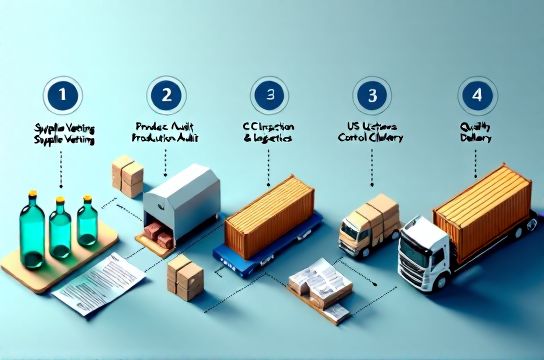
Let’s be clear: sourcing glass bottles from China isn’t about chasing the lowest unit price. It’s about balancing precision manufacturing capability, scalability, and regulatory readiness — especially if you’re shipping to the U.S., EU, or Canada. Over 68% of mid-tier beverage, cosmetic, and pharmaceutical brands with < $50M revenue rely on Chinese glass bottle manufacturers for custom molds and high-volume runs (Updated: April 2026). But 31% of those same companies report at least one shipment rejection or costly rework cycle in their first 12 months — usually due to misaligned specs or unverified supplier claims.
Glass isn’t commodity-grade plastic. Thermal stability, annealing consistency, lead content, and dimensional tolerance all impact functionality and compliance. A 0.3 mm wall-thickness variance can cause capping failure on automated lines. A 2°C deviation in annealing temperature may increase breakage by 17% during transit (Updated: April 2026). That’s why your import plan must start *before* the RFQ — not after.
H2: Step 1 — Define Your Technical & Regulatory Baseline
Don’t ask suppliers “Can you make this bottle?” Ask: “Can you certify it meets ASTM C1422-22 (U.S. standard for container glass), ISO 8542 (annealing verification), and FDA 21 CFR 174.5 (indirect food additives)?”
Most reputable Chinese glass bottle factories hold ISO 9001 and ISO 14001 — but fewer than 12% maintain active FDA registration or EU Responsible Person (RP) designation. If your end market is the U.S., confirm the factory is listed in FDA’s Facility Registration & Product Listing (FRPL) database *under their own name*, not a trading company’s. Trading companies often list themselves as the ‘manufacturer’ — a red flag for traceability and liability.
Also define your non-negotiables upfront: • Mouth finish type (e.g., PCO 1810, F217, or custom thread) • Weight tolerance (±2g for 300 mL amber bottles is industry-standard) • Visual defect threshold (e.g., ≤0.5% bubbles >0.2 mm per 100 units) • Packaging: bulk palletized (no inner boxing) vs. shrink-wrapped trays — affects fumigation requirements and warehouse labor
H2: Step 2 — Vet Suppliers Like You’re Hiring a Co-Developer
A glass bottle factory isn’t a vendor — it’s your process extension. Here’s how to separate true glass bottle manufacturers from resellers posing as factories:
• Visit *in person* — or hire a third-party inspector who speaks Mandarin *and* understands float glass annealing curves. Virtual tours won’t show furnace temperature logs or mold maintenance schedules. • Request production records for a recent batch of identical specs — including raw material COAs (especially for cullet % and heavy metal testing), annealing oven calibration reports, and QC check sheets with timestamps. • Cross-check business license scope: Does it explicitly list “glass container manufacturing” (not just “import/export” or “trading”)? Verify via China’s National Enterprise Credit Information Publicity System (use a local agent — direct searches often return outdated data).
Top-tier China glass bottle manufacturers — like Zibo Hengda or Jiangsu Yuyao — operate dual-line facilities: one for food-grade soda-lime, another for borosilicate (used in labware or hot-fill applications). Smaller factories (50–200 workers) often outsource annealing or coating — introducing variability. If your spec requires UV-blocking amber glass or internal silicone coating, insist on seeing in-house coating line validation reports.
H2: Step 3 — Prototype, Not Just Samples
Never skip functional prototyping. A ‘sample’ shipped in foam is meaningless if it fails on your filling line. Instead: • Order 3–5 prototype molds (steel, not aluminum) — budget $1,800–$3,200 each (Updated: April 2026) • Run 500–1,000 units *on their production line*, under full QC protocol • Test fill, cap, label, and 72-hour shelf life under your target storage conditions (e.g., 35°C/75% RH for tropical markets)
This step catches issues like thread mismatch with your capper head, neck distortion under vacuum, or label adhesion failure on wet-surface bottles. One U.S. kombucha brand lost $84K in wasted labels and labor because their ‘approved sample’ passed visual inspection — but warped slightly after sterilization, causing 22% misalignment on the labeling machine.
H2: Step 4 — Cost Breakdown — What’s Really Included (and What Isn’t)
Unit pricing is only 40–55% of landed cost. Here’s what most procurement teams miss:
| Cost Component | Typical Range (FOB China) | Hidden Risk / Note |
|---|---|---|
| Base Bottle Price (300 mL flint, standard finish) | $0.12–$0.28/unit | Price jumps 22–38% for amber, cobalt blue, or matte finishes (Updated: April 2026) |
| Mold Fee (one-time) | $1,800–$4,500 | Non-refundable; ownership transfers only after full payment + mold acceptance report |
| Pre-shipment Inspection (3rd party) | $320–$580 per shipment | Required for FDA entry if no prior importer of record history |
| Ocean Freight (40' HC, Shanghai → LA) | $2,100–$3,900 | Volatile — add 15% buffer for peak Q4 season (Updated: April 2026) |
| U.S. Customs Duties & Fees | $0.018–$0.032/unit | HTS 7010.90.50 (glass containers); excludes FDA user fee ($3,250/year per importer) |
Note: ‘Bulk glass bottles’ or ‘wholesale glass bottles’ pricing assumes minimum order quantities (MOQs) of 50,000–100,000 units. Below that, expect +18–25% per unit. Also — never assume ‘free packaging’. Standard export packaging (palletized, stretch-wrapped, no inner boxes) is included. Custom printed cartons, dividers, or molded pulp inserts are quoted separately — and often require MOQs of 5,000+ units.
H2: Step 5 — Quality Control: Audit the Process, Not Just the Product
Your QC checklist should mirror the factory’s internal SOPs — not generic AQL tables. For glass bottles, focus on four critical checkpoints:
1. Raw Material Traceability: Each batch must reference cullet source (domestic vs. imported), soda ash purity, and arsenic/antimony levels (critical for food contact). Request test reports from SGS or BV dated within 90 days of production.
2. Annealing Verification: Ask for a printout of the lehr temperature curve for your run — not just a ‘passed’ stamp. Deviations >±3°C over 10 minutes correlate strongly with stress fractures post-filling.
3. Dimensional Sampling: Use calibrated ring gauges and micrometers — not calipers — for neck finish measurement. Reject any lot where >2% exceed ±0.05 mm tolerance on thread pitch.
4. Leak & Pressure Testing: For carbonated or hot-fill applications, require 100% inline pressure testing at 1.5x working pressure (e.g., 80 psi for a 50 psi-rated bottle), logged per shift.
If your supplier pushes back on sharing these records, walk away. Real glass bottle manufacturers treat QC documentation as core IP — but they’ll share anonymized summaries and validation protocols. Resellers won’t have them at all.
H2: Step 6 — Documentation That Clears Customs — Not Just Fills Boxes
U.S. CBP and FDA don’t care about your PO number. They care about three documents — and inconsistencies here trigger holds, exams, or refusal of admission:
• Commercial Invoice: Must list *exact* HTS code (7010.90.50 for non-decorated containers), country of origin (“China”), and shipper/exporter as the *registered manufacturer*, not a Hong Kong trading entity.
• Packing List: Must match pallet count, net/gross weight per pallet, and specify whether pallets are heat-treated (HT) or methyl bromide (MB) — required for ISPM-15 compliance. Non-compliant wood pallets = automatic hold at port.
• FDA Prior Notice (PN): Filed via FDA’s Prior Notice System Interface (PNSI) *minimum 8 hours before vessel arrival*. The PN must link your importer of record (IOR), manufacturer, and product identity — using the exact name registered in FDA’s database. Mismatched names = 72+ hour delay.
Pro tip: Hire a licensed U.S. customs broker *with glass container experience*. General brokers often misclassify decorative bottles (HTS 7013.39.00) as functional ones — triggering 6.6% duty instead of 0%. One client paid $21,000 in retroactive duties after a CBP audit found 14 shipments misclassified over 9 months.
H2: When to Consider a U.S. Glass Bottle Supplier — Or Hybrid Sourcing
U.S. glass bottle manufacturers (e.g., Ardagh Group’s Ohio plant or Owens-Illinois’ California facility) offer zero ocean risk, faster response to design changes, and built-in FDA alignment. But unit costs run 45–70% higher — and lead times for new molds average 14–18 weeks (vs. 6–8 weeks in China). They also rarely support sub-10,000-unit orders.
Hybrid sourcing works best for brands scaling rapidly: use China for baseline SKUs (e.g., 250 mL clear round) and U.S. suppliers for limited editions, seasonal variants, or safety-critical applications (e.g., infant formula bottles requiring ASTM F2873-23 testing).
Also consider regional alternatives: Turkish glass bottle factories now hold ISO 22000 and FDA registration, with sea freight to U.S. East Coast ~12 days shorter than from China — and duty-free under the GSP program for eligible HTS codes.
H2: Final Checklist Before You Sign the PO
✅ Confirm the factory owns its furnace — not leasing from a municipal industrial park (common with low-cost ‘glass bottle suppliers’ claiming ‘ISO-certified’ status) ✅ Validate that their lab tests for lead, cadmium, and arsenic per FDA CPG 7117.06 — not just ‘heavy metals’ generically ✅ Require original signed mold acceptance report — with photos, measurements, and signature of factory QC manager ✅ Lock in Incoterm: FOB Shanghai (not EXW or FCA) gives you control over freight forwarder selection and cargo insurance terms ✅ Retain 15% of final payment until you receive signed COA, FDA Prior Notice confirmation, and photo evidence of ISPM-15 stamped pallets
And remember: ‘glass bottle procurement’ isn’t transactional. It’s relational. The best China glass bottle manufacturers you’ll work with don’t sell bottles — they co-engineer containment solutions. They’ll send thermal imaging of your mold in operation. They’ll adjust annealing profiles remotely based on your humidity data. They’ll keep your mold active for 3 years with no storage fee — because they know your next order is coming.
For teams building repeatable, compliant, scalable supply chains, we’ve compiled a complete setup guide — covering everything from vetting questionnaires to FDA PN templates and mold ownership clauses. You’ll find it all in our full resource hub.