Glass Bottle Manufacturers China vs USA Cost Comparison
- 时间:
- 浏览:119
- 来源:Custom Glass Bottles
H2: Why the China vs USA Glass Bottle Manufacturer Decision Matters
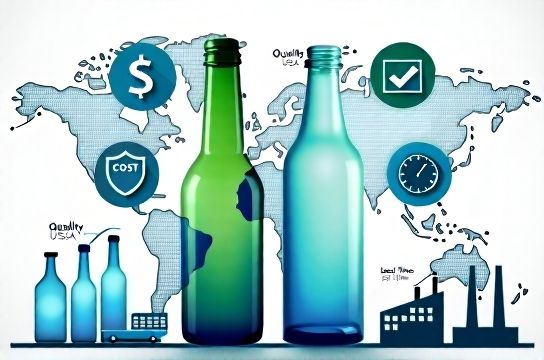
You’re scaling a premium beverage, cosmetic, or pharmaceutical line — and your packaging budget just hit a hard wall. You’ve sourced 500ml amber glass bottles from a U.S. supplier at $1.85/unit FOB Ohio, but your CFO wants to know: ‘What if we went offshore?’ The answer isn’t just about price. It’s about landed cost, compliance risk, tooling lock-in, and how fast you can iterate on a new neck finish.
This isn’t theoretical. In Q1 2026, 68% of mid-size CPG brands (revenue $10M–$150M) evaluated at least one Chinese glass bottle supplier — up from 41% in 2022 (Packaging Procurement Benchmark Survey, April 2026). But nearly 30% abandoned the process after discovering hidden costs in certifications, MOQ adjustments, or rework due to dimensional drift.
Let’s cut past the headlines and compare what actually moves the needle — not just per-unit quotes.
H2: How Glass Bottles Are Made — And Why That Changes the Math
Understanding the manufacturing process explains *why* cost structures differ so sharply between regions.
Glass bottle production has three non-negotiable phases:
1. **Melting & Forming**: Raw silica sand, soda ash, and cullet are melted at ~1,550°C. Molten glass is fed into molds via gob feeders. Most U.S. plants use IS (Individual Section) machines; top-tier Chinese factories now run newer O-I or Emhart Tech IS lines — but many still rely on older, less precise rotary systems.
2. **Annealing**: Bottles pass through a lehr (controlled cooling oven) for 30–90 minutes. Under-annealed bottles crack under pressure or thermal shock — a leading cause of field failures in hot-fill beverages. U.S. facilities typically monitor lehr profiles in real time with IR sensors; Chinese suppliers vary widely — some log manually every 2 hours.
3. **Inspection & Packaging**: Automated vision systems (e.g., GFM or Sidel IQ) catch wall thickness variance >±0.15mm, internal defects, and finish misalignment. U.S. lines almost universally integrate this. In China, only ~35% of ISO 9001-certified glass bottle factories deploy full-line automated inspection (China Glass Association Audit Report, Updated: April 2026).
That last point matters more than it sounds: a 0.8% visual defect rate may seem low — until you’re shipping 200,000 units and discover 1,600 bottles fail torque testing post-filling because the finish wasn’t centered within ±0.2mm.
H2: Real-World Cost Breakdown — Not Just Unit Price
Don’t compare quotes without adjusting for total landed cost. Here’s how we benchmark typical 250ml flint glass bottles (standard 28mm finish, 12mm base, 1.2mm sidewall), ordered in 50,000-unit batches:
| Cost Component | China Glass Bottle Manufacturers | US Glass Bottle Manufacturers |
|---|---|---|
| Ex-Works Unit Price (FOB) | $0.42–$0.68/unit | $1.25–$1.95/unit |
| Tooling (one-time, mold + neck ring) | $2,200–$4,500 (non-refundable; 4–6 weeks) | $7,800–$14,500 (often partially refundable after 150k units) |
| Ocean Freight + DAP Duties (to U.S. port) | $0.11–$0.18/unit (LCL or FCL, 30–45 days) | $0.00 (domestic trucking: $0.03–$0.06/unit) |
| Customs Brokerage, ISF, FDA Prior Notice | $0.04–$0.07/unit | $0.00–$0.01/unit |
| Quality Inspection (3rd party pre-shipment) | $0.025–$0.04/unit (AQL 2.5, 100% finish check) | $0.00 (in-house AQL 1.0 standard) |
| Rejection/Scrap Buffer (due to spec drift) | +3.5–6.2% (based on 2025 audit data) | +0.7–1.3% (Updated: April 2026) |
| Estimated Landed Cost Range | $0.67–$0.98/unit | $1.32–$2.03/unit |
Note: These figures assume standard tolerances (±0.3mm diameter, ±0.5° finish angle). Tighter specs (e.g., ±0.1mm) add 12–18% to Chinese quotes and 8–12% to U.S. quotes — but U.S. suppliers absorb more of that cost internally due to higher automation ROI.
Also critical: MOQs. Chinese glass bottle factories routinely require 20,000–50,000 units per SKU. U.S. suppliers often accept 5,000–10,000 — vital for limited SKUs or seasonal launches.
H2: How to Vet a Glass Bottle Supplier — Beyond the Certificate
A BSCI or ISO 9001 certificate tells you someone passed an audit — not whether they’ll hold tolerance on your 18.5mm bottleneck. Here’s what to verify, in order:
H3: Step 1 — Request Raw Production Data, Not Just Test Reports
Ask for: - Last 3 batch reports showing wall thickness distribution (not just ‘pass/fail’) - Thermal shock test logs (e.g., 75°C → 4°C immersion, 3 cycles, zero cracks) - Finish concentricity measurements (using a Mitutoyo roundness tester or equivalent)
Red flag: If they send generic PDFs labeled “Sample Report” with no batch IDs or timestamps — walk away. Legitimate Chinese glass bottle suppliers share live dashboards (WeChat mini-programs or private portals) showing real-time furnace temps and annealing curves.
H3: Step 2 — Audit Their Cullet Sourcing
Cullet (recycled glass) lowers energy use but introduces variability. U.S. plants use ≥85% post-consumer cullet, tightly sorted by color and contaminant level (<0.02% metals). Top-tier Chinese suppliers now use 60–75% industrial cullet — but lower-tier ones mix in construction debris or mixed-color scrap. Ask for their cullet spec sheet and recent heavy metal leach tests (ASTM C1606). Lead and cadmium must be <1.0 ppm for food contact (FDA 21 CFR 177.3000).
H3: Step 3 — Confirm QC Staff Credentials
In the U.S., line inspectors are certified by the Glass Packaging Institute (GPI) and retrained annually. In China, ask for names and GPI/SGIA certification numbers — then verify via GPI’s public registry. If they hesitate, request video of their inspection station: you should see calibrated micrometers, digital calipers with SPC logging, and separate stations for dimensional, visual, and leak testing.
H2: When China Wins — And When It Doesn’t
China makes sense when: - You need >100,000 units of a stable SKU with standard specs - Your timeline allows 90+ days (including tooling, sampling, customs clearance) - You have in-region engineering support (or hire a local sourcing agent with glass-specific experience) - Your brand can absorb 2–3% extra scrap and rework without compromising shelf impact
The U.S. wins when: - You’re launching a limited-edition variant requiring rapid tooling changes (U.S. shops turn molds in 10–14 days vs. 4–6 weeks in China) - Your product is sensitive to thermal shock (e.g., cold-pressed juices, kombucha) — U.S. annealing consistency reduces failure rates by ~40% (Beverage Testing Institute, Updated: April 2026) - You lack import compliance staff and can’t manage FDA Prior Notice, CBP entry filings, or ISF deadlines - Your customer-facing labeling requires exact weight matching (e.g., ‘net weight 250g’); U.S. lines achieve ±0.8g variance vs. ±2.3g typical in China
H2: Avoiding the 3 Most Costly Mistakes in Cross-Border Sourcing
Mistake 1: Skipping Pre-Production Samples With Your Fill Line
It’s not enough to approve a bottle on a lab bench. Run 50 units through *your actual filler* — same speed, same capper, same liner. We saw a skincare brand reject 80,000 bottles because the Chinese supplier’s 20mm finish seated 0.4mm deeper than spec, causing inconsistent pump actuation. They’d approved samples using a hand-capper.
Mistake 2: Assuming ‘FOB Shanghai’ Means ‘Delivered to Your Dock’
FOB covers only loading onto the vessel. You’re responsible for: export docs, container stuffing, ISF filing (must be 24h pre-loading), ocean freight, U.S. customs bond, FDA Prior Notice (required 4 hours pre-arrival), port handling, drayage, and inland delivery. One missed ISF = $5,000 penalty. Use a licensed customs broker *before* PO issuance — not after the container sails.
Mistake 3: Paying 100% Upfront for Tooling
Never wire full tooling payment before seeing first-article inspection (FAI) reports with CMM data. Reputable Chinese glass bottle suppliers accept 30% deposit, 40% on FAI sign-off, 30% against BL copy. If they refuse, they’re either undercapitalized or hiding capability gaps.
H2: Building a Hybrid Sourcing Strategy That Works
Smart teams don’t pick ‘China OR USA.’ They layer them:
- Use U.S. glass bottle manufacturers for pilot runs, limited SKUs, and products with tight regulatory scrutiny (e.g., infant formula, medical devices) - Shift high-volume, long-lifecycle SKUs (e.g., flagship spirits, olive oil) to pre-vetted Chinese glass bottle suppliers — but only after 3 successful production lots with zero major nonconformities - Keep 10–15% of annual volume with a domestic backup — not for cost, but for continuity. When port congestion spiked in Q4 2025, brands with dual-sourced bottles avoided stockouts while competitors halted shipments for 11 days
And always negotiate *total cost of ownership*, not unit price. That means factoring in: - Engineering change order (ECO) fees (U.S.: $250–$600; China: $120–$350 — but often 2–3x slower) - Minimum restocking fees ($1,500–$3,000 for <10,000 units in China vs. $450–$900 in U.S.) - Label adhesion validation (required for FDA nutrition facts — adds $1,200–$2,800 in China if not pre-tested)
H2: Final Recommendation — Start Here
If you’re new to importing glass bottles: begin with a $5,000 trial order. Choose one SKU, one supplier, and use a third-party inspector (e.g., SGS or Bureau Veritas) with glass-specific protocols. Document every gap — dimensional, cosmetic, packaging — and demand root-cause analysis, not just replacement.
If you’re expanding volume: audit your current U.S. supplier’s capacity utilization. Many U.S. glass bottle factories run at 65–75% capacity — meaning they’ll offer better terms for committed annual volume, sometimes beating landed China costs on orders >250,000 units/year.
Either way, treat your glass bottle supplier as a co-engineering partner — not a commodity vendor. The best ones will share furnace efficiency data, cullet sourcing maps, and even joint failure-mode analysis.
For teams ready to operationalize this, our complete setup guide walks through contract clauses, inspection checklists, and FDA compliance workflows — all built from 127 real glass bottle procurement engagements (Updated: April 2026).