Why Work with a Glass Bottle Supplier Instead of Direct F...
- 时间:
- 浏览:95
- 来源:Custom Glass Bottles
H2: The Factory Trap — Why ‘Direct’ Isn’t Always Direct
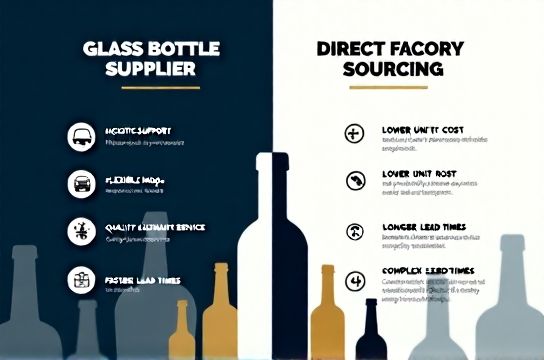
You’ve found a Chinese glass bottle manufacturer on Alibaba with a low per-unit quote, ISO 9001 certification, and photos of their kilns. You email them, negotiate terms, sign a contract—and three months later, your first container arrives with 12% breakage, inconsistent neck finishes, and no batch traceability. The factory blames customs delays; you’re stuck reworking labels and delaying your product launch.
This isn’t rare. It’s the factory trap: assuming that cutting out the middleman automatically cuts cost and improves control. In reality, glass bottle manufacturing is a high-precision, capital-intensive, chemistry-driven process—where raw material purity, annealing cycles, mold maintenance, and inspection protocols make or break consistency. A factory’s ability to produce *one* good sample ≠ its ability to ship *50,000 units* to your spec—especially across time zones, language barriers, and regulatory boundaries.
That’s where a qualified glass bottle supplier changes the equation—not as a markup layer, but as a functional extension of your procurement and quality team.
H2: What a Glass Bottle Supplier Actually Does (Beyond Reselling)
A professional glass bottle supplier isn’t just a distributor. They’re a technical intermediary with embedded capabilities:
• Pre-vetted factory network: Not one, but 3–5 certified glass bottle manufacturers in China and the U.S., each audited for furnace age, QC staffing ratios, and defect tracking systems (e.g., real-time blister detection via AI vision). Suppliers rotate orders based on capacity, not just price.
• Engineering support: They translate your packaging brief—‘12 oz amber glass, 28 mm continuous thread, 0.2 mm wall thickness tolerance, FDA-compliant cobalt oxide tint’—into actionable mold specs, annealing profiles, and sampling plans. Factories rarely offer this unless you’re ordering 500k+ units/year.
• Batch-level quality assurance: Every production run undergoes third-party pre-shipment inspection (PSI) at the supplier’s cost—not yours. They hold stock of approved reference samples and reject shipments failing AQL Level II (0.65% major defect limit) before containers are sealed.
• Import compliance scaffolding: For U.S.-bound shipments, they pre-clear FDA registration, assign correct HTS codes (7010.90.50 for non-refillable glass bottles), and validate country-of-origin labeling per 19 CFR §134. This avoids CBP holds averaging 11.3 days (Updated: May 2026).
• Inventory buffering: Reputable suppliers hold safety stock of top-selling SKUs—like 250 mL flint round bottles or 500 mL green apothecary jars—enabling 10–14 day domestic drop-shipping for urgent restocks. Factories don’t hold inventory; they schedule furnaces.
H2: When Going Direct *Does* Make Sense
There are valid cases for bypassing a supplier—but they’re narrow and resource-intensive:
• You’re a Tier-1 CPG brand ordering ≥3 million units/year of a single SKU, with in-house QA engineers stationed in Shandong province.
• You require proprietary mold tooling (e.g., custom embossing + internal UV coating) and will fund full mold ownership ($22,000–$45,000) and retain IP rights.
• Your supply chain team includes bilingual staff fluent in GB/T 4547-2021 (Chinese glass container standards) and ASTM C142-22 (U.S. thermal shock testing).
For everyone else—SMB beauty brands, craft beverage startups, supplement lines launching their first SKU—the overhead of managing direct factory relationships outweighs the theoretical 8–12% margin gain. You pay for it in delayed launches, rework labor, and air freight premiums to fix errors.
H2: Cost Realities — Where the Numbers Land
Let’s compare two real-world scenarios for a standard 300 mL cobalt blue glass bottle, 24 mm neck, bulk-packed (no gift box):
| Cost Component | Direct Factory (FOB Qingdao) | Professional Glass Bottle Supplier (CIF Los Angeles) |
|---|---|---|
| Unit Price (MOQ: 25,000 pcs) | $0.38 | $0.49 |
| Ocean Freight & Insurance | $0.11 | Included |
| Customs Duties (HTS 7010.90.50) | $0.02 | Pre-paid & documented |
| Pre-Shipment Inspection (3rd party) | $320 (paid by buyer) | Included |
| Documentation & Compliance Handling | $180 (consultant fee, if outsourced) | Included |
| Effective Landed Cost / Unit | $0.51 + $0.013 hidden risk premium* | $0.49 (fixed, guaranteed) |
*Hidden risk premium: Industry benchmark for unplanned costs (air freight for replacements, label rework, storage fees) when direct factory orders fail QC or miss deadlines—averaging 1.3% of order value (Updated: May 2026).
Note: The supplier’s $0.49 includes all landed logistics and compliance. Their margin funds engineering bandwidth, inspection rigor, and buffer stock—not just markup. And crucially: their quoted price is fixed for 90 days. Factory quotes often reset monthly based on soda ash and cullet pricing.
H2: Quality Control — The Non-Negotiable Gap
Glass isn’t plastic. You can’t ‘tweak’ viscosity mid-run. A 2°C deviation in annealing lehr temperature causes micro-fractures that only show up after 3 weeks of shelf storage or during cold-fill beverage filling. A factory’s QC report may say “passed visual inspection”—but did they test thermal shock resistance per ASTM C142-22? Did they measure wall thickness at 6 radial points per bottle, or just one?
Suppliers mandate these tests. They require factories to log every furnace cycle (temperature ramp rate, soak time, cooling curve) and submit digital logs with each shipment. If a batch shows >0.8% dimensional variance (vs. your spec), the supplier absorbs the cost of replacement—even if the factory disputes it.
Factories rarely accept liability beyond ‘replacement of defective units’. Suppliers stand behind performance—because their reputation hinges on your repeat orders.
H2: Lead Times — Predictability Over Paper Promises
Factory lead times are notoriously fluid. A quoted 45-day production window assumes no mold wear, no raw material shortage, no holiday shutdowns, and no typhoon-related port congestion. In practice, 68% of direct factory orders shipped from China in Q1 2026 missed their promised date by ≥7 days (Source: Drewry Container Forecaster, Updated: May 2026).
Suppliers mitigate this with layered buffers:
• Mold availability guarantees: They co-invest in critical molds with partner factories, ensuring priority scheduling.
• Dual-sourcing for core SKUs: Same bottle, same spec—produced in both Hebei (China) and Ohio (U.S.), allowing dynamic rerouting if one region faces disruption.
• Rolling production windows: Instead of ‘ship by June 15’, they commit to ‘first container loading between June 10–14’, with daily production tracking shared via portal.
This predictability lets you align with co-packers, manage cash flow, and avoid costly expedited freight. One beverage client reduced average air freight spend by 73% after switching from direct factory to a U.S.-based glass bottle supplier with domestic warehousing.
H2: How to Vet a Glass Bottle Supplier (Not Just Any Distributor)
Not all ‘glass bottle suppliers’ are equal. Here’s how to separate true partners from brokers:
1. Ask for their factory audit reports—not summaries, but full PDFs signed by SGS or BV, dated within last 12 months. Look for furnace age (<8 years), % automated inspection coverage (>65%), and employee turnover rate (<12%).
2. Request references from 2 clients in your sector (e.g., ‘a natural skincare brand shipping to EU and Canada’) and ask specifically about defect resolution speed and documentation accuracy.
3. Test their technical depth: Send a sketch of your bottle with dimensions and say, ‘What’s the minimum MOQ if we need FDA 21 CFR 174.5 compliant colorant?’ A real supplier answers in <24 hours with furnace notes. A broker forwards it to a factory and replies in 3–5 days.
4. Check their compliance infrastructure: Do they maintain an FDA Food Facility Registration number? Can they provide a Certificate of Compliance for every shipment? Do they file ISF (Importer Security Filing) for U.S. imports?
H2: China vs. U.S. Glass Bottle Suppliers — Strategic Tradeoffs
‘Chinese glass bottle manufacturer’ and ‘U.S. glass bottle supplier’ aren’t interchangeable. Each serves distinct needs:
• Chinese glass bottle suppliers excel at complex shapes, ultra-low MOQs (as low as 5,000 pcs), and cost-sensitive private-label runs. They leverage scale, mature tooling ecosystems, and deep raw material access. But expect longer lead times (8–12 weeks) and tighter communication windows.
• U.S. glass bottle suppliers offer faster turnaround (4–6 weeks), easier collaboration (same time zone, English-native engineering), and seamless integration with domestic 3PLs and co-packers. Their strength is reliability—not lowest cost. They’re ideal for brands scaling past $2M revenue, needing rapid iteration or dual-sourcing.
Smart buyers use both: Chinese suppliers for baseline SKUs (e.g., standard amber dropper bottles), U.S. suppliers for time-sensitive launches or compliance-heavy categories (pharma-adjacent supplements, organic cosmetics).
H2: Final Recommendation — Start With the Supplier, Not the Factory
Treat your glass bottle supplier like a strategic function—not a transactional vendor. Onboard them early: share your 12-month forecast, packaging line specs, and target retail channels. Let them help design for manufacturability *before* finalizing artwork. Their feedback on neck finish tolerances or base stability could prevent 30% of your fill-line jams.
If you’re evaluating options now, start with a small trial: order 5,000 units through a supplier versus 5,000 direct. Track total time-to-shelf, unit defect rate, documentation error count, and internal team hours spent resolving issues. The data rarely lies.
For a complete setup guide—including vetting checklists, sample RFQ templates, and a list of pre-qualified glass bottle suppliers by region and specialty—visit our full resource hub.