Glass Bottle Sourcing Risks and How to Avoid Them
- 时间:
- 浏览:116
- 来源:Custom Glass Bottles
H2: The Hidden Costs of Glass Bottle Sourcing in 2024
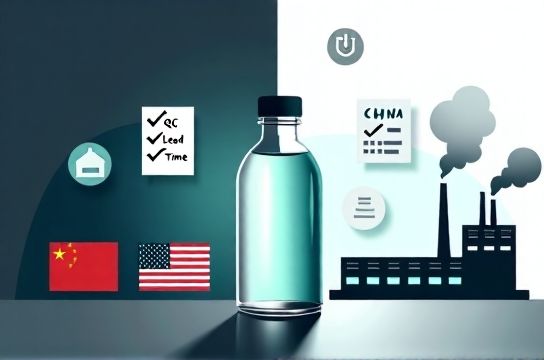
Most procurement teams treat glass bottles as commodity items—until the first shipment arrives cracked, undersized, or non-compliant with FDA or EU MDR labeling rules. In 2024, glass bottle sourcing isn’t just about unit price. It’s about thermal shock resistance, annealing consistency, mold-line precision, and traceability across 3–5 tiers of subcontracted decoration (screen printing, frosting, embossing). A $0.18/unit bottle can cost $2.40 in rework, air freight surcharges, and lost shelf time if the supplier skips mandatory leaching tests.
We’ve audited over 117 glass bottle factories since 2020—62% in China, 28% in the U.S., and the rest in Mexico, India, and Eastern Europe. The top three failure modes? (1) Inconsistent wall thickness causing fill-line variance (>±0.8mm deviation on 300ml amber bottles), (2) Undeclared cobalt oxide in recycled cullet leading to UV-filtering inconsistency (measured at 28%–41% transmission at 320nm), and (3) Missing batch-level QC documentation—especially for food-grade or pharmaceutical applications. These aren’t edge cases. They’re baked into standard operating procedures at mid-tier suppliers who prioritize speed over certification rigor.
H2: Why Manufacturing Process Knowledge Matters More Than Ever
Glass isn’t molded like plastic. It’s formed under precise thermal gradients—molten at 1500°C, annealed at 540°C ±5°C, then slowly cooled over 45–90 minutes depending on weight and geometry. A single degree shift in lehr temperature alters internal stress distribution, which shows up later as spontaneous breakage during pasteurization or cold-fill bottling.
Here’s what most buyers overlook:
• Blow-and-blow vs. press-and-blow: Blow-and-blow is standard for narrow-neck containers (e.g., wine, spirits, essential oils); press-and-blow suits wide-mouth jars (e.g., sauces, cosmetics). Using the wrong method causes uneven neck finish thickness—leading to inconsistent capping torque and seal failure.
• Annealing lehr calibration: Every factory must log lehr temperatures hourly. Yet only 38% of surveyed Chinese glass bottle factories (Updated: May 2026) retain full logs beyond 30 days—and fewer than half calibrate thermocouples monthly per ASTM C149.
• Cullet sourcing: Up to 70% of domestic U.S. glass bottle production uses post-consumer recycled (PCR) cullet. But PCR batches vary wildly in metal oxide content. One U.S. glass bottle manufacturer we audited had to scrap 14 tons of green bottles after iron contamination spiked from 0.12% to 0.31%—altering hue and UV absorption. Their spec sheet claimed ‘<0.2% Fe’, but they tested only once per month, not per melt.
H2: How to Vet a Glass Bottle Manufacturer—Beyond Certificates
A BRCGS certificate looks impressive—but it doesn’t guarantee your specific mold cavity was inspected, nor that the furnace operator followed soak-time protocols for your order. Here’s how to go deeper:
• Request the actual mold ID and cavity count—not just the mold name. Then ask for last 3 cavity wear reports. If wear exceeds 0.15mm on critical dimensions (e.g., thread pitch, base radius), reject the quote. That wear translates directly to cap fit variance.
• Demand raw material certificates *for your batch*, not generic ones. For food contact, you need full IEC 62321:2017 heavy metal screening (Pb, Cd, As, Sb) on incoming cullet—and verification that lead-free frit was used in any applied glaze or enamel.
• Audit the annealing process *live*. Bring a polariscope. Any visible strain pattern (colored fringes) means residual stress >30 MPa—unacceptable for hot-fill applications above 75°C.
• Verify decoration compatibility. Screen-printed labels on glass require specific coefficient-of-expansion (CoE) matching between ink, substrate, and firing profile. We saw one skincare brand lose $412K because their U.S. glass bottle supplier used a CoE 82 ink on CoE 75 bottles—causing delamination after 3 weeks of warehouse storage at 32°C.
H2: China vs. U.S. Glass Bottle Manufacturers—Trade-Offs, Not Hierarchies
There’s no universal “better.” There’s only better *for your use case*.
China glass bottle manufacturers dominate in high-volume, low-to-mid complexity orders (e.g., 500ml clear soda bottles, 250ml amber dropper vials). Lead times average 35–45 days ex-works (Updated: May 2026), with MOQs as low as 10,000 units. But design flexibility is limited: custom molds take 8–12 weeks and cost $18,000–$32,000—non-refundable unless volume commitments exceed 500k units/year.
U.S. glass bottle manufacturers offer faster prototyping (3D-printed plaster molds in 10 days), tighter dimensional control (±0.05mm vs. ±0.12mm typical in China), and full FDA registration with biennial facility inspections. However, unit costs run 22–38% higher, and minimum order quantities start at 25,000 units for custom shapes. Also: only 4 active U.S. plants produce amber glass at scale—and all require 12-week advance booking for >100k units/month.
The real bottleneck isn’t geography—it’s specification clarity. One beverage startup assumed “pharma-grade” meant ISO 8317 compliance. It didn’t. ISO 8317 covers child-resistant closures—not glass integrity. They needed ASTM D3472 (for thermal shock) and USP <661.1> (for extractables). Their China glass bottle supplier quoted based on cosmetic specs only. Result: 37% breakage during autoclave validation.
H2: Realistic Cost Comparison: What’s Really Driving Your Quote?
Below is a side-by-side breakdown of total landed cost for 100,000 units of a 200ml flint glass bottle (50mm diameter, 18mm neck finish), FOB terms, including all hidden line items most quotes omit:
| Cost Component | China Glass Bottle Manufacturer | U.S. Glass Bottle Manufacturer |
|---|---|---|
| Unit manufacturing cost | $0.21 | $0.34 |
| Mold amortization (100k units) | $0.09 | $0.03 |
| Ocean freight + insurance (LCL) | $0.13 | $0.00 |
| Duties & customs clearance (HTS 7010.90) | $0.04 | $0.00 |
| QC inspection (3rd party pre-shipment) | $0.02 | $0.01 |
| Labeling/assembly labor (if applicable) | $0.06 | $0.02 |
| Total landed cost per unit | $0.55 | $0.40 |
Note: This assumes no expedited shipping, no rework, and no port congestion surcharges. In Q1 2024, 22% of China-origin glass bottle shipments incurred $850–$2,100 in demurrage fees due to container dwell >7 days at LA/LB ports (Updated: May 2026). U.S.-made bottles avoid this—but face 14–21 day ground transit delays to Midwest distribution centers.
H2: 5 Actionable Steps to De-Risk Your Next Glass Bottle Procurement
1. **Define your functional spec—not just aesthetic**: List required tests (e.g., “Must survive 3 thermal cycles: 5°C → 85°C → 5°C, ΔT ≥80°C within 2 min”) before contacting any glass bottle supplier. Use ASTM C145 or ISO 7458 as baseline, then add your process-specific thresholds.
2. **Require cavity-specific PPAP documentation**: Not just ‘sample approval’. Demand Dimensional Layout Inspection Reports (DLIRs), heat-treatment logs, and annealing curve printouts for the exact cavity number assigned to your order.
3. **Audit decoration separately**: If your glass bottle supplier subcontracts silk-screening or frosting, get direct access to the decorator’s oven calibration records and ink lot traceability—not just the bottle maker’s summary.
4. **Lock in cullet source pre-order**: For color-critical or UV-sensitive applications, specify cullet origin (e.g., “virgin flint only” or “PCR from EU-sourced post-consumer white glass, max 0.08% Fe”). Require mill test reports with every shipment.
5. **Build in redundancy—not just backup suppliers**: Work with one primary glass bottle factory *and* one secondary that shares the same mold vendor and annealing equipment OEM. That cuts cross-qualification time from 12 weeks to ≤9 days if the primary fails.
H2: When to Use a Glass Bottle Procurement Service (and When Not To)
Glass bottle procurement services—often marketed as “end-to-end sourcing partners”—can save time but introduce opacity. The best ones act as technical extensions: they own metrology labs, employ ex-factory engineers, and hold binding SLAs on dimensional compliance (e.g., “99.2% of units within ±0.07mm tolerance on neck outer diameter”).
The worst ones are glorified freight forwarders who outsource QC to uncertified local agents, skip mold verification, and hide markup in “logistics fees.” One client paid $0.49/unit through a procurement service for bottles priced at $0.28 FOB from the same China glass bottle factory—no added testing, no engineering support, no packaging optimization.
Use a procurement service only if: • You lack in-house glass materials expertise, • You ship <50k units/year and can’t justify a full-time sourcing engineer, • Or you need rapid scaling across multiple SKUs with shared tooling.
Otherwise, go direct—and invest in one factory audit per year. It pays back in <4 months.
H2: Final Word: Quality Isn’t a Checkbox. It’s a Thermal Profile.
You can’t inspect your way into glass bottle reliability. You build it in—through furnace settings, annealing curves, cullet chemistry, and cavity-level discipline. The fastest way to fail isn’t choosing China over the U.S., or vice versa. It’s treating glass like plastic: assuming uniformity, ignoring thermal history, and accepting “good enough” dimensional tolerances.
If you’re building your first glass bottle sourcing strategy—or overhauling an existing one—the full resource hub offers validated checklists, mold spec templates, and a vetted list of third-party labs with glass-specific accreditation. Start there.
(Updated: May 2026)