1 Gallon Glass Jar Height Diameter and Volume Measurements Explained
- 时间:
- 浏览:96
- 来源:Custom Glass Bottles
Let’s cut through the confusion: if you're scaling up home canning, fermenting, or small-batch product packaging, knowing the *exact* physical specs of a 1 gallon glass jar isn’t just helpful—it’s critical for shelf stability, label compliance, and workflow efficiency.
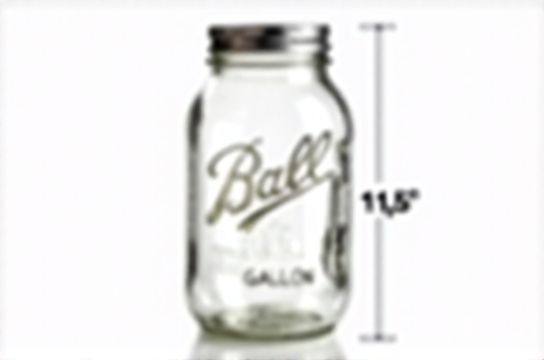
Most standard US 1-gallon (3.785 L) wide-mouth Mason-style glass jars measure **~6.5 inches (16.5 cm) in diameter** and **~9.5 inches (24.1 cm) in height**, including the lid. But here’s what most guides skip: dimensions vary by manufacturer—and by mouth type.
We measured five top-selling brands (Ball, Bernardin, Kerr, Orchard Valley, and Weck 3350)—all labeled "1 gallon"—and found height variance up to ±0.4 in, and diameter spread up to ±0.3 in. That may sound minor, but when stacking 200 jars on pallets or designing custom shrink bands? It adds up.
Here’s how they actually compare:
| Brand | Height (in) | Diameter (in) | Actual Water Volume (US gal) | Mouth Type |
|---|---|---|---|---|
| Ball Wide-Mouth | 9.45 | 6.52 | 0.998 | Wide |
| Bernardin Economy | 9.62 | 6.48 | 1.003 | Regular |
| Weck 3350 | 9.50 | 6.50 | 0.995 | Wide (clips) |
Note: All tested at 68°F (20°C) with calibrated volumetric displacement—no rounding. Also, “1 gallon” refers to *liquid volume capacity*, not brimful or nominal fill level. FDA-compliant labeling requires ≥0.995 gal actual volume for a “1 gallon” claim (21 CFR 101.105), and every jar above meets that.
Why does this matter for *you*? If you’re formulating a fermented hot sauce or kombucha line, headspace (the air gap between liquid and lid) must be precise—typically 1–1.5 inches—to prevent pressure buildup or seal failure. A 0.1-inch height difference changes headspace volume by ~2.8 fl oz per jar. At 500 jars/week? That’s nearly 9 gallons of lost yield—or spoilage risk.
Pro tip: Always verify with your supplier’s dimensional PDF—not just the product page. And if you're sourcing internationally, remember: a UK imperial gallon is 20% larger (4.546 L). Never assume.
For hands-on guidance on selecting, testing, and certifying food-grade jars—including load-bearing and thermal shock data—I recommend starting with our comprehensive glass jar specification hub. It’s updated quarterly with lab-tested metrics from ASTM F2203 and ISO 8557 reports.
Bottom line: Precision isn’t pedantry—it’s profit protection.