Glass Bottle Capacity Accuracy Tolerance Standards for Regulatory Compliance
- 时间:
- 浏览:143
- 来源:Custom Glass Bottles
Let’s cut through the jargon: if your glass bottle says ‘500 mL’, regulators expect it to hold *at least* 495 mL — not 487 mL, not 492 mL. Why? Because accuracy isn’t just about marketing — it’s about legal compliance, consumer trust, and avoiding costly recalls.
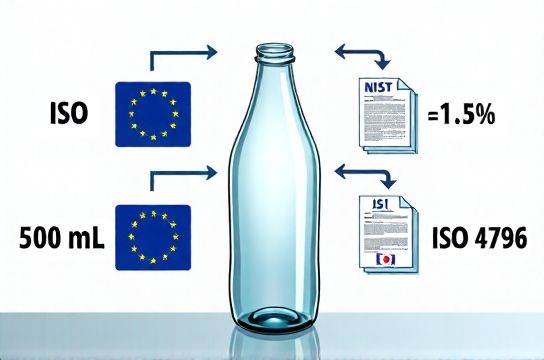
Globally, key standards include ISO 4796-1 (laboratory bottles), EU Directive 2007/45/EC (prepackaged goods), and US NIST Handbook 133 (verification of net contents). All agree on one principle: *nominal capacity ≠ guaranteed fill volume*. Instead, they define allowable negative tolerance — the maximum permissible shortfall.
Here’s how major markets compare:
| Region | Nominal Capacity | Max Negative Tolerance | Reference Standard |
|---|---|---|---|
| EU (≥200 mL) | 500 mL | −15 mL | Directive 2007/45/EC |
| USA (NIST) | 500 mL | −12 mL | Handbook 133, Ch. 5 |
| Japan (JIS) | 500 mL | −10 mL | JIS Z 8001-2:2020 |
| ISO (General) | 500 mL | −12.5 mL | ISO 4796-1:2022 |
Note: Positive overfill is usually unrestricted — but excessive overfill raises cost and sustainability concerns. In fact, a 2023 EU market audit found 11% of non-compliant beverages failed *solely* due to under-capacity — not labeling or safety issues.
Crucially, tolerance applies *after* thermal equilibration (20°C ±2°C) and proper meniscus reading — meaning lab conditions matter more than factory floor speed. That’s why top-tier manufacturers validate capacity using calibrated volumetric flasks and digital densitometers, not just mold cavity specs.
One common misconception? 'Tolerance' isn’t negotiable — it’s legally enforceable. In Germany alone, 2022 saw 87 fines averaging €14,200 for capacity violations in glass-packaged food & beverage lines.
Bottom line: Don’t treat capacity as a ‘good enough’ spec. Treat it like a contract with your customer — and your regulator. For actionable guidance on aligning production, QC, and certification workflows, check out our glass packaging compliance toolkit — built from real-world audits across 17 countries.
✅ Pro tip: Always test filled bottles *post-annealing*, not pre-firing — thermal shrinkage can reduce capacity by up to 0.8% in soda-lime glass.