Glass Bottle Supplier Due Diligence Steps
- 时间:
- 浏览:90
- 来源:Custom Glass Bottles
H2: Why Skipping Due Diligence Costs More Than You Think
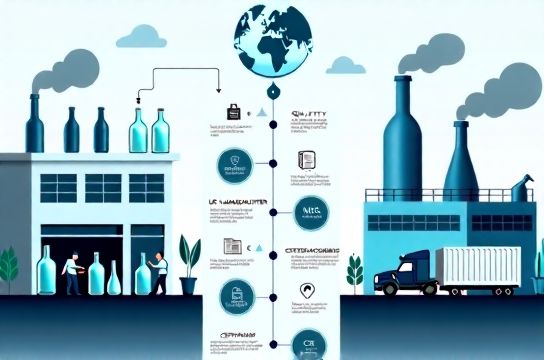
Last month, a skincare startup ordered 50,000 amber glass bottles from a new China-based glass bottle supplier found on a B2B platform. They paid 30% upfront. When the shipment arrived in Los Angeles, 22% of bottles had micro-fractures invisible during visual inspection — failing ASTM C1422 thermal shock resistance testing. Customs held the cargo for rework; the brand missed Q3 product launch. Total loss: $87,000 — not counting reputational damage with retailers.
This isn’t rare. Glass is deceptively simple. But manufacturing it consistently — especially for cosmetics, pharmaceuticals, or premium beverages — demands tight control over raw materials, annealing cycles, mold maintenance, and dimensional tolerances. A single deviation in annealing time (±3 seconds) can shift internal stress levels enough to cause field failure. That’s why due diligence isn’t paperwork — it’s risk engineering.
H2: Step-by-Step Due Diligence Framework
Don’t treat supplier evaluation as a linear checklist. Treat it as layered verification — technical, operational, commercial, and regulatory. Here’s how seasoned procurement teams execute it:
H3: 1. Confirm Core Manufacturing Capability (Not Just Trading)
Many so-called "glass bottle suppliers" are trading companies masking as factories. They subcontract to unknown kilns — often without quality oversight. Ask directly: "Do you own and operate your melting furnace, forming lines, and annealing lehrs? Can we see furnace ID numbers and annual maintenance logs for your primary lehr?"
Red flags: • Refusal to share factory address with GPS coordinates (not just city/district) • No mention of ISO 9001:2015 certification *with scope explicitly covering 'glass container manufacturing'* • Website shows stock photos of generic green bottles — no facility shots of actual forming machines (e.g., IS machines by O-I or Emhart)
Validated benchmark: Top-tier Chinese glass bottle manufacturers (e.g., Zhejiang Shaoxing Yuyao, Anhui Huilong) run 3–5 IS machines per line, with automated dimensional gauging (±0.15 mm tolerance on neck finish). US-based glass bottle manufacturers (e.g., Ardagh in Ohio, Verallia in Kentucky) typically use older but highly maintained NIS equipment with tighter process controls for pharmaceutical-grade output (USP <660> compliance).
H3: 2. Audit Raw Material Traceability
Soda-lime glass (used in >95% of food/beverage/cosmetic bottles) requires consistent silica sand, soda ash, limestone, and cullet (recycled glass). Impurities like iron oxide cause greenish tint; inconsistent cullet % affects melt viscosity and bubble formation.
Require written documentation showing: • Sand source (e.g., “Ottawa Silica Co. Northern White Sand, Lot OS-2026-0411”) • Cullet origin and sorting method (manual vs. NIR-sorted) • Heavy metal test reports (Pb, Cd, As) per FDA 21 CFR 174.5 — updated every 6 months (Updated: May 2026)
Note: US glass bottle manufacturers typically use ≥30% post-consumer cullet; top Chinese glass bottle manufacturers average 22–28%, but only if they control their own cullet washing line.
H3: 3. Validate Process Controls — Especially Annealing & Finish Accuracy
Annealing isn’t optional — it’s the step that determines whether your bottle survives pasteurization or cold-fill. Under-annealed bottles crack under thermal stress; over-annealed ones lose mechanical strength.
Ask for: • Annealing cycle chart: Time/temperature profile for your specific bottle weight and wall thickness • Daily lehr temperature log (min/max/mean at 3 zones), signed by shift supervisor • Neck finish measurement report (e.g., for PCO-1881, tolerance must be ±0.08 mm on thread pitch and ±0.10 mm on outer diameter)
A reliable glass bottle factory runs destructive sampling on 1 in 500 bottles per shift — measuring internal pressure resistance (IPR), vertical load strength (VLS), and thermal shock delta-T (minimum 40°C for cosmetic bottles).
H3: 4. Inspect Real Production Capacity — Not Just Headcount
“Capacity: 2 million bottles/month” means nothing unless you know line speed, changeover frequency, and bottleneck station.
Request: • OEE (Overall Equipment Effectiveness) report for last 3 months (industry benchmark: ≥72% for mature glass bottle factories; <60% indicates chronic downtime or poor maintenance) • Changeover time between molds (e.g., switching from 200 mL serum to 50 mL dropper: realistic range is 45–75 minutes) • Current backlog schedule — not just “available slots,” but confirmed orders with PO numbers and ship dates
Caution: Some China glass bottle suppliers quote capacity based on theoretical max (e.g., “IS machine = 240 bpm × 16 hrs”), ignoring scheduled maintenance, mold wear, and reject rates (typical first-pass yield: 88–93% for standard shapes; drops to 79–84% for complex shoulders or embossing).
H3: 5. Verify Compliance Documentation — Beyond “We’re FDA Registered”
FDA registration ≠ FDA approval. For food-contact glass, what matters is: • Letter of Guarantee (LoG) stating compliance with 21 CFR 174.5 and 177.1000 • Migration test reports (EU 10/2011 or FDA extractables) using your intended fill (e.g., 70% ethanol for essential oils) • If exporting to EU: Do they hold a valid EC Declaration of Conformity with notified body number?
For pharmaceutical use: Demand evidence of compliance with USP <660> (glass type classification) and ISO 8536-1 (for parenteral containers). Fewer than 12 facilities globally — including 2 in China (Jiangsu Hengli, Guangdong Kanghui) and 3 in the US — are certified for Type I borosilicate vials.
H2: Cost Comparison: What’s Really Behind the Price Gap?
A 250 mL flint glass bottle quoted at $0.18/unit FOB Ningbo vs. $0.39/unit FOB Owensboro, KY isn’t just about labor. It reflects trade-offs in consistency, lead time, and liability.
| Factor | Top-Tier China Glass Bottle Manufacturer | Established US Glass Bottle Manufacturer | Key Trade-off |
|---|---|---|---|
| Lead Time (Standard Mold) | 35–45 days after deposit | 12–18 weeks | China: faster, but less flexibility for rush changes |
| MOQ (Standard Shape) | 15,000–30,000 pcs | 50,000–100,000 pcs | US: higher MOQ, but lower per-unit tooling amortization |
| Reject Rate (Incoming Inspection) | 1.8–3.2% (Updated: May 2026) | 0.4–0.9% (Updated: May 2026) | China: higher variance; US: tighter statistical process control |
| Custom Mold Cost | $2,200–$4,800 (non-refundable) | $12,000–$28,000 (50% refundable after 200K units) | US: higher upfront, better long-term ROI for stable SKUs |
| Incoterm Flexibility | FCA, FOB, CIF common; DDP rare | FCA, EXW, DDP available | US: easier landed-cost predictability; China: more freight negotiation leverage |
H2: The Import Reality Check — Hidden Costs You’ll Pay
Buying from a China glass bottle supplier means managing more than tariffs. Consider: • Ocean freight volatility: Spot rates from Shanghai to LA spiked 220% YoY in early 2025 (Updated: May 2026); locked-in contracts now require 6-month minimums • LCL (Less-than-Container Load) surcharges: $180–$320 per pallet for handling fragile glass — often unquoted until booking • US FDA Prior Notice requirement: Must be filed 72+ hours pre-arrival; errors cause $12,000–$25,000 detention fees • Bonded warehouse storage: $0.42–$0.68/sq ft/month — critical if QC fails and you need rework space
Pro tip: Use a licensed customs broker who specializes in glass packaging — not general importers. They’ll catch mismatches like “glass bottle” misclassified under HTS 7010.90 (other glass containers) instead of 7013.29 (perfume/cosmetic bottles), which carries different duty rates and FDA scrutiny.
H2: How to Run a Remote Factory Audit (When You Can’t Visit)
Travel budgets are tight. But remote audits work — if structured right.
Do this: • Require live video walkthrough *using their factory Wi-Fi* (not mobile hotspot) — pan slowly across furnace controls, lehr zone thermocouples, and final inspection station. Pause on any handwritten log — ask them to read it aloud. • Request screen-share of their ERP system showing real-time OEE dashboard (not static PDF) • Ask for 3 random production batch records from last month — cross-check furnace temp logs vs. annealing charts vs. final QC reports
Skip this: • Pre-recorded factory tours (easily edited) • Certificates without issue dates or accreditation body IDs (e.g., “ISO 9001” without TÜV Rheinland certificate ) • Test reports without sample ID matching your PO number
H2: When to Use a Glass Bottle Procurement Service — And When Not To
Third-party glass bottle procurement services (often called “glass bottle procurement service” or “glass bottle buying agents”) add value in three scenarios: 1. You lack Mandarin-speaking technical staff to interpret furnace logs or negotiate mold specs 2. You’re ordering <50,000 units/year and can’t justify hiring full-time sourcing 3. You need bonded warehousing + QC coordination in China pre-shipment
But beware: Most charge 5–8% commission — which erodes margin fast on low-value bottles. And many don’t carry liability for defects. Read their contract: Does it state they’re “jointly liable for material non-conformance” — or just “facilitators”? If it’s the latter, you’re still holding the bag.
For brands doing >200,000 units/year, building direct relationships with 2–3 pre-vetted glass bottle manufacturers — one in China, one in the US — delivers better long-term control. You’ll get priority scheduling, shared tooling investment, and faster problem resolution.
H2: Final Gate: The Pre-Shipment Inspection Protocol
Never skip this — even with trusted suppliers. Your inspection must go beyond “count and cosmetic.”
Require third-party inspectors (e.g., SGS, Bureau Veritas) to perform: • Dimensional check on 40 randomly selected bottles (neck finish, height, base thickness, wall thickness at 3 points) • Thermal shock test: 10 bottles cycled from 5°C to 65°C in <30 seconds — zero cracks allowed • Internal pressure test: 10 bottles pressurized to 1.2× working pressure for 60 sec — zero leakage • Label adhesion test (if applicable): Cross-hatch + tape pull per ASTM D3359
Set clear pass/fail thresholds *in writing before inspection*. Example: “Reject batch if >2 bottles fail thermal shock OR >3 show dimensional variance beyond ±0.20 mm on neck OD.”
If the batch fails, do not accept “rework at port.” Glass re-annealing isn’t possible post-forming. It’s scrap — and your supplier should bear the cost if their process control failed.
H2: Wrapping Up — Your Action List
Before sending that first PO, complete these five actions: 1. Pull the supplier’s business license and verify it lists “glass container manufacturing” — not just “trading” or “export agency” 2. Get furnace ID and lehr maintenance logs — compare dates against their claimed uptime 3. Run a $299 mini-audit via a local Chinese inspection firm (e.g., AsiaInspection) — includes photo report and 2-hour debrief 4. Confirm they’ll provide migration test reports using *your exact formula*, not generic water/ethanol 5. Negotiate Incoterm + payment terms that align with risk: 30% deposit, 60% against BL copy, 10% after QC clearance
There’s no shortcut — but there is a repeatable system. Done right, due diligence turns glass bottle procurement from a cost center into a strategic advantage: predictable supply, consistent quality, and fewer fire drills.
For deeper implementation support — including template audit checklists, inspector scorecards, and a full resource hub, visit our /.