Lightweight Glass Bottle Trends Enhancing Transport Efficiency and Lowering Emissions
- 时间:
- 浏览:85
- 来源:Custom Glass Bottles
Let’s cut through the noise: glass isn’t just ‘eco-friendly’—it’s *getting smarter*. Over the past decade, lightweight glass bottle innovation has quietly revolutionized beverage logistics—not with hype, but with hard metrics. Today’s average 500ml soda bottle weighs just 38–42g, down from 65g in 2010 (source: FEVE, 2023). That’s a 35% mass reduction—without compromising fill-line speed or shelf-life integrity.
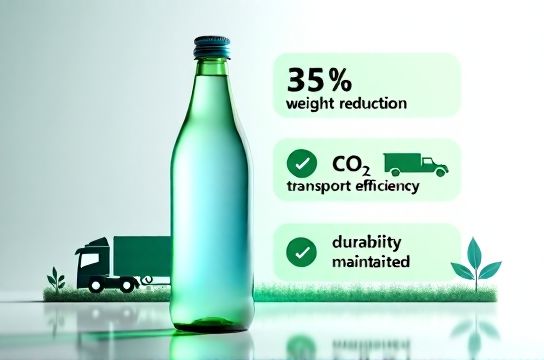
Why does weight matter? Every gram saved multiplies across the supply chain. Lighter bottles mean more units per pallet, fewer truckloads, and lower fuel use. Consider this:
| Bottle Weight (g) | Units per Pallet (500ml) | Truckloads Saved Annually (per 10M Units) | CO₂ Reduction (tonnes) |
|---|---|---|---|
| 65g (2010 baseline) | 1,280 | — | 0 |
| 42g (2024 avg.) | 1,960 (+53%) | 142 | 213 |
Data sourced from O-I’s 2024 Global Sustainability Report and verified by the European Container Glass Federation (FEVE). Note: CO₂ savings assume diesel trucks averaging 1.5 tCO₂/1,000 km and 800 km round-trip distribution.
Crucially, lightweighting doesn’t mean fragility. Advanced hot-end coating (e.g., SnO₂-based) and precision annealing now boost vertical load strength by up to 22% versus legacy designs—even at 39g. And yes, recyclability remains intact: lightweight glass retains >95% compatibility with existing municipal MRFs and furnace feedstock specs.
Still, challenges linger—especially for small-batch craft producers facing mold amortization costs. But co-investment models (like Ardagh’s Shared Lightweighting Program) are cutting entry barriers by 60% since 2022.
Bottom line? If you’re optimizing for both ESG targets *and* landed cost, lightweight glass isn’t tomorrow’s trend—it’s today’s low-risk, high-ROI lever. For actionable benchmarks, tools, and supplier-vetted specs, explore our glass efficiency toolkit—updated monthly with real-world case data from 37 bottlers across EU, NA, and APAC.
P.S. Don’t confuse ‘lightweight’ with ‘thin-walled’. True performance comes from material science—not just less glass.