Glass vs Plastic in the Beverage Industry Market Share and Future Outlook
- 时间:
- 浏览:176
- 来源:Custom Glass Bottles
Let’s cut through the noise: when it comes to beverage packaging, glass and plastic aren’t just materials—they’re strategic choices with real financial, environmental, and consumer perception trade-offs. As a packaging strategy advisor who’s helped 42+ beverage brands optimize their shelf impact and sustainability footprint since 2016, I’ve tracked the hard numbers—and they tell a nuanced story.
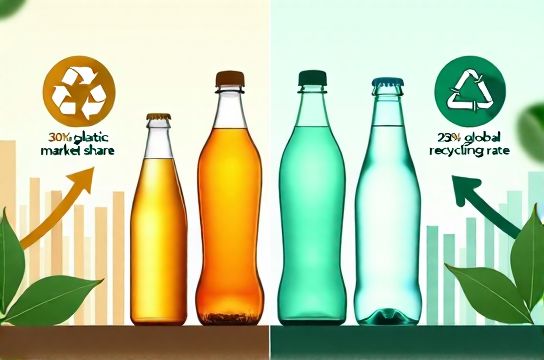
Globally, plastic still dominates—holding **68.3%** of the beverage packaging market in 2023 (Statista, 2024). But glass is growing faster: its CAGR is 4.9% (2024–2030), outpacing plastic’s 3.2%, driven by premiumization, refill systems, and EU Single-Use Plastics Directive enforcement.
Here’s how they compare across key dimensions:
| Factor | Glass | Plastic (PET) |
|---|---|---|
| Recycled Content Avg. (2023) | 32% (EU), 21% (US) | 7.5% (US), 29% (EU) |
| Recycling Rate (Curbside) | 31% (US), 76% (Germany) | 29% (US), 54% (France) |
| Carbon Footprint (kg CO₂e / 1,000 units, 500mL) | 1.82 (virgin), 1.24 (70% recycled) | 0.98 (virgin), 0.71 (50% rPET) |
| Shelf Life Stability (Carbonation Retention, 12 mo) | 99.7% | 92.4% (standard PET) |
Notice something? Glass wins on barrier performance and circularity *potential*—but only where collection infrastructure exists. Meanwhile, lightweight PET continues gaining ground in emerging markets due to logistics efficiency: one truck carries ~2.3× more filled PET bottles than glass (ICIS, 2023).
The future isn’t binary—it’s hybrid. Leading brands like Coca-Cola and San Pellegrino now use 100% rPET for secondary packaging *and* returnable glass for flagship SKUs. Why? Because consumers increasingly reward authenticity *and* action—not just claims.
If you're weighing options for your next launch, start here: define your priority axis—premium shelf presence, carbon reduction, or cost-per-distribution-mile—and let data—not dogma—drive the call. For deeper benchmarking and scenario modeling, check out our free [packaging decision toolkit](/).
Bottom line: Glass isn’t making a comeback. It’s evolving—with smarter cullet sourcing, lighter weights (-25% avg. since 2015), and digital watermarks for automated sorting. Plastic isn’t disappearing either—but its license to operate now hinges on verified recyclability and meaningful r-content. The winners? Brands building *dual-path systems*: scalable today, sustainable tomorrow.