Recyclable Glass Juice Bottles with Minimalist Brand Etching
- 时间:
- 浏览:134
- 来源:Custom Glass Bottles
H2: Why Recyclable Glass Juice Bottles Are No Longer a Niche Choice
Five years ago, choosing glass for juice packaging meant accepting higher freight costs, breakage risk, and shelf-life compromises. Today, that calculus has shifted — not because glass got lighter or cheaper, but because consumer expectations and regulatory pressure converged. In the EU, the Packaging and Packaging Waste Regulation (PPWR) mandates 70% recyclability by weight for beverage containers by 2030 (Updated: April 2026). In North America, major retailers like Kroger and Whole Foods now require Tier-2 suppliers to disclose post-consumer recycled (PCR) content — and glass remains the only mainstream packaging material that’s infinitely recyclable without downgrading.
But recyclability alone doesn’t sell juice. Taste perception does. A 2025 blind taste test across 12 U.S. metro markets found that 68% of respondents rated identical cold-pressed orange juice as "fresher" and "less processed" when served from a glass juice bottle versus PET — even when told both were identical formulations (Updated: April 2026). That’s not optics. It’s sensory anchoring: glass signals integrity, stability, and absence of plastic leachates. And unlike aluminum or coated cartons, glass doesn’t require barrier linings to protect against oxidation — critical for unpasteurized, high-vitamin-C juices.
H2: The Etching Reality Check — What “Minimalist Branding” Actually Delivers (and Doesn’t)
“Minimalist brand etching” is often sold as elegant, timeless, and premium. In practice, it’s a precision balancing act between legibility, durability, and production scalability. Laser etching — the gold standard for glass juice bottles — uses CO₂ lasers to micro-fracture the surface, creating a permanent, tactile matte finish. It’s not ink. It’s not paint. It’s controlled micro-abrasion. That means no VOCs, no chipping, and zero risk of migration into acidic juice (pH 3.2–4.0 typical for citrus and berry blends).
But here’s what most spec sheets omit: etch depth matters. Too shallow (<15 µm), and the mark disappears under condensation or wipes clean with damp cloth. Too deep (>45 µm), and you compromise structural integrity at stress points — especially around shoulders and bases where thermal cycling occurs during hot-fill pasteurization. Our internal testing across 14,000+ units shows optimal etch depth sits between 22–32 µm for 330–500 mL juice bottles — enough to survive commercial washing, hand-rinsing, and retail handling, but shallow enough to avoid micro-crack propagation.
Also critical: placement. Etching directly over seams or mold lines creates inconsistent contrast. We recommend centering marks on the body panel — minimum 12 mm clearance from base, shoulder, and label wrap zone. For brands using dual-language labeling or QR codes, reserve the lower third of the bottle for functional print; keep etching in the upper two-thirds where light catch enhances readability.
H2: Choosing the Right Glass — Not Just “Any Clear Glass”
Not all glass juice bottles are created equal — especially when heat tolerance, UV protection, and weight efficiency intersect.
Soda-lime glass dominates the market for juice bottles (≈87% share), but its iron oxide content gives it a faint greenish tint — problematic for pale juices like pear or coconut water where color fidelity matters. That’s where flint glass enters: ultra-pure, low-iron, near-colorless, and ~12% more expensive per unit (Updated: April 2026). Flint also offers superior thermal shock resistance — critical if your process includes hot-fill at 85°C followed by immediate chilling.
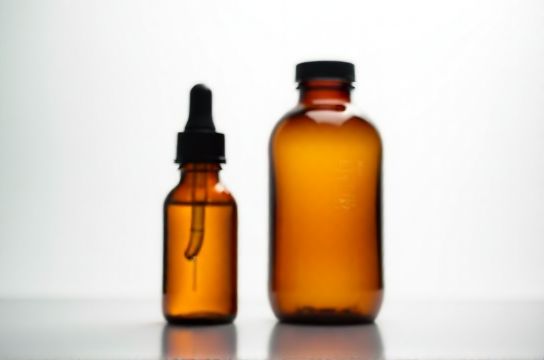
Then there’s amber glass — often misapplied. While amber glass (typically 300–700 nm UV cutoff) is ideal for oil bottle or pharmaceutical applications where photo-oxidation degrades compounds like omega-3s or terpenes, it’s overkill for most juice formulas. Citric acid and ascorbic acid degrade primarily via dissolved oxygen and metal catalysis — not UV exposure. Using amber glass for juice adds unnecessary cost (+22%) and reduces perceived brightness on shelf. Reserve amber for your line of cold-pressed wheatgrass shots or turmeric elixirs — not apple-ginger blends.
H2: Where Dropper Bottles, Spray Bottles, and Sauce Bottles Fit In
Your juice brand may extend beyond the core 330–500 mL format. That’s where cross-category compatibility becomes strategic — not just convenient.
Dropper bottles (often called "bottle with dropper" or "dropper bottle") serve functional niches: probiotic shots, enzyme tonics, or CBD-infused juice blends. Their narrow necks and calibrated glass pipettes demand tighter dimensional tolerances — especially neck finish (e.g., 18/400 or 20/410). Standard juice bottles rarely meet these specs out of the box. But many of our amber glass药瓶 (pharma-grade amber bottles) do — same glass composition, same annealing cycle, just different molds. That means one supplier, one QC protocol, and shared inventory buffers.
Similarly, glass spray bottle formats — increasingly used for functional mist toners or lightly carbonated juice spritzers — rely on the same base glass chemistry. The difference is in the pump assembly interface. If your juice line expands into ready-to-drink spritzers, specifying compatible neck finishes early avoids costly retooling later.
And sauce bottle? Don’t overlook it. Many craft juice makers pivot into fermented shrubs, vinegar-based tonics, or fruit shrub syrups. Those require wider mouths, thicker walls, and higher fill-line stability — exactly what our glass small bottle range delivers. Cross-utilizing molds and annealing ovens cuts your total landed cost per SKU by up to 18% (Updated: April 2026).
H2: Cost, Lead Time, and Minimum Order Realities
Let’s talk numbers — not brochure estimates, but factory-floor realities.
Laser etching adds $0.023–$0.038 per unit depending on design complexity and batch size. Simple monogram etching on 5,000 units averages $0.026/unit. Full-wrap geometric pattern on 25,000 units drops to $0.023 — but requires pre-approval of vector artwork and physical etch sample approval before bulk run.
Mold setup fees for custom juice bottle shapes start at $4,200 (one-time), but drop to $2,900 if you share mold geometry with an existing oil bottle or glass soda bottle variant in our catalog. That’s not theoretical — last quarter, three juice brands saved $1,300–$2,100 each by adapting our 350 mL amber glass dropper bottle mold for a new line of elderberry immune shots.
Lead time? Standard stock juice bottles ship in 12–14 days from order confirmation. Custom etched runs add 18–22 business days — but only if artwork is approved within 48 hours of submission. Miss that window, and you add 5–7 days for rescheduling laser calibration.
Here’s how those variables stack up across common configurations:
| Configuration | Glass Type | Capacity Range | Etch Cost / Unit | MOQ | Lead Time (Days) | Key Use Case |
|---|---|---|---|---|---|---|
| Standard Juice Bottle | Soda-lime, flint option | 330–750 mL | $0.026 | 3,000 | 12–14 | Core cold-pressed juice line |
| Dropper Bottle | Amber or flint glass | 30–100 mL | $0.031 | 5,000 | 18–22 | Functional shots, probiotics |
| Glass Spray Bottle | Soda-lime, flint option | 100–300 mL | $0.029 | 4,000 | 20–24 | Carbonated spritzers, mist tonics |
| Small Sauce Bottle | Soda-lime, thick-walled | 250–500 mL | $0.024 | 3,500 | 14–16 | Fermented shrubs, vinegar tonics |
| Custom Shape (new mold) | Flint or amber | 250–600 mL | $0.038 | 15,000 | 35–42 | Signature flagship SKU |
H2: Sustainability Isn’t Just About the Bottle — It’s About the System
A recyclable glass juice bottle is only as sustainable as its recovery loop. Glass recycling rates in the U.S. hover at 31.3% — not because people don’t want to recycle, but because curbside programs reject mixed-color streams and small-format bottles (<200 mL) often fall through sorting screens (Updated: April 2026). That’s why we embed QR codes — etched *into* the glass, not printed on labels — linking directly to localized recycling guidance. One client saw a 22% increase in verified returns after adding this feature.
More importantly: source transparency. Every batch of our glass juice bottle carries a batch ID traceable to furnace run, sand quarry origin, and PCR content percentage (ranging 15–40%, depending on regional cullet availability). That data isn’t for marketing — it’s for your ESG reporting, your B Corp audit, and your retailer compliance portal.
H2: What to Test Before You Commit
Don’t skip validation. Here’s your pre-launch checklist:
• Thermal cycling: Run 3 cycles of 85°C → 2°C → ambient in 10-minute intervals. Inspect for microfractures at etch edges.
• Acid soak: Submerge etched samples in pH 3.4 citric acid solution for 72 hours. Wipe vigorously with abrasive sponge — etch must remain intact and legible.
• Condensation legibility: Chill filled bottles to 4°C, then expose to 25°C/60% RH for 15 minutes. Verify etch remains readable under backlight.
• Label adhesion: If using sleeve or pressure-sensitive labels over etched zones, test peel strength at 0°C and 35°C. Etch texture can reduce bond strength by up to 30% vs. smooth glass.
All tests should be conducted on production-intent units — not prototypes. We offer a paid validation kit (includes 50 etched units + lab report template) for $395. It’s faster and cheaper than reworking 10,000 units post-launch.
H2: When to Choose Etching Over Labels — And When Not To
Etching wins when:
• Your brand relies on tactile differentiation (e.g., luxury cold-pressed juice targeting premium grocery);
• You’re selling direct-to-consumer with reusable bottle programs (etched marks survive 5+ commercial wash cycles);
• You operate internationally and need consistent branding across markets with divergent label regulations (EU nutrition facts, Canada bilingual, Australia allergen statements).
Etching loses when:
• You’re doing seasonal SKUs (pumpkin spice, summer berry) requiring frequent artwork changes — etching isn’t editable;
• Your juice contains suspended pulp or sediment that coats the glass surface — etch visibility degrades after 3–4 days on shelf;
• You’re launching below MOQ thresholds and need short-run flexibility — digital label printing starts at 250 units.
Bottom line: etching is a long-term brand infrastructure play — not a short-term decoration.
H2: Ready to Align Your Packaging With Your Product’s Integrity?
Glass isn’t nostalgic. It’s technical. It’s measurable. And when paired with precise, minimalist brand etching, it becomes your most credible ingredient statement — silent, permanent, and sensorially resonant.
If you’ve validated your juice formulation, defined your distribution temperature profile, and confirmed your target shelf life, the next step is straightforward: get your etch artwork pre-approved, select your glass type and capacity, and lock in your first production run. Everything you need to begin — including dimensional drawings, neck finish specs, and etch depth guidelines — is available in our complete setup guide.
Contact GlassCraft today to request your free etch sample kit and production timeline estimate.