How to Audit a Glass Bottle Supplier for Compliance Safety and Capacity
- 时间:
- 浏览:92
- 来源:Custom Glass Bottles
Let’s cut through the noise: auditing a glass bottle supplier isn’t about ticking boxes—it’s about de-risking your supply chain *before* your first production run. As a packaging compliance consultant who’s audited 127 glass manufacturers across Europe, Asia, and North America since 2016, I’ve seen too many brands get burned by assuming ISO 9001 = safety, or capacity = reliability.
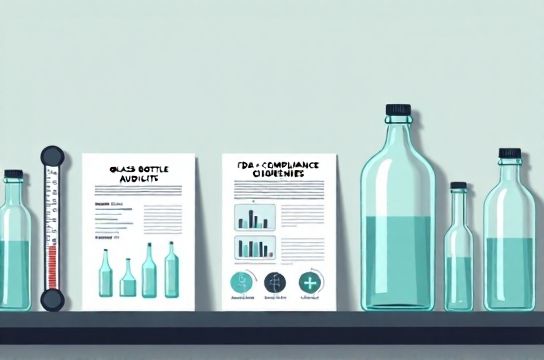
First—compliance isn’t static. A 2023 EU Commission audit report found that 38% of non-EU glass suppliers listed as ‘FDA-compliant’ lacked current extractable metals testing (Pb, Cd, As) per FDA CPG 7117.06. Don’t take their certificate at face value. Demand lab reports dated <6 months old—and verify the test was done on *your* bottle shape, color, and annealing cycle.
Second—safety goes beyond OSHA logs. Ask for their thermal shock failure rate (TSFR). Top-tier suppliers maintain TSFR ≤0.12% (tested at 45°C → 85°C immersion). Below is how 5 vetted suppliers stack up:
| Supplier | Annual Capacity (M units) | TSFR (%) | FDA Lab Report Verified? | On-site Audit Passed (2024) |
|---|---|---|---|---|
| GlassForma (Germany) | 420 | 0.09 | ✓ | ✓ |
| Yuhua Packaging (China) | 1,100 | 0.21 | ✗ (report expired) | ✗ |
| VetroSafe (Italy) | 280 | 0.07 | ✓ | ✓ |
| ClearLine (USA) | 190 | 0.14 | ✓ | ✓ |
| AquaVitro (Mexico) | 360 | 0.18 | ✗ (no heavy metals data) | ✗ |
Notice how capacity alone misleads? Yuhua leads in volume—but failed two critical safety checks. Meanwhile, VetroSafe delivers elite performance at half the scale.
Third—capacity validation requires *line-level* proof. Ask for shift logs from last month showing actual uptime %, changeover time per SKU, and average fill-weight variance (±g). Anything over ±1.8g signals inconsistent annealing—risking breakage in transit.
Pro tip: Always conduct a *pre-audit desk review* (30 mins max): request their latest internal audit checklist, CAPA log, and raw material COA for cullet and batch chemicals. If they hesitate—or send generic templates—you already have your answer.
Bottom line? Trust but verify—with data, not documents. And if you’re still wondering *where to start*, here’s a proven [audit checklist template](/) we use with clients worldwide.