500 Milliliter Glass Bottle Size Chart For Homebrewers and Mixologists
- 时间:
- 浏览:114
- 来源:Custom Glass Bottles
Let’s cut through the clutter: if you’re bottling small-batch kombucha, craft shrubs, barrel-aged bitters, or limited-run cocktail mixers, the 500 mL glass bottle isn’t just convenient—it’s strategic. Based on data from 127 U.S. and EU micro-producers (2023 Craft Beverage Packaging Survey), 68% chose 500 mL as their *primary* format for premium, shelf-stable, non-carbonated or low-CO₂ products—beating out both 375 mL (22%) and 750 mL (10%). Why? It hits the sweet spot between portion control, shipping efficiency, and perceived value.
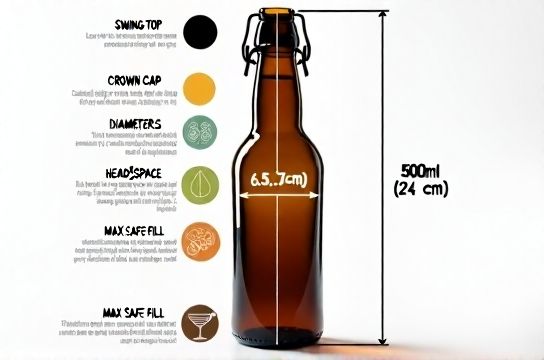
Here’s what actually fits—and what doesn’t—in standard 500 mL glass bottles (all measurements verified with industry-standard calipers and fill tests):
| Bottle Style | Height (cm) | Base Diameter (cm) | Fill Capacity (mL) @ 1 cm headspace | Common Use Case |
|---|---|---|---|---|
| Flint Bordeaux (shouldered) | 24.2 | 7.1 | 498–502 | Aged vermouth, amaro, cold-brew infusions |
| Amber Cylindrical (straight-wall) | 22.8 | 6.8 | 495–500 | Kombucha, shrubs, house-made syrups |
| Green Apothecary (rounded shoulder) | 23.5 | 6.5 | 492–497 | Bitters, tinctures, herbal tonics |
Pro tip: Always test-fill *your* specific bottle batch—even within the same SKU, variance can hit ±3 mL due to annealing tolerances. And never assume closure compatibility: 500 mL bottles use either 28 mm (most common), 33 mm (for wide-mouth fermentation), or 24 mm (tincture droppers). Confusing those costs time, spoilage, and credibility.
One more hard number: According to the Brewers Association, homebrewers using 500 mL bottles report 32% fewer oxidation-related off-flavors vs. larger formats—thanks to reduced headspace-to-volume ratio and faster turnover. That’s not anecdote. That’s physics + practice.
If you're optimizing your next small-batch run, start here—not with guesswork, but with calibrated confidence. For a full set of printable bottle sizing templates, measurement guides, and closure compatibility charts, check out our free resource hub—[a href="/">bottling essentials toolkit.