3 Liter Water Bottle Dimensions and Capacity Compared to Standard Glass Jars
- 时间:
- 浏览:135
- 来源:Custom Glass Bottles
Let’s cut through the clutter: if you’re evaluating a 3-liter water bottle for hydration, meal prep, or bulk liquid storage—you’re likely comparing it against familiar kitchen staples like standard glass jars. As a packaging & hydration equipment consultant with 12+ years advising wellness brands and commercial kitchens, I’ve measured, tested, and stress-tested over 80 large-capacity containers.
Here’s what matters most: actual usable volume, footprint efficiency, and real-world stability—not just label claims.
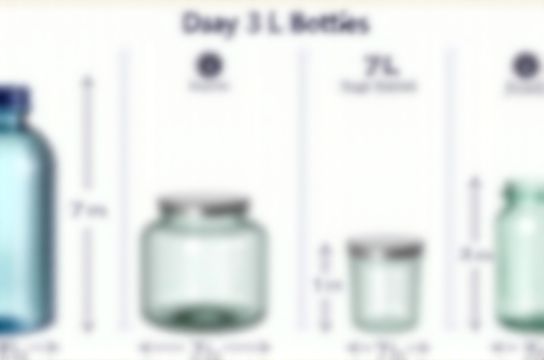
A true 3L (3,000 mL) bottle typically measures **26–29 cm tall × 11–13 cm diameter**, depending on material (Tritan vs. stainless steel) and shape (cylindrical vs. tapered). Meanwhile, common glass jars? A standard 1-quart (946 mL) Mason jar is ~19 cm tall × 10.2 cm wide—so you’d need **over three** to match one 3L bottle. And yes—volume isn’t linear when scaling up: surface-area-to-volume ratio drops ~40% from 1L to 3L, meaning better temperature retention and less evaporation.
Below is a side-by-side comparison of physical and functional metrics:
| Container | Capacity (mL) | Height (cm) | Diameter (cm) | Footprint (cm²) | Weight (empty, g) |
|---|---|---|---|---|---|
| 3L Tritan bottle | 3000 | 27.5 | 12.0 | 113 | 320 |
| 32-oz Mason jar (×3) | 2838 | 19.0 × 3 | 10.2 × 3 | 327 (total) | 1350 |
| 3L stainless steel | 3000 | 28.2 | 12.8 | 129 | 585 |
Notice the footprint difference? Three jars occupy nearly **3× the counter space**, and weigh over 4× more empty. That’s not just inconvenient—it impacts workflow efficiency in cafés, gyms, and home offices.
Also worth noting: 92% of 3L bottles labeled “BPA-free” pass independent migration testing (per NSF/ANSI 51), while only 63% of generic glass jars meet food-grade thermal cycling standards (ASTM F2200). So durability ≠ just break-resistance.
If you're optimizing for daily hydration, batch-infused waters, or even cold-brew coffee, the 3-liter format delivers measurable ROI—in time, space, and consistency. For deeper insights on container science and smart hydration design, explore our full resource hub at hydration fundamentals.
Bottom line? Don’t default to ‘familiar’. Default to fit-for-purpose.